


Racial/ethnic differences in activities of daily living disability in older adults with arthritis: a longitudinal study
- PMID: 17665484
- PMCID: PMC2740914
- DOI: 10.1002/art.22906
Racial/ethnic differences in activities of daily living disability in older adults with arthritis: a longitudinal study
Abstract
Objective: To investigate racial/ethnic differences in disability onset among older Americans with arthritis. Factors amenable to clinical and public health intervention that may explain racial/ethnic differences in incident disability were examined.
Methods: We analyzed longitudinal data (1998-2004) from a national representative sample of 5,818 non-Hispanic whites, 1,001 African Americans, 228 Hispanics interviewed in Spanish (Hispanic/Spanish), and 210 Hispanics interviewed in English (Hispanic/English), with arthritis and age >or=51 years who did not have baseline disability. Disability in activities of daily living (ADL) was identified from report of inability, avoidance, or needing assistance to perform >or=1 ADL task.
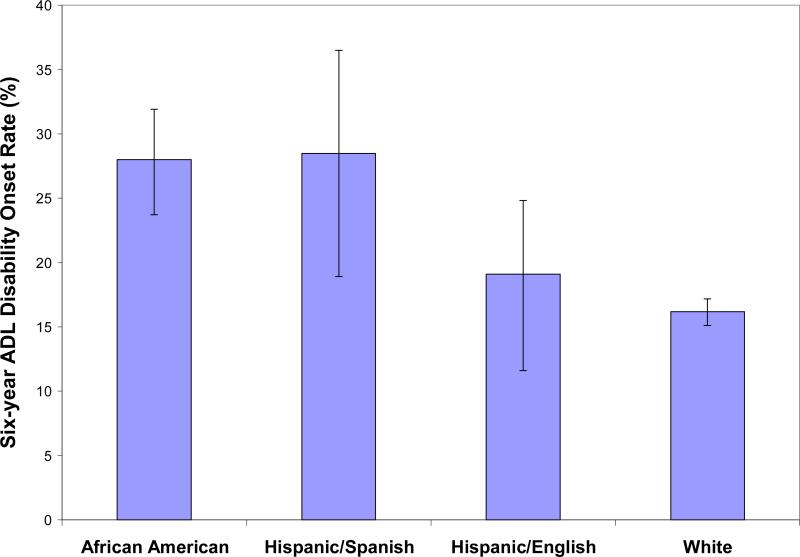
Results: Over the period of 6 years, 28.0% of African Americans, 28.5% of Hispanic/Spanish, 19.1% of Hispanic/English, and 16.2% of whites developed disability. The demographic-adjusted disability hazard ratios (AHR) were significantly greater among African Americans (AHR 1.94, 95% confidence interval [95% CI] 1.51-2.38) and Hispanic/Spanish (AHR 2.03, 95% CI 1.35-2.71), but not significantly increased for Hispanic/English (AHR 1.41, 95% CI 0.82-2.00) compared with whites. Differences in health factors (comorbid conditions, functional limitations, and behaviors) explained over half the excess risk among African Americans and Hispanic/Spanish. Medical access factors (education, income, wealth, and health insurance) were substantial mediators of racial/ethnic differences in all minority groups.
Conclusion: Racial/ethnic differences in the development of disability among older adults with arthritis were largely attenuated by health and medical access factors. Lack of health insurance was particularly problematic. At the clinical level, treatment of comorbid conditions, functional limitations, and promotion of physical activity and weight maintenance should be a priority to prevent the development of disability, especially in minority populations.
Figures
References
-
- Centers for Disease Control and Prevention Prevalence of disabilities and associated health conditions among adults--United States, 1999. MMWR Morb Mortal Wkly Rep. 2001;50(7):120–5. - PubMed
-
- Centers for Disease Control and Prevention Arthritis prevalence and activity limitations--United States, 1990. MMWR Morb Mortal Wkly Rep. 1994;43(24):433–8. - PubMed
-
- Centers for Disease Control and Prevention Racial/ethnic differences in the prevalence and impact of doctor-diagnosed arthritis--United States, 2002. MMWR Morb Mortal Wkly Rep. 2005;54(5):119–23. - PubMed
-
- Cutler DM. Declining disability among the elderly. Health Aff (Millwood) 2001;20(6):11–27. - PubMed
Publication types
MeSH terms
Grants and funding
LinkOut - more resources
Full Text Sources
Medical
