Review
. 2007;9(4):217.
doi: 10.1186/ar2197.

Falling into TRAPS--receptor misfolding in the TNF receptor 1-associated periodic fever syndrome

Affiliations
Review

Falling into TRAPS--receptor misfolding in the TNF receptor 1-associated periodic fever syndrome

Fiona C Kimberley et al. Arthritis Res Ther. 2007.

Abstract

TNF receptor-associated periodic syndrome (TRAPS) is a dominantly inherited disease caused by missense mutations in the TNF receptor 1 (TNFR1) gene. Patients suffer from periodic bouts of severe abdominal pain, localised inflammation, migratory rashes, and fever. More than 40 individual mutations have been identified, all of which occur in the extracellular domain of TNFR1. In the present review we discuss new findings describing aberrant trafficking and function of TNFR1 harbouring TRAPS mutations, challenging the hypothesis that TRAPS pathology is driven by defective receptor shedding, and we suggest that TNFR1 might acquire novel functions in the endoplasmic reticulum, distinct from its role as a cell surface receptor. We also describe the clinical manifestations of TRAPS, current treatment regimens, and the widening array of patient mutations.


Figures
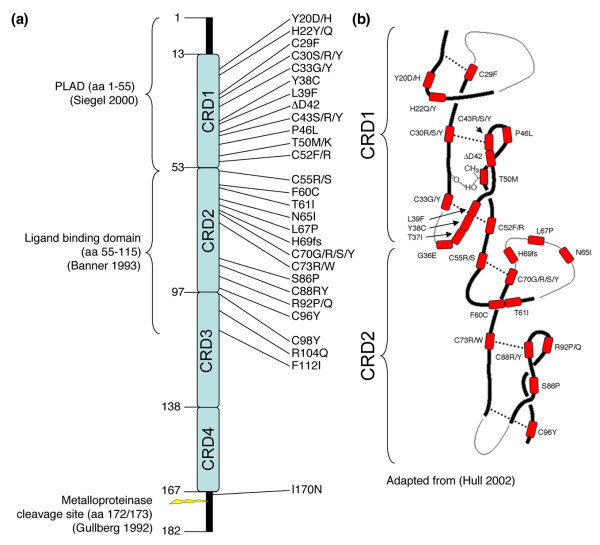
Figure 1
Figure 1
TNF receptor-associated periodic syndrome mutations in TNF receptor 1. Schematic of TNF receptor-associated periodic syndrome (TRAPS) mutations in TNF receptor 1 (TNFR1) illustrating the extreme clustering of mutations towards cysteine-rich domains CRD1 and CRD2. (a) The preligand assembly domain (PLAD), ligand binding domain, and other structural features of TNFR1 are highlighted. (b) A line model of CRD1 and CRD2 of TNFR1, with the sites of TRAPS mutations and amino acid (aa) changes indicated (red boxes).
Figure 2
Figure 2
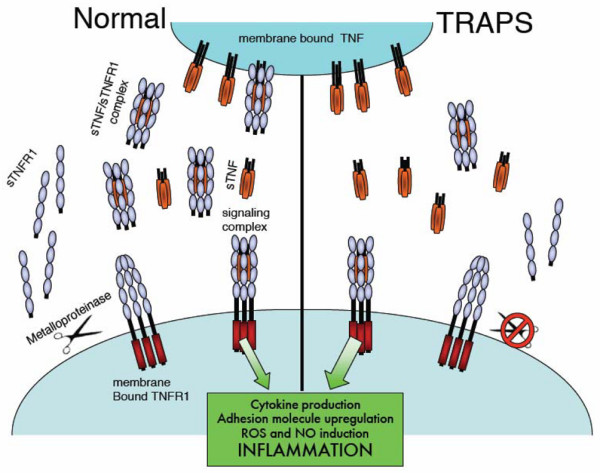
The shedding hypothesis. Mutations in TNF receptor 1 (TNFR1) were thought to impair cleavage of TNFR1 from the membrane by membrane metalloproteases, leading to depletion in the pool of soluble TNF (sTNF) receptor (sTNFR1). In this model for TNF receptor-associated periodic syndrome mutations (TRAPS), both soluble and membrane-bound TNFα are no longer sequestered by the soluble receptor, resulting in overstimulation of membrane-bound TNFR1. NO, nitric oxide; ROS, reactive oxygen species.
Figure 3
Figure 3
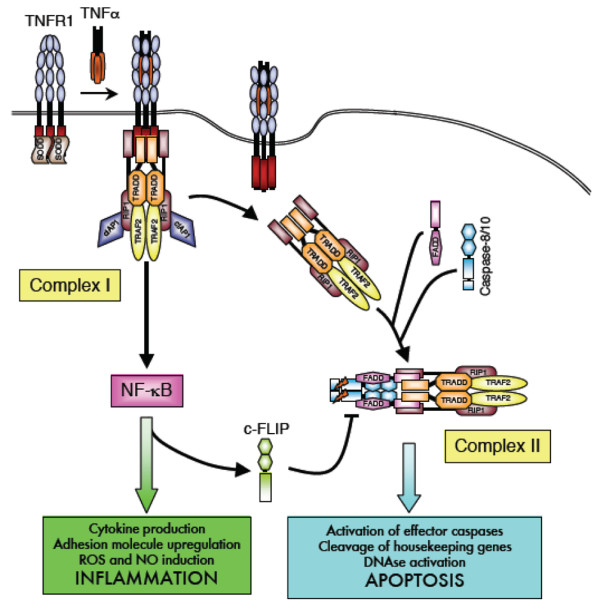
TNF receptor 1 signalling. TNF receptor 1 (TNFR1) ligation induces death domain-mediated recruitment of TNFR1/TRADD/TRAF2/RIP1 (complex I) at the cell surface, and this complex initiates NF-κB activation, which in turn drives production of cFLIP, an apoptotic inhibitor. Activated TNFR1 is then endocytosed and the TRADD/TRAF2/RIP1 complex dissociates from the receptor in a temporal manner. This complex then recruits FADD and caspase-8 (complex II), which activates the apoptotic machinery, provided that the levels of cFLIP are low enough to remove inhibition. Adapted from [64]. In a second model, proposed by Schneider-Brachart and colleagues [65], the apoptotic complex is internalised upon assembly in receptosomes, which fuse with golgi vesicles and signal for apoptosis from within the cell. NO, nitric oxide; ROS, reactive oxygen species.
Figure 4
Figure 4
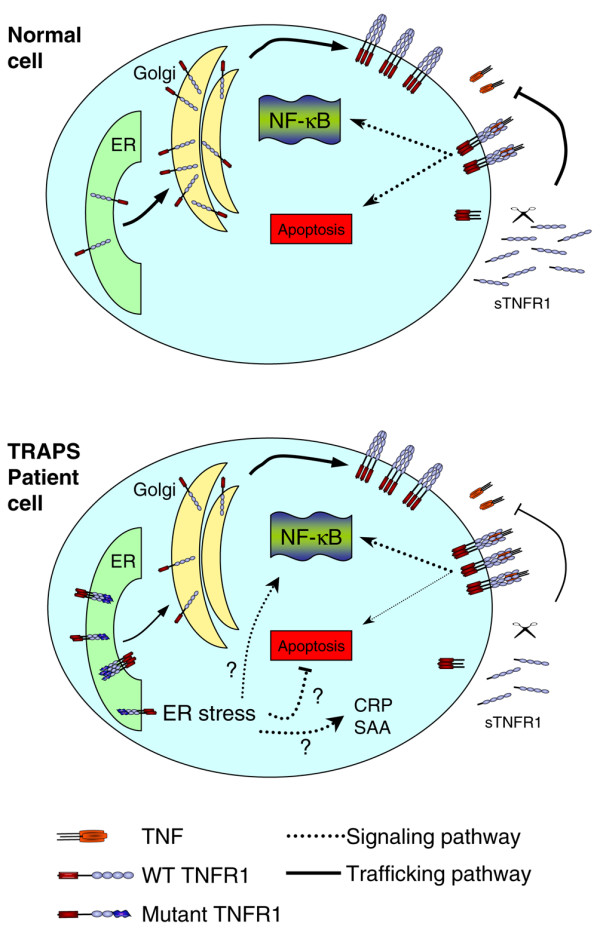
Signalling and trafficking pathways for wild-type and mutant TNF receptor 1. In TNF receptor-associated periodic syndrome mutations (TRAPS) patient cells, mutant TNF receptor 1 (TNFR1) are retained in the endoplasmic reticulum (ER) as disulphide-linked oligomers while the wild-type (WT) receptors traffic to the cell surface, leaving TNFα-induced NF-κB activation intact. ER-retained oligomers may independently activate novel signalling pathways leading to inflammation, may modify ER stress-induced responses, or may block TNFα-induced apoptosis. Mutant TNFR1 does not contribute to the antagonistic pool of soluble TNFR1 because it does not bind ligand. CRP, C-reactive protein; SAA, serum amyloid A; sTNFR1, soluble TNFR1.

References

    1. Drenth JP, van der Meer JW. Hereditary periodic fever. N Engl J Med. 2001;345:1748–1757. doi: 10.1056/NEJMra010200. - DOI - PubMed
    1. Centola M, Wood G, Frucht DM, Galon J, Aringer M, Farrell C, Kingma DW, Horwitz ME, Mansfield E, Holland SM, et al. The gene for familial Mediterranean fever, MEFV, is expressed in early leukocyte development and is regulated in response to inflammatory mediators. Blood. 2000;95:3223–3231. - PubMed
    1. Chae JJ, Komarow HD, Cheng J, Wood G, Raben N, Liu PP, Kastner DL. Targeted disruption of pyrin, the FMF protein, causes heightened sensitivity to endotoxin and a defect in macrophage apoptosis. Mol Cell. 2003;11:591–604. doi: 10.1016/S1097-2765(03)00056-X. - DOI - PubMed
    1. Martinon F, Burns K, Tschopp J. The inflammasome: a molecular platform triggering activation of inflammatory caspases and processing of proIL-beta. Mol Cell. 2002;10:417–426. doi: 10.1016/S1097-2765(02)00599-3. - DOI - PubMed
    1. Hiller S, Kohl A, Fiorito F, Herrmann T, Wider G, Tschopp J, Grutter MG, Wuthrich K. NMR structure of the apoptosis- and inflammation-related NALP1 pyrin domain. Structure. 2003;11:1199–1205. doi: 10.1016/j.str.2003.08.009. - DOI - PubMed

MeSH terms

Substances