Review
. 2007 Nov;72(10):1188-91.
doi: 10.1038/sj.ki.5002461. Epub 2007 Aug 1.

Advances in renal (patho)physiology using multiphoton microscopy

Affiliations
Review

Advances in renal (patho)physiology using multiphoton microscopy

A Sipos et al. Kidney Int. 2007 Nov.

Abstract

Multiphoton excitation fluorescence microscopy is a state-of-the-art confocal imaging technique ideal for deep optical sectioning of living tissues. It is capable of performing ultrasensitive, quantitative imaging of organ functions in health and disease with high spatial and temporal resolution which other imaging modalities cannot achieve. For more than a decade, multiphoton microscopy has been successfully used with various in vitro and in vivo experimental approaches to study many functions of different organs, including the kidney. This study focuses on recent advances in our knowledge of renal (patho)physiological processes made possible by the use of this imaging technology. Visualization of cellular variables like cytosolic calcium, pH, cell-to-cell communication and signal propagation, interstitial fluid flow in the juxtaglomerular apparatus (JGA), real-time imaging of tubuloglomerular feedback (TGF), and renin release mechanisms are reviewed. A brief summary is provided of kidney functions that can be measured by in vivo quantitative multiphoton imaging including glomerular filtration and permeability, concentration, dilution, and activity of the intrarenal renin-angiotensin system using this minimally invasive approach. New visual data challenge a number of existing paradigms in renal (patho)physiology. Also, quantitative imaging of kidney function with multiphoton microscopy has tremendous potential to eventually provide novel non-invasive diagnostic and therapeutic tools for future applications in clinical nephrology.


Figures

Figure 1
Figure 1
Multi-photon imaging of the juxtaglomerular apparatus using the microperfused afferent arteriole (AA)-glomerulus (G)-attached macula densa (MD) preparation. A: Visualization of individual renin granules and exocytosis of granular content in JG granular cells using quinacrine (green). Differential interference contrast (DIC) overlay. B: Fluo-4 and Fura red ratiometric calcium imaging. High ratio values indicate significant elevations in [Ca2+]i in both AA and intraglomerular cells after TGF activation. Bar is 20 μm. EA: efferent arteriole.
Figure 2
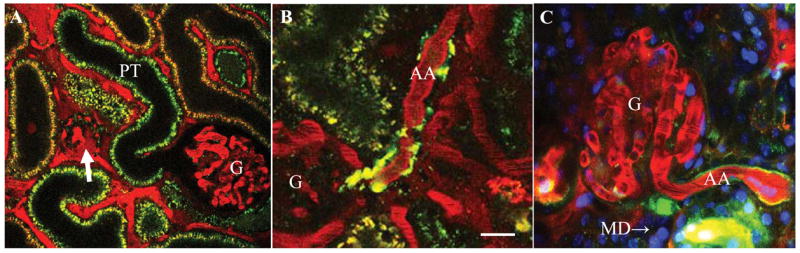
Figure 2
In vivo multi-photon imaging of the intact rodent kidney (A–B: rat, C: mouse). Rhodamine B-conjugated 70 kD dextran (red) was given iv to label the cortical vasculature (plasma). Quinacrine (green) is a strong marker of renin granular content in the afferent arteriole (AA) and it also weakly stains renal tubules (proximal tubule, PT). A: In vivo imaging of the STZ-diabetic kidney and visualization of glomerular permeability. A sclerotic (arrow) and a hyperfiltering glomerulus (G) are shown. Note the intense ultrafiltration of the high molecular weight (70 kD) dextran-rhodamine B (red) from the plasma into the Bowman’s space in the sclerotic, but not in the hyperfiltering glomerulus. B: In vivo imaging of the juxtaglomerular renin content in the diabetic kidney treated with an angiotensin II type 1 receptor (AT1) blocker. Note the significantly increased renin content around the juxtaglomerular portion of the afferent arteriole (AA). C: Multi-photon image of the proximal (P) and juxtaglomerular (JG) segments of the afferent arteriole (AA) in mouse. Content of individual renin granules is labeled by quinacrine (green). The vascular endothelium is labeled by the endocytosis of lucifer yellow (yellow). Note the intense and continuous yellow labeling in the proximal AA segment compared to the weakly fluorescent dash-dot pattern in the JG, renin-positive part. MD: macula densa. Scale is 20 μm.
Figure 3
Figure 3
In vivo imaging of cell [Ca2+] in the intact mouse cortical collecting duct (CCD) (A) and cell pH in the proximal tubule (PT) (B). Fluo-4 or BCECF was loaded in the living kidney to measure cell [Ca2+] and pH, respectively. Note the diffuse cytosolic distribution of Fluo-4 fluorescence in the CCD, but the primarily apical, microvillar BCECF fluorescence in the PT. Intense [Ca2+] oscillations were observed in some CCD cells (arrow). On panel A, the intense, patchy labeling in the PT is mainly tissue autofluorescence, typical for this tubular segment. Rhodamine B-conjugated 70 kD dextran (red) was given iv to label peritubular capillaries (plasma). DT: distal tubule containing highly fluorescent, concentrated tubular fluid. Scale is 20 μm.

References

    1. Zipfel WR, Williams RM, Webb WW. Nonlinear magic: multiphoton microscopy in the biosciences. Nat Biotechnol. 2003;11:1369–77. - PubMed
    1. Peti-Peterdi J. Multiphoton imaging of renal tissues in vitro. Am J Physiol Renal Physiol. 2005;288:F1079–83. - PubMed
    1. Peti-Peterdi J, Morishima S, Bell PD, et al. Two-photon excitation fluorescence imaging of the living juxtaglomerular apparatus. Am J Physiol Renal Physiol. 2002;283:F197–201. - PubMed
    1. Komlosi P, Fintha A, Bell PD. Unraveling the relationship between macula densa cell volume and luminal solute concentration/osmolality. Kidney Int. 2006;70:865–71. - PubMed
    1. Peti-Peterdi J. Calcium wave of tubuloglomerular feedback. Am J Physiol Renal Physiol. 2006;291:F473–80. - PubMed

Publication types

MeSH terms

LinkOut - more resources