. 2007 Aug 1;2(7):e659.
doi: 10.1371/journal.pone.0000659.

Genome sequence of Fusobacterium nucleatum subspecies polymorphum - a genetically tractable fusobacterium

Affiliations

Genome sequence of Fusobacterium nucleatum subspecies polymorphum - a genetically tractable fusobacterium

Sandor E Karpathy et al. PLoS One. .

Abstract

Fusobacterium nucleatum is a prominent member of the oral microbiota and is a common cause of human infection. F. nucleatum includes five subspecies: polymorphum, nucleatum, vincentii, fusiforme, and animalis. F. nucleatum subsp. polymorphum ATCC 10953 has been well characterized phenotypically and, in contrast to previously sequenced strains, is amenable to gene transfer. We sequenced and annotated the 2,429,698 bp genome of F. nucleatum subsp. polymorphum ATCC 10953. Plasmid pFN3 from the strain was also sequenced and analyzed. When compared to the other two available fusobacterial genomes (F. nucleatum subsp. nucleatum, and F. nucleatum subsp. vincentii) 627 open reading frames unique to F. nucleatum subsp. polymorphum ATCC 10953 were identified. A large percentage of these mapped within one of 28 regions or islands containing five or more genes. Seventeen percent of the clustered proteins that demonstrated similarity were most similar to proteins from the clostridia, with others being most similar to proteins from other gram-positive organisms such as Bacillus and Streptococcus. A ten kilobase region homologous to the Salmonella typhimurium propanediol utilization locus was identified, as was a prophage and integrated conjugal plasmid. The genome contains five composite ribozyme/transposons, similar to the CdISt IStrons described in Clostridium difficile. IStrons are not present in the other fusobacterial genomes. These findings indicate that F. nucleatum subsp. polymorphum is proficient at horizontal gene transfer and that exchange with the Firmicutes, particularly the Clostridia, is common.


Conflict of interest statement

Competing Interests: The authors have declared that no competing interests exist.

Figures

Figure 1
Figure 1. Map of the FNP ATCC 10953 genome.
The inner circle (orange) shows the percent GC calculated using a sliding window of 5 kb. The triangles in the next circle show the location and directionality of tRNAs (red) and ncRNAs (blue). The next tract shows the coordinate scale; this is surrounded by the ORFs, on both strands. ORFs are colored by category, as follows: tan, cell processes; purple, cell structure; red; DNA replication and recombination; blue, general metabolism; green, regulation; yellow, transcription; orange, translation, cyan, transport; fuchsia, virulence; and black, unknown. The IStrons are indicated by the fuchsia arrowheads on the outside circle; the intact IStron is indicated with the star. Plasmid (green) and phage locations (cyan) also appear on the outside circle.
Figure 2
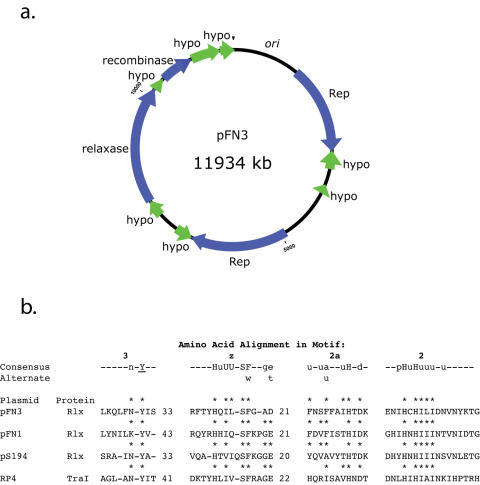
Figure 2. Plasmid pFN3.
a) Map of plasmid pFN3. Replication and recombination ORFs are shown in blue and hypotheticals are colored green. b) Alignments of fusobacterial relaxase protein domains to mobilization class consensus motifs . Consensus sequence abbreviations: uppercase letters, conserved; lowercase letters, present in 50% of sites; U or u, bulky hydrophobic residues (I, L, V, M, F, Y and W); -, no consensus at this site; Y, putative active site tyrosine residue. Asterisks (*) above residues indicate identity with consensus sequence. Alignments were performed using Clustal W and then adjusted to best fit the consensus.
Figure 3
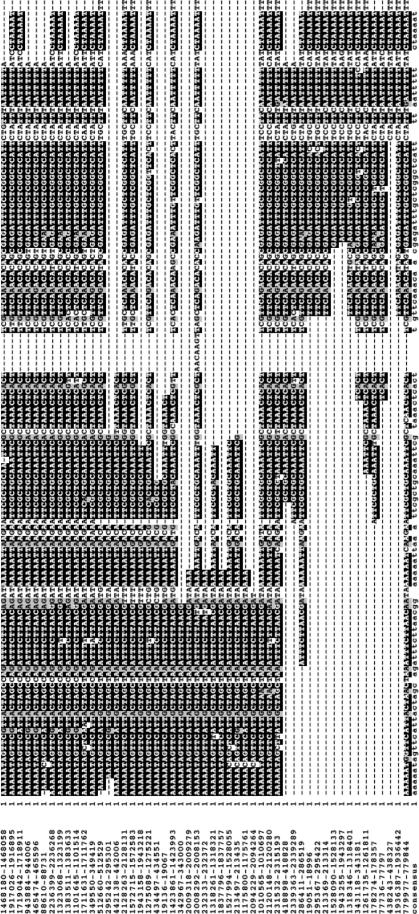
Figure 3. Intergenic repeats.
The repeats were aligned using ClustalW and conserved bases were shaded using BOXSHADE (www.ch.embnet.org/software/BOX_form.html). Coordinates are shown in the left column.
Figure 4
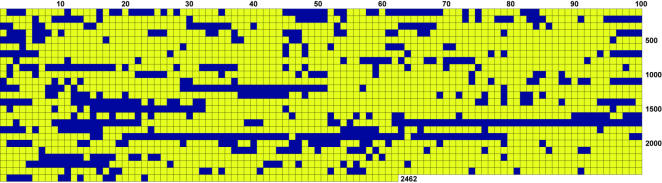
Figure 4. Whole genome display of FNP illustrating clustering of genes without hits in FNN or FNV.
Yellow boxes represent FNP genes with either FNN or FNV as top BLASTN hits (1835/2462 or 75%) and blue boxes represent genes whose top BLASTN hits are to genes from other organisms (627/2462 or 25%).
Figure 5
Figure 5. Linear map of prophage located between nts 2,024,189 and 2,053,649 in FNP.
Replication and regulatory ORFs are colored blue, ORFs encoding structural proteins are red, ORFs encoding proteins with homologs in the nr database but of unknown function are colored green, and hypotheticals are shaded gray.

References

    1. Paster BJ, Boches SK, Galvin JL, Ericson RE, Lau CN, et al. Bacterial diversity in human subgingival plaque. J Bacteriol. 2001;183:3770–3783. - PMC - PubMed
    1. Ximénez-Fyvie LA, Haffajee AD, Socransky SS. Comparison of the microbiota of supra- and subgingival plaque in health and periodontitis. J Clin Periodontol. 2000;27:648–657. - PubMed
    1. Kononen E. Development of oral bacterial flora in young children. Ann Med. 2000;32:107–112. - PubMed
    1. Kolenbrander PE, London J. Adhere today, here tomorrow: Oral bacterial adherence. J Bacteriol. 1993;175:3247–3252. - PMC - PubMed
    1. Diaz PI, Zilm PS, Rogers AH. Fusobacterium nucleatum supports the growth of Porphyromonas gingivalis in oxygenated and carbon-dioxide-depleted environments. Microbiol. 2002;148:467–472. - PubMed

Publication types

MeSH terms

LinkOut - more resources