. 2007;35(15):e97.
doi: 10.1093/nar/gkm566. Epub 2007 Aug 1.

Targeted high-throughput sequencing of tagged nucleic acid samples

Affiliations

Targeted high-throughput sequencing of tagged nucleic acid samples

Matthias Meyer et al. Nucleic Acids Res. 2007.

Abstract

High-throughput 454 DNA sequencing technology allows much faster and more cost-effective sequencing than traditional Sanger sequencing. However, the technology imposes inherent limitations on the number of samples that can be processed in parallel. Here we introduce parallel tagged sequencing (PTS), a simple, inexpensive and flexible barcoding technique that can be used for parallel sequencing any number and type of double-stranded nucleic acid samples. We demonstrate that PTS is particularly powerful for sequencing contiguous DNA fragments such as mtDNA genomes: in theory as many as 250 mammalian mtDNA genomes can be sequenced in a single GS FLX run. PTS dramatically increases the sequencing throughput of samples in parallel and thus fully mobilizes the resources of the 454 technology for targeted sequencing.


Figures
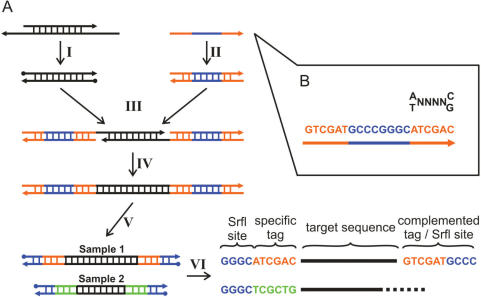
Figure 1.
Figure 1.
Workflow for barcoding and sequencing double-stranded DNA samples. (A) The DNA is blunt end repaired (I) and sample-specific self-complementary oligos are self-hybridized to form double-stranded barcoding adapters (II), which are subsequently ligated to both ends of the DNA molecules (III). Resulting nicks are removed by strand-displacement (IV). Individually tagged samples are combined into a single master library and treated with phosphatase. Half of the adapter is removed by SrfI digestion (V) leaving ligatable ends for the standard 454 library production. After sequencing (VI), the tags are used to identify the sample origin and removed prior to further analysis. (B) Barcoding tags begin with either an A or T, followed by four freely chosen nucleotides and end with C or G with no homopolymers allowed. From 324 possible tags, 72 can be chosen to differ by at least two substitutions.
Figure 2.
Figure 2.
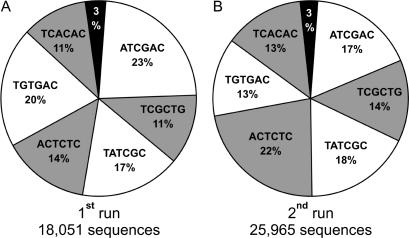
Sequence representation of barcoded shotgun libraries obtained from two independently constructed sequencing libraries (A and B, respectively).
Figure 3.
Figure 3.
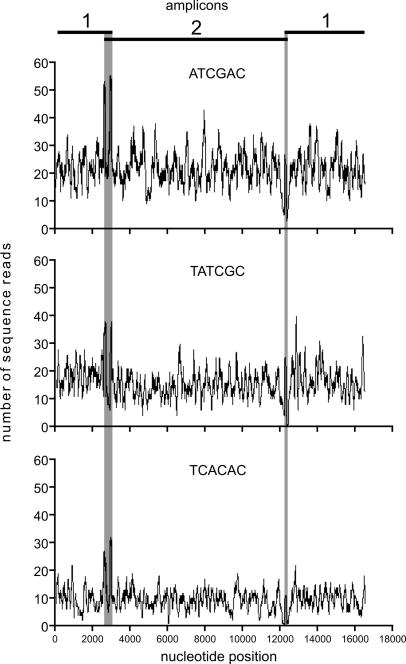
Three coverage plots representing the spectrum of coverage obtained for the six human mtDNA genomes with known Sanger sequence. The overlapping regions of the long-range amplicons are indicated by gray shading.

References

    1. Margulies M, Egholm M, Altman WE, Attiya S, Bader JS, Bemben LA, Berka J, Braverman MS, Chen YJ, et al. Genome sequencing in microfabricated high-density picolitre reactors. Nature. 2005;437:376–380. - PMC - PubMed
    1. Hofreuter D, Tsai J, Watson RO, Novik V, Altman B, Benitez M, Clark C, Perbost C, Jarvie T, et al. Unique features of a highly pathogenic Campylobacter jejuni strain. Infect. Immun. 2006;74:4694–4707. - PMC - PubMed
    1. Gowda M, Li H, Alessi J, Chen F, Pratt R, Wang GL. Robust analysis of 5′-transcript ends (5′-RATE): a novel technique for transcriptome analysis and genome annotation. Nucleic Acids Res. 2006;34:e126. - PMC - PubMed
    1. Thomas RK, Nickerson E, Simons JF, Janne PA, Tengs T, Yuza Y, Garraway LA, LaFramboise T, Lee JC, et al. Sensitive mutation detection in heterogeneous cancer specimens by massively parallel picoliter reactor sequencing. Nat. Med. 2006;12:852–855. - PubMed
    1. Nielsen KL, Hogh AL, Emmersen J. DeepSAGE – digital transcriptomics with high sensitivity, simple experimental protocol and multiplexing of samples. Nucleic Acids Res. 2006;34:e133. - PMC - PubMed

Publication types

Substances