


Review
doi: 10.1523/JNEUROSCI.1554-07.2007.
The role of the dorsal striatum in reward and decision-making
Affiliations
- PMID: 17670959
- PMCID: PMC6673072
- DOI: 10.1523/JNEUROSCI.1554-07.2007
Item in Clipboard
Review
The role of the dorsal striatum in reward and decision-making
J Neurosci.
.
Abstract
Although the involvement in the striatum in the refinement and control of motor movement has long been recognized, recent description of discrete frontal corticobasal ganglia networks in a range of species has focused attention on the role particularly of the dorsal striatum in executive functions. Current evidence suggests that the dorsal striatum contributes directly to decision-making, especially to action selection and initiation, through the integration of sensorimotor, cognitive, and motivational/emotional information within specific corticostriatal circuits involving discrete regions of striatum. We review key evidence from recent studies in rodent, nonhuman primate, and human subjects.
Figures
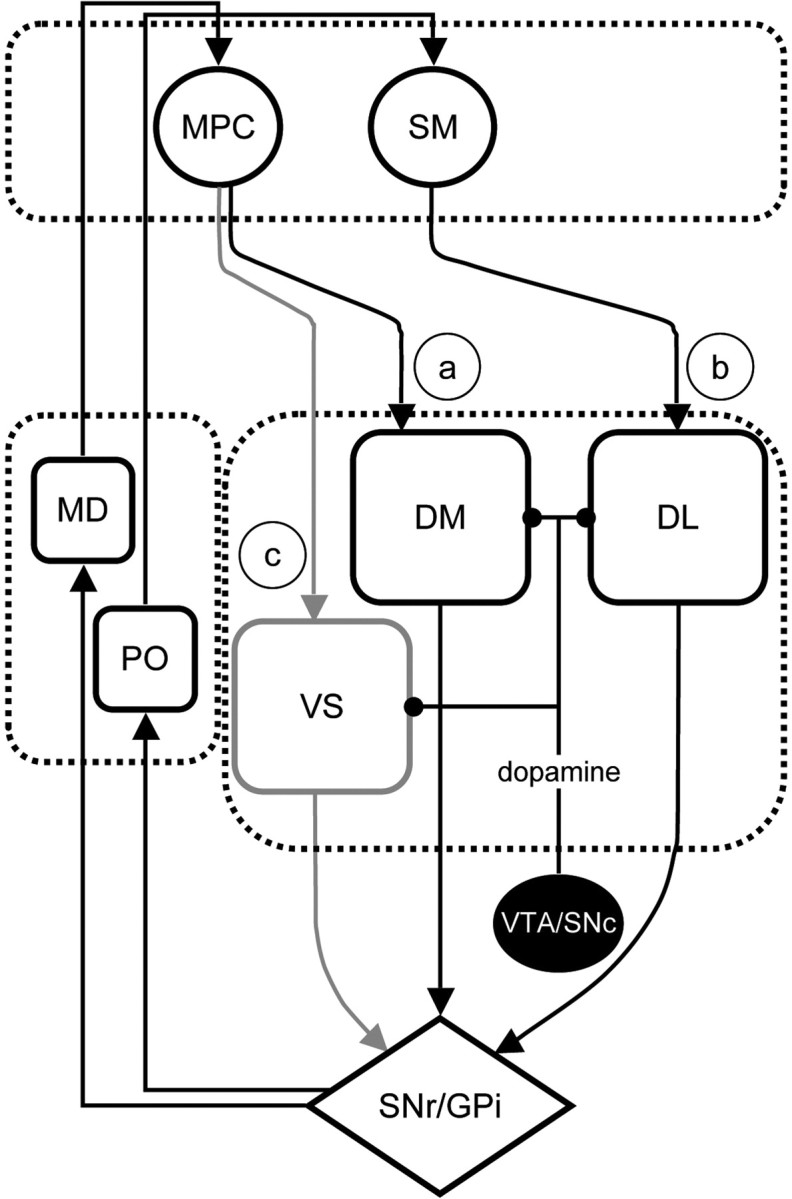
Corticostriatal circuits involved in decision-making. a, b, The learning processes controlling the acquisition of reward-related actions are mediated by converging projections from regions of anteromedial prefrontal cortex (MPC) to the rodent dorsomedial striatum or primate dorsoanterior striatum (DM), whereas the processes mediating the acquisition of stimulus-bound actions, or habits, are thought to be mediated by projections from sensorimotor cortex (SM) to the rodent dorsolateral–primate dorsoposterior striatum (DL) (b). These corticostriatal connections are parts of distinct feedback loops that project back to their cortical origins via substantia nigra pars reticulata (SNr)/globus pallidus internal segment (GPi) and the mediodorsal (MD)/posterior (PO) nuclei of the thalamus. c, Reward and predictors of reward are the major motivational influences on the performance of goal-directed and habitual actions that are thought to be mediated by corticostriatal circuits involving, particularly, ventral striatum (VS) and regions of the amygdala. Dopamine is an important modulator of plasticity in the dorsal striatum, whereas its tonic release has long been associated with the motivational processes mediated by the ventral circuit. VTA, Ventral tegmental area; SNc, substantia nigra pars compacta.
References
-
- Alexander GE, Crutcher MD. Functional architecture of basal ganglia circuits: neural substrates of parallel processing. Trends Neurosci. 1990;13:266–271. - PubMed
-
- Antonini A, Moresco RM, Gobbo C, De Notaris R, Panzacchi A, Barone P, Calzetti S, Negrotti A, Pezzoli G, Fazio F. The status of dopamine nerve terminals in Parkinson's disease and essential tremor: a PET study with the tracer [11-C]FE-CIT. Neurol Sci. 2001;22:47–48. - PubMed
-
- Balleine BW. Neural bases of food seeking: affect, arousal and reward in corticostriatolimbic circuits. Physiol Behav. 2005;86:717–730. - PubMed
-
- Balleine BW, Dickinson A. Goal-directed instrumental action: contingency and incentive learning and their cortical substrates. Neuropharmacology. 1998;37:407–419. - PubMed
Publication types
MeSH terms
Grants and funding
LinkOut - more resources
Full Text Sources
Other Literature Sources
