


Review
doi: 10.1172/JCI32577.
Chromosomal rearrangements and microRNAs: a new cancer link with clinical implications
Affiliations
- PMID: 17671640
- PMCID: PMC1934569
- DOI: 10.1172/JCI32577
Item in Clipboard
Review
Chromosomal rearrangements and microRNAs: a new cancer link with clinical implications
J Clin Invest.
2007 Aug.
Abstract
There is widespread aberrant expression of mature and/or precursor microRNAs in cancer cells, as microRNAs are deregulated consequent to chromosomal alterations and other genomic abnormalities. The identification of such abnormalities has a clear diagnostic and prognostic significance, and there are ever increasing examples of links between certain human cancers and modifications at microRNA loci.
Figures
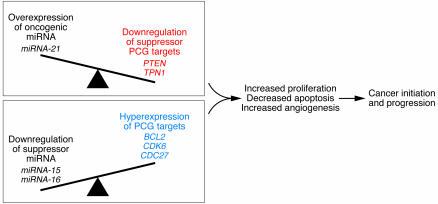
Alterations in miRNA genes play a critical role in the pathophysiology of many, perhaps all, human cancers. Loss or amplification of miRNA genes has been reported in a variety of cancers, and altered patterns of miRNA expression may affect cell cycle and survival programs. Downregulation of suppressor miRNA is accompanied by the hyperexpression of the oncogenic PCG targets (marked in blue), while overexpression of oncogenic miRNA is followed by downregulation of suppressor PCG targets (marked in red). The two paradigms presented in this Review, miR-15a/miR-16-1 cluster and miR-21, are shown in correlation with their main identified targets.
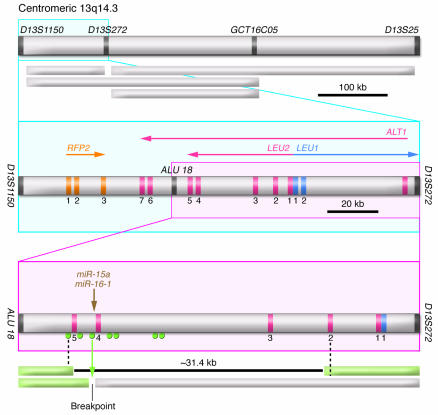
The genomic map of the 13q14.3 locus between ALU 18 and D13S272 markers is shown. Exons for LEU2/ALT1 and LEU1 are indicated by numbers. The brown arrow marks the position of miR-15a and miR-16-1 genes. Green circles mark the positions of PCR primers used to screen somatic cell hybrid clones derived from a fusion of two independent leukemia cases. The green arrow represents the position of the breakpoint in CLL carrying a t(2;13)(q32;q14) translocation. Green boxes represent portions of chromosome 13 present in the hybrids. The 31.4-kb deletion was present in a clone derived from a patient with CLL, bilateral retinoblastoma, and ulcerative colitis. Figure modified from Proceedings of the National Academy of Sciences of the United States of America (32).
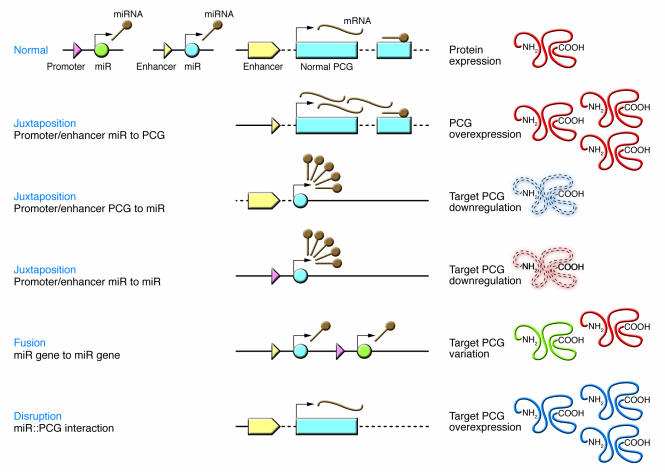
The main mechanisms (some identified in patient samples [refs. 32, 53, 62, 64, 65], others only shown in the case of PCGs altered by translocations) of miRNA deregulation are schematically presented. On the left side, the primary genomic alteration is presented, while on the right side, the correspondent consequence at proteomic levels is shown. miR, miRNA gene.
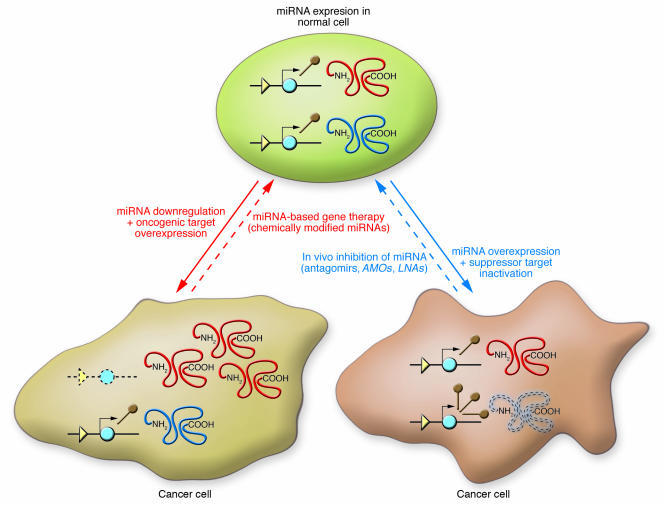
The major types of new miRNA drugs or manipulations toward the therapeutic goal of reverting the malignant phenotype are presented in conjunction with the main miRNA abnormalities found in human cancers. AMOs, anti-mRNA oligonucleotides; LNAs, locked nucleic acids.
References
-
- Jemal A., et al. Cancer statistics, 2007. CA Cancer J. Clin. 2007;57:43–66. - PubMed
-
- Bishop J.M. Molecular themes in oncogenesis. Cell. 1991;64:235–248. - PubMed
-
- Hunter T. Cooperation between oncogenes. Cell. 1991;64:249–270. - PubMed
-
- Weinberg R.A. Tumor suppressor genes. Science. 1991;254:1138–1146. - PubMed
-
- Calin G.A., Croce C.M. MicroRNA signatures in human cancers. Nat. Rev. Cancer. 2006;6:857–866. - PubMed
Publication types
MeSH terms
Substances
LinkOut - more resources
Full Text Sources
Other Literature Sources
