


Prime suspect: the TCF7L2 gene and type 2 diabetes risk
- PMID: 17671643
- PMCID: PMC1934573
- DOI: 10.1172/JCI33077
Prime suspect: the TCF7L2 gene and type 2 diabetes risk
Abstract
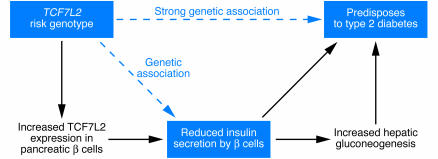
Transcription factor-7-like 2 (TCF7L2) is the most important type 2 diabetes susceptibility gene identified to date, with common intronic variants strongly associated with diabetes in all major racial groups. This ubiquitous transcription factor in the Wnt signaling pathway was not previously known to be involved in glucose homeostasis, so defining the underlying mechanism(s) will provide new insights into diabetes. In this issue of the JCI, Lyssenko and colleagues report on their human and isolated islet studies and suggest that the risk allele increases TCF7L2 expression in the pancreatic beta cell, reducing insulin secretion and hence predisposing the individual to diabetes (see the related article beginning on page 2155).
Figures
Comment on
-
Mechanisms by which common variants in the TCF7L2 gene increase risk of type 2 diabetes.J Clin Invest. 2007 Aug;117(8):2155-63. doi: 10.1172/JCI30706. J Clin Invest. 2007. PMID: 17671651 Free PMC article. Clinical Trial.
References
-
- Altshuler D., et al. The common PPARgamma Pro12Ala polymorphism is associated with decreased risk of type 2 diabetes. Nat. Genet. 2000;26:76–80. - PubMed
-
- Gloyn A.L., et al. Large-scale association studies of variants in genes encoding the pancreatic beta-cell K-ATP channel subunits Kir6.2 (KCNJ11) and SUR1 ABCC8) confirm that the KCNJ11 E23K variant is associated with Type 2 diabetes. Diabetes. 2003;52:568–572. - PubMed
-
- Barroso I., et al. Dominant negative mutations in human PPARgamma associated with severe insulin resistance, diabetes mellitus and hypertension. Nature. 1999;402:880–883. - PubMed
-
- Gloyn A.L., et al. Activating mutations in the gene encoding the ATP-sensitive potassium-channel subunit Kir6.2 and permanent neonatal diabetes. N. Engl. J. Med. 2004;350:1838–1849. - PubMed
