


doi: 10.1016/j.febslet.2007.07.038.
Epub 2007 Jul 25.
Different activities of the largest subunit of replication protein A cooperate during SV40 DNA replication
Affiliations
- PMID: 17673209
- PMCID: PMC2045582
- DOI: 10.1016/j.febslet.2007.07.038
Item in Clipboard
Different activities of the largest subunit of replication protein A cooperate during SV40 DNA replication
FEBS Lett.
.
Abstract
Replication protein A (RPA) is a stable heterotrimeric complex consisting of p70, p32 and p14 subunits. The protein plays a crucial role in SV40 minichromosome replication. Peptides of p70 representing interaction sites for the smaller two subunits, DNA as well as the viral initiator protein large T-antigen (Tag) and the cellular DNA polymerase alpha-primase (Pol) all interfered with the replication process indicating the importance of the different p70 activities in this process. Inhibition by the peptide disrupting protein-protein interactions was observed only during the pre-initiation stage prior to primer synthesis, suggesting the formation of a stable initiation complex between RPA, Tag and Pol at the primer end.
Figures
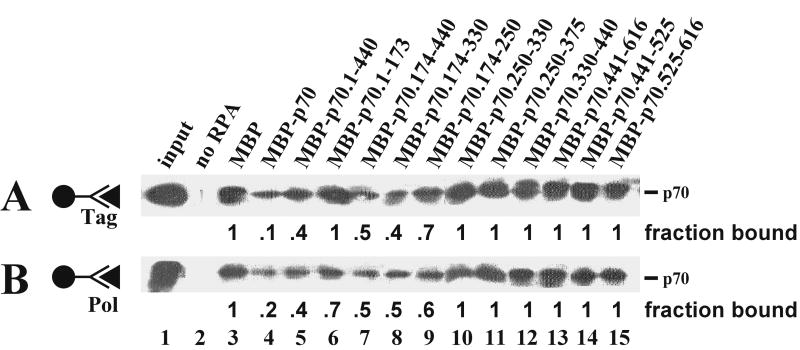
Co-precipitations of 17.5 pmol soluble H6-RPA were performed with the same amounts of immobilized Tag (panel A) and Pol (panel B) in the presence of a 100-fold molar excess of the indicated p70 competitor polypeptides. Bound H6-RPA was detected with his-tag specific antibodies by western blotting and ECL detection. The numbers below the lanes refer to the fractions of H6-RPA bound in relation to the amount obtained in the presence of MBP. The position of the p70 subunit bearing the histidin-tag is indicated. Lane 1 represents a loading control of 1/10th of the input material, whereas in lane 2 no RPA was added.
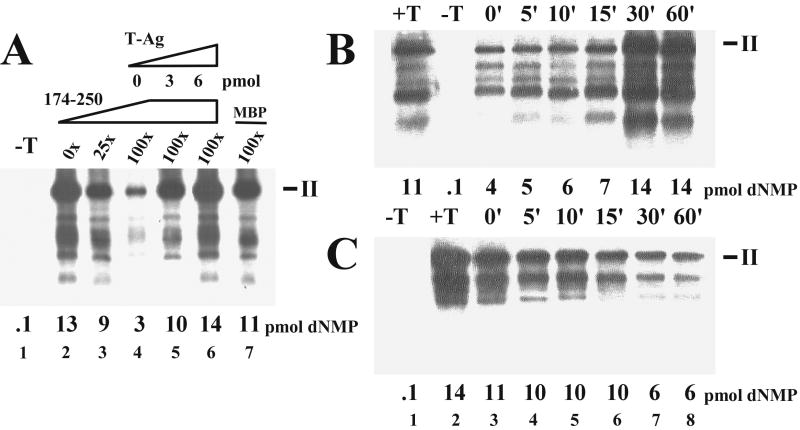
Panel A. Inhibition of SV40 DNA replication by peptide 174-250. The peptide was titrated into the assay in increasing quantities defined as a molar excess over the 6.25 pmol of Tag present in the assay (lanes 3-4). Lane 2 (0x) contained no peptide and a control reaction MBP in a 100 fold molar excess over Tag (lane 7). Tag was back titrated with the indicated amounts where indicated (lanes 5-6). Lane 1 (−Tag) contained no Tag to determine background replication. Panel B. Kinetics of inhibition by peptide 174-250. The peptide was added to the mix at the indicated times after start of the replication reaction with a 100 fold molar excess over the 6.25 pmol of Tag (lanes 3-8). Incubation continued for a total of 120 minutes. Reactions in the presence (+Tag, lane 1) and absence (−Tag, lane 2) of Tag without peptide served as positive and negative controls, respectively. Panel C. Kinetics of inhibition relief by extra Tag. Reactions were supplied with peptide 174-250 at the onset of the reaction in a 100 fold molar excess over the 6.25 pmol of Tag. After the indicated times an additional 6 pmol of Tag was added (lanes 3-8). Incubation continued for a total of 120 minutes. Reactions in the presence (+Tag, lane 1) and absence (−Tag, lane 2) of Tag without peptide served as positive and negative controls, respectively. The position of the linearized plasmid DNA (form II) is indicated. The numbers below each lane indicate the pmol of dNMPs incorporated.
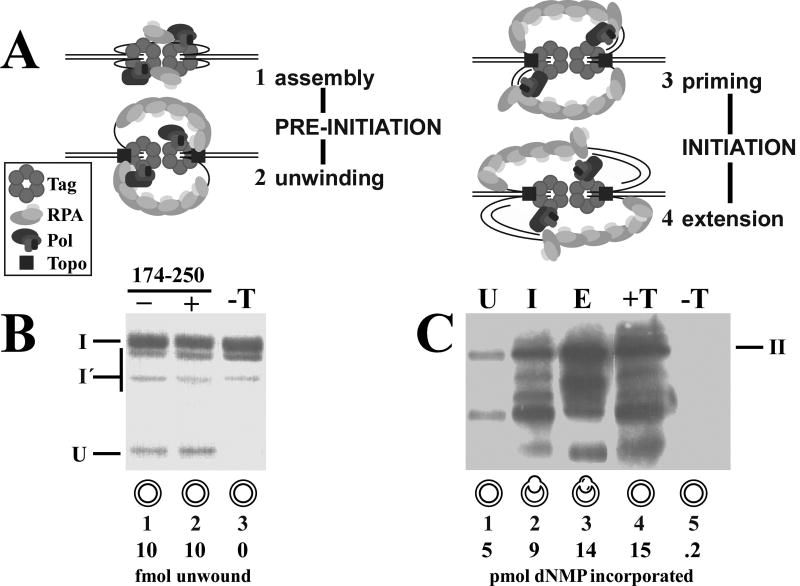
Panel A: Enzymatic events during initiation of cell-free SV40 DNA replication. The sketch shows mechanistic views of the single steps: assembly of Tag, Pol and RPA on origin sequences and unmelting of duplex DNA (step 1); recruitment of Topoisomerase I (Topo), extensive unwinding by Tag and coating of ssDNA by RPA (step 2); RNA primer synthesis by the primase subunit of Pol (step 3); and primer extension with DNA by the polymerase subunit of Pol (step 4). Steps 1 and 2 belong to the pre-initiation or lag phase and are ATP dependent, steps 3 and 4 comprise the initiation phase and depend on rNTPs and dNTPs, respectively. Panel B. Effect of peptide 174-250 at the unwinding step. The peptide was added before the addition of ATP, which is needed for the bidirectional unwinding reaction (lane 2). Lane 1 is a positive control without peptide. In lane 3 Tag was omitted. The position of supercoiled template DNA (form I), topoisomers (form I') and underwound DNA (form U) are indicated. The amount of form U is given below each lane. Panel C. Effect of peptide 174-250 at different replication steps. The peptide was added to the assay before unwinding (U, lane 1), primer synthesis (I, lane 2) and primer extension (E, lane 3). The respective template DNAs present at the time point of peptide addition are supercoiled, underwound and primed underwound plasmid DNA. All are represented by symbols below each lane. Reactions with (lane 4) and without (lane 5) Tag in the absence of the peptide served as positive and negative controls. The pmol of incorporated dNMPs are indicated.
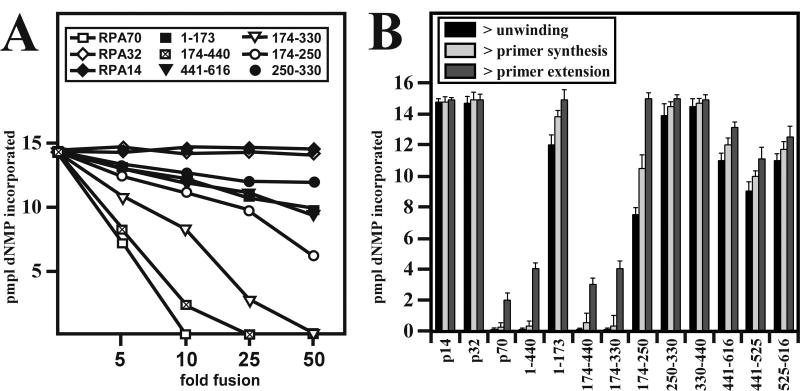
Panel A: Titration of peptides. Peptides were added in increasing amounts expressed as fold molar excess over the 6.25 pmol of Tag present at the onset of the reaction. After a total of 120 min. incubation time incorporated nucleotides were determined and plotted versus the molar excess of the respective peptides. Panel B. Influence of peptides on different replication steps. Peptides were added at a 50 fold molar excess over Tag before unwinding, primer synthesis and primer extension as indicated (>). The pmol of incorporated nucleotides were determined for each case.
References
-
- Wold MS. Replication protein A: a heterotrimeric, single-stranded DNA-binding protein required for eukaryotic DNA metabolism. Annu Rev Biochem. 1997;66:61–92. - PubMed
-
- Brill SJ, Stillman B. Replication factor-A from Saccharomyces cervisiae is encoded by three essential genes coordinately expressed at S phase. Genes Dev. 1991;5:1589–1600. - PubMed
-
- Kenny MK, Schlegel U, Furneaux H, Hurwitz J. The role of human single-stranded DNA binding protein and its individual subunits in simian virus 40 DNA replication. J Biol Chem. 1990;265:7693–7700. - PubMed
-
- Umbricht CB, Erdile LF, Jabs EW, Kelly TJ. Cloning, overexpression, and genomic mapping of the 14-kDa subunit of human replication protein A. J Biol Chem. 1993;268:6131–6138. - PubMed
Publication types
MeSH terms
Substances
Grants and funding
LinkOut - more resources
Full Text Sources
Molecular Biology Databases
Research Materials
