


Oncogenic PIK3CA mutations occur in epidermal nevi and seborrheic keratoses with a characteristic mutation pattern
- PMID: 17673550
- PMCID: PMC1948900
- DOI: 10.1073/pnas.0705218104
Oncogenic PIK3CA mutations occur in epidermal nevi and seborrheic keratoses with a characteristic mutation pattern
Abstract
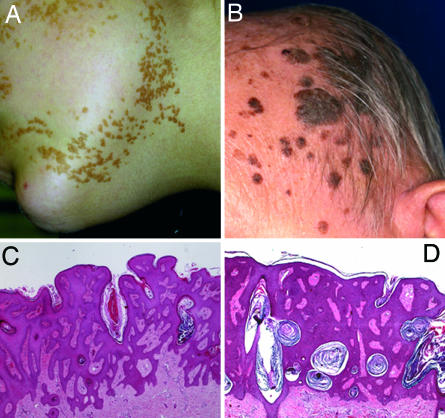
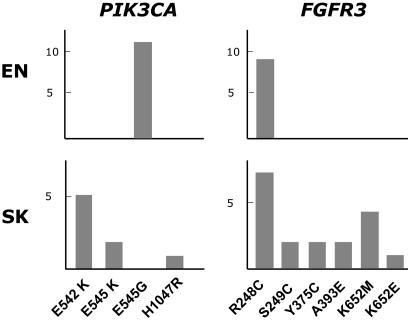
Activating mutations of the p110 alpha subunit of PI3K (PIK3CA) oncogene have been identified in a broad spectrum of malignant tumors. However, their role in benign or preneoplastic conditions is unknown. Activating FGF receptor 3 (FGFR3) mutations are common in benign skin lesions, either as embryonic mutations in epidermal nevi (EN) or as somatic mutations in seborrheic keratoses (SK). FGFR3 mutations are also common in low-grade malignant bladder tumors, where they often occur in association with PIK3CA mutations. Therefore, we examined exons 9 and 20 of PIK3CA and FGFR3 hotspot mutations in EN (n = 33) and SK (n = 62), two proliferative skin lesions lacking malignant potential. Nine of 33 (27%) EN harbored PIK3CA mutations; all cases showed the E545G substitution, which is uncommon in cancers. In EN, R248C was the only FGFR3 mutation identified. By contrast, 10 of 62 (16%) SK revealed the typical cancer-associated PIK3CA mutations E542K, E545K, and H1047R. The same lesions displayed a wide range of FGFR3 mutations. Corresponding unaffected tissue was available for four EN and two mutant SK: all control samples displayed a WT sequence, confirming the somatic nature of the mutations found in lesional tissue. Forty of 95 (42%) lesions showed at least one mutation in either gene. PIK3CA and FGFR3 mutations displayed an independent distribution; 5/95 lesions harbored mutations in both genes. Our findings suggest that, in addition to their role in cancer, oncogenic PIK3CA mutations contribute to the pathogenesis of skin tumors lacking malignant potential. The remarkable genotype-phenotype correlation as observed in this study points to a distinct etiopathogenesis of the mutations in keratinocytes occuring either during fetal development or in adult life.
Conflict of interest statement
The authors declare no conflict of interest.
Figures

References
Publication types
MeSH terms
Substances
LinkOut - more resources
Full Text Sources
Other Literature Sources
Medical
Molecular Biology Databases
Research Materials
Miscellaneous
