


School-based interventions for aggressive and disruptive behavior: update of a meta-analysis
- PMID: 17675014
- PMCID: PMC2246021
- DOI: 10.1016/j.amepre.2007.04.011
School-based interventions for aggressive and disruptive behavior: update of a meta-analysis
Abstract
Background: Research about the effectiveness of school-based psychosocial prevention programs for reducing aggressive and disruptive behavior was synthesized using meta-analysis. This work updated previous work by the authors and further investigated which program and student characteristics were associated with the most positive outcomes.
Methods: Two hundred forty-nine experimental and quasi-experimental studies of school-based programs with outcomes representing aggressive and/or disruptive behavior were obtained. Effect sizes and study characteristics were coded from these studies and analyzed.
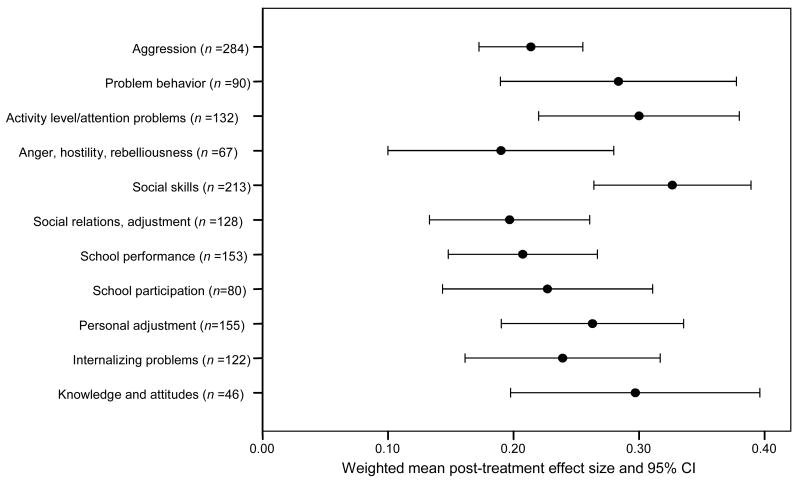
Results: Positive overall intervention effects were found on aggressive and disruptive behavior and other relevant outcomes. The most common and most effective approaches were universal programs and targeted programs for selected/indicated children. The mean effect sizes for these types of programs represent a decrease in aggressive/disruptive behavior that is likely to be of practical significance to schools. Multicomponent comprehensive programs did not show significant effects and those for special schools or classrooms were marginal. Different treatment modalities (e.g., behavioral, cognitive, social skills) produced largely similar effects. Effects were larger for better-implemented programs and those involving students at higher risk for aggressive behavior.
Conclusions: Schools seeking prevention programs may choose from a range of effective programs with some confidence that whatever they pick will be effective. Without the researcher involvement that characterizes the great majority of programs in this meta-analysis, schools might be well-advised to give priority to those that will be easiest to implement well in their settings.
Conflict of interest statement
No financial conflict of interest was reported by the authors of this paper.
Figures
References
-
- Gottfredson GD, Gottfredson DC, Czeh ER, Cantor D, Crosse S, Hantman I. National study of delinquency prevention in schools. Ellicott City (MD): Gottfredson Associates, Inc.; 2000. Final Report, Grant No. 96-MU-MU-0008. Available from: www.gottfredson.com.
-
- Brener ND, Martindale J, Weist MD. Mental health and social services: results from the School Health Policies and Program Study. J of Sch Health. 2001;71:305–12. - PubMed
-
- Wilson SJ, Lipsey MW, Derzon JH. The effects of school-based intervention programs on aggressive and disruptive behavior: a meta-analysis. J Consult Clin Psychol. 2003;71:136–49. - PubMed
-
- Gottfredson DC, Gottfredson GD. Quality of school-based prevention programs: results from a national survey. J Res Crime Delinq. 2002;39:3–35.
-
- Durlak JA. School-based prevention programs for children and adolescents. Thousand Oaks: Sage; 1995.
Publication types
MeSH terms
Grants and funding
LinkOut - more resources
Full Text Sources
Medical
