


Cloning and transfer of the Salmonella pathogenicity island 2 type III secretion system for studies of a range of gram-negative genera
- PMID: 17675443
- PMCID: PMC2074921
- DOI: 10.1128/AEM.00952-07
Cloning and transfer of the Salmonella pathogenicity island 2 type III secretion system for studies of a range of gram-negative genera
Abstract
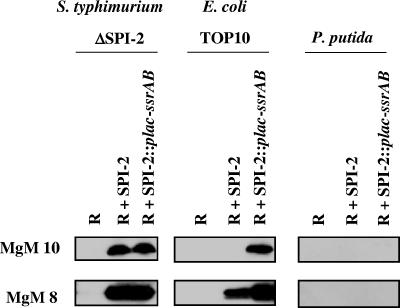
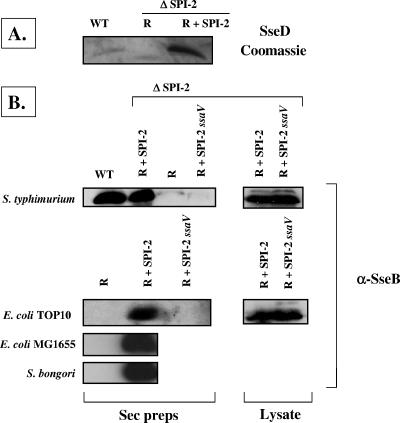
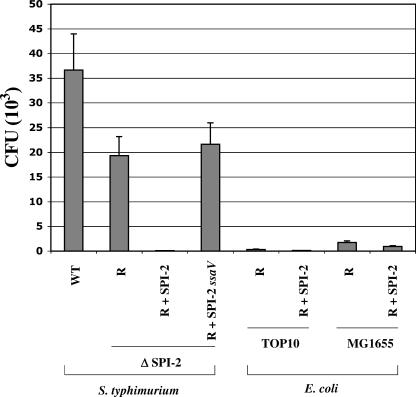
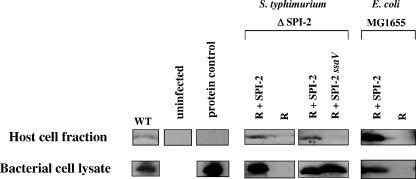
The engineering of bacterial strains with specific phenotypes frequently requires the use of blocks or "cassettes" of genes that act together to perform a desired function. The potential benefits of utilizing type III secretion systems in this regard are becoming increasingly realized since these systems can be used to direct interactions with host cells for beneficial purposes such as vaccine development, anticancer therapies, and targeted protein delivery. However, convenient methods to clone and transfer type III secretion systems for studies of a range of different types of bacteria are lacking. In addition to functional applications, such methods would also reveal important information about the evolution of a given type III secretion system, such as its ability to be expressed and functional outside of the strain of origin. We describe here the cloning of the Salmonella enterica serovar Typhimurium pathogenicity island 2 (SPI-2) type III secretion system onto a vector that can be easily transferred to a range of gram-negative bacterial genera. We found that expression of the cloned SPI-2 system in different Gammaproteobacteria and Alphaproteobacteria (as monitored by SseB protein levels) is dependent on the bacterial strain and growth medium. We also demonstrate that the cloned system is functional for secretion, can direct interactions with macrophages, and can be used as a novel tool to analyze the predicted interaction of SseB with host cells. This work provides a foundation for future applications where the cloned SPI-2 region (or other cloned type III systems) can provide a desired function to an engineered gram-negative strain.
Figures
References
-
- Ausubel, F. M., R. Brent, R. E. Kingston, D. D. Moore, J. G. Seidman, J. A. Smith, and K. Struhl (ed.). 1996. Current protocols in molecular biology. John Wiley & Sons, Inc., New York, NY.
-
- Baker, D., G. Church, J. Collins, D. Endy, J. Jacobson, J. Keasling, P. Modrich, C. Smolke, and R. Weiss. 2006. Engineering life: building a fab for biology. Sci. Am. 294:44-51. - PubMed
-
- Beuzon, C. R., G. Banks, J. Deiwick, M. Hensel, and D. W. Holden. 1999. pH-dependent secretion of SseB, a product of the SPI-2 type III secretion system of Salmonella typhimurium. Mol. Microbiol. 33:806-816. - PubMed
-
- Blattner, F. R., G. Plunkett III, C. A. Bloch, N. T. Perna, V. Burland, M. Riley, J. Collado-Vides, J. D. Glasner, C. K. Rode, G. F. Mayhew, J. Gregor, N. W. Davis, H. A. Kirkpatrick, M. A. Goeden, D. J. Rose, B. Mau, and Y. Shao. 1997. The complete genome sequence of Escherichia coli K-12. Science 277:1453-1474. - PubMed
Publication types
MeSH terms
Substances
LinkOut - more resources
Full Text Sources
Other Literature Sources
Molecular Biology Databases
Miscellaneous
