Combined electric and contralateral acoustic hearing: word and sentence recognition with bimodal hearing
- PMID: 17675589
- PMCID: PMC2441834
- DOI: 10.1044/1092-4388(2007/058)
Combined electric and contralateral acoustic hearing: word and sentence recognition with bimodal hearing
Abstract
Purpose: The authors assessed whether (a) a full-insertion cochlear implant would provide a higher level of speech understanding than bilateral low-frequency acoustic hearing, (b) contralateral acoustic hearing would add to the speech understanding provided by the implant, and (c) the level of performance achieved with electric stimulation plus contralateral acoustic hearing would be similar to performance reported in the literature for patients with a partial insertion cochlear implant.
Method: Monosyllabic word recognition as well as sentence recognition in quiet and at +10 and +5 dB was assessed. Before implantation, scores were obtained in monaural and binaural conditions. Following implantation, scores were obtained in electric-only and electric-plus-contralateral acoustic conditions.
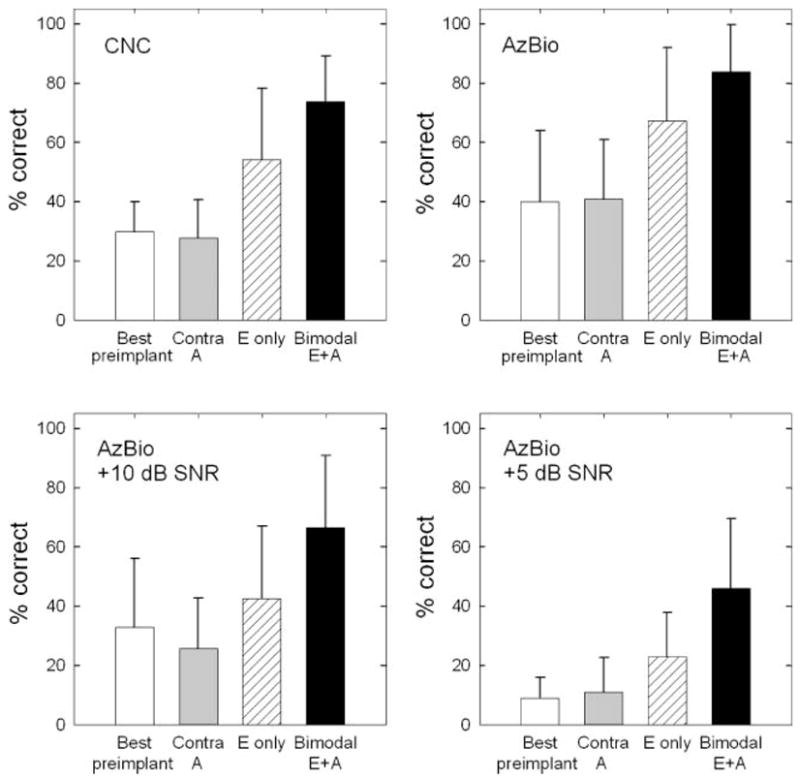
Results: Postoperatively, all individuals achieved higher scores in the electric-only test conditions than they did in the best pre-implant test conditions. All individuals benefited from the addition of low-frequency information to the electric hearing.
Conclusion: A full-insertion cochlear implant provides better speech understanding than bilateral, low-frequency residual hearing. The combination of an implant and contralateral acoustic hearing yields comparable performance to that of patients with a partially inserted implant and bilateral, low-frequency acoustic hearing. These data suggest that a full-insertion cochlear implant is a viable treatment option for patients with low-frequency residual hearing.
Figures
References
-
- Amos NE, Humes LE. The contribution of high frequencies to speech recognition in sensorineural hearing loss. In: Breebaart DJ, Houtsma AJM, Kohlrausch A, Prijs VF, Schoonhoven R, editors. Physiological and psychophysical bases of auditory function. Maastricht, the Netherlands: Shaker; 2001. pp. 437–444.
-
- Armstrong M, Pegg P, James C, Blamey P. Speech perception in noise with implant and hearing aid. American Journal of Otolaryngology. 1997;18:S140–S141. - PubMed
-
- Centers for Medicare and Medicaid Services. Cochlear implantation. Medlearn Matters: Medicare Learning Network. 2005. July 6, (No. MM3796). Retrieved June 6, 2007, from www.cms.hhs.gov/MLNMattersArticles.
-
- Ching TY, Dillon H, Byrne D. Speech recognition of hearing-impaired listeners: Predictions from audibility and the limited role of high-frequency amplification. The Journal of the Acoustical Society of America. 1998;103:1128–1140. - PubMed
-
- Ching TY, Incerti P, Hill M. Binaural benefits for adults who use hearing aids and cochlear implants in opposite ears. Ear and Hearing. 2004;25:9–21. - PubMed
Publication types
MeSH terms
Grants and funding
LinkOut - more resources
Full Text Sources
Medical
Miscellaneous