


Mortality trends in a new South Africa: hard to make a fresh start
- PMID: 17676500
- PMCID: PMC2825807
- DOI: 10.1080/14034950701355668
Mortality trends in a new South Africa: hard to make a fresh start
Abstract
Aims: This paper examines trends in age-specific mortality in a rural South African population from 1992 to 2003, a decade spanning major sociopolitical change and emergence of the HIV/AIDS pandemic. Changing mortality patterns are discussed within a health-transition framework.
Methods: Data on population size, structure, and deaths, obtained from the Agincourt health and demographic surveillance system, were used to calculate person-years at risk and death rates. Life tables were computed by age, sex and calendar year. Mortality rates for the early period 1992-93 and a decade later, 2002-03, were compared.
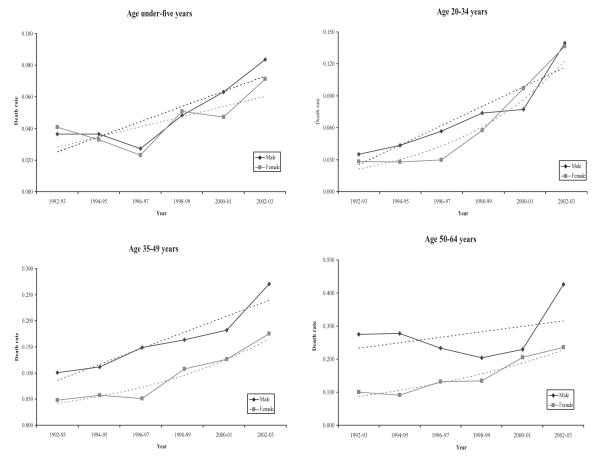
Results: Findings demonstrate significant increases in mortality for both sexes since the mid-1990s, with a rapid decline in life expectancy of 12 years in females and 14 years in males. The increases are most prominent in children (0-4) and young adult (20-49) age groups, in which increases of two- and fivefold respectively have been observed in the past decade. Sex differences in mortality patterns are evident with increases more marked in females in most adult age groups.
Conclusions: Empirical data demonstrate a marked "counter transition" with mortality increasing in children and young adults, "epidemiologic polarization" with vulnerable subgroups experiencing a higher mortality burden, and a "protracted transition" with simultaneous emergence of HIV/AIDS together with increasing non-communicable disease in older adults. The health transition in rural South Africa is unlikely to predict patterns elsewhere; hence the need to examine trends in as many contexts as have the data to support such analyses.
Figures


Comment in
-
Comment: health transitions and regressions in Southern Africa.Scand J Public Health Suppl. 2007 Aug;69:66-7. doi: 10.1080/14034950701359512. Scand J Public Health Suppl. 2007. PMID: 17676505 No abstract available.
References
-
- Beaglehole R, Bonita R. Public health at the crossroads: Achievements and Prospects. 2nd ed Cambridge University Press; Cambridge: 2004.
-
- Murray CJL, Chen LC. Dynamics and patterns of mortality change. In: Chen LC, Kleinman A, Ware NC, editors. Health and social change in international perspective. Harvard University Press; Boston, MA: 1994. pp. 3–23.
-
- Omran AR. The epidemiologic transition: A theory of the epidemiology of population change. Milbank Memorial Fund Q. 1971;49:509–38. - PubMed
-
- Omran AR. Epidemiologic transition. In: Ross JA, editor. International encyclopaedia of population. Free Press; London: 1982. pp. 172–83.
Publication types
MeSH terms
Grants and funding
LinkOut - more resources
Full Text Sources
Miscellaneous