


Returning home to die: circular labour migration and mortality in South Africa
- PMID: 17676501
- PMCID: PMC2825805
- DOI: 10.1080/14034950701355619
Returning home to die: circular labour migration and mortality in South Africa
Abstract
Aim: To examine the hypothesis that circular labour migrants who become seriously ill while living away from home return to their rural homes to convalesce and possibly to die.
Methods: Drawing on longitudinal data collected by the Agincourt health and demographic surveillance system in rural northeastern South Africa between 1995 and 2004, discrete time event history analysis is used to estimate the likelihood of dying for residents, short-term returning migrants, and long-term returning migrants controlling for sex, age, and historical period.
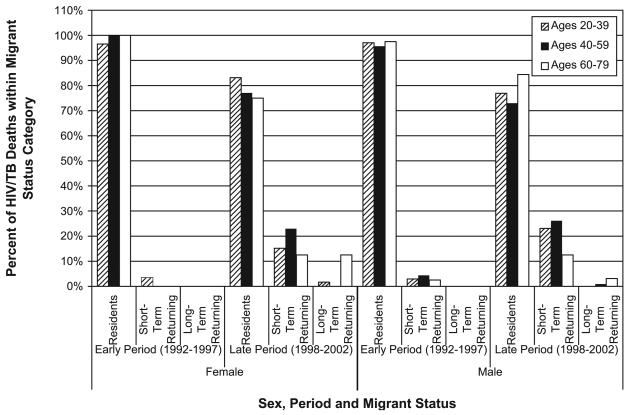
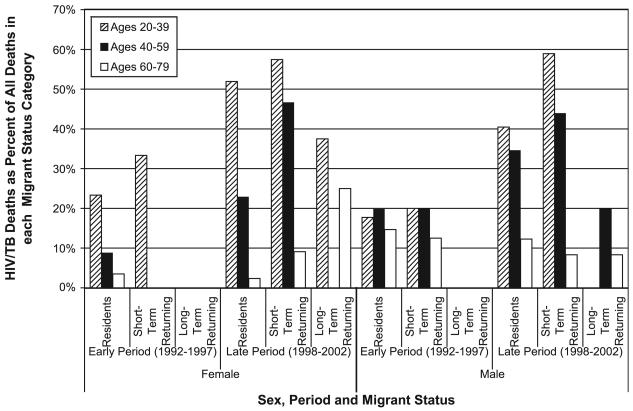
Results: The annual odds of dying for short-term returning migrants are generally 1.1 to 1.9 times (depending on period, sex, and age) higher than those of residents and long-term returning migrants, and these differences are generally highly statistically significant. Further supporting the hypothesis is the fact that the proportion of HIV/TB deaths among short-term returning migrants increases dramatically as time progresses, and short-term returning migrants account for an increasing proportion of all HIV/TB deaths.
Conclusions: This evidence strongly suggests that increasing numbers of circular labour migrants of prime working age are becoming ill in the urban areas where they work and coming home to be cared for and eventually to die in the rural areas where their families live. This shifts the burden of caring for them in their terminal illness to their families and the rural healthcare system with significant consequences for the distribution and allocation of health care resources.
Figures


Comment in
-
Comment: health transitions and regressions in Southern Africa.Scand J Public Health Suppl. 2007 Aug;69:66-7. doi: 10.1080/14034950701359512. Scand J Public Health Suppl. 2007. PMID: 17676505 No abstract available.
References
-
- Crush J, James W. Crossing boundaries: Mine migrancy in a democratic South Africa. Institute for Democracy in South Africa; Johannesburg: 1995.
-
- Lurie M. Migration and AIDS in Southern Africa: A review. S Afr J Sci. 2000:96.
-
- Hallett R. Desolation on the Veld: Forced removals in South Africa. African Affairs. 1984;83:301–20.
-
- Tollman SM, Kark SL, Kark E. The Pholela Health Centre: Understanding health and disease in South Africa through community-oriented primary care. In: Das Gupta M, Aaby P, Garenne M, Pison G, editors. Prospective community studies in developing countries. Clarendon Press; Oxford: 1997.
-
- Gelderblom D, Kok P. Dynamics, vol. 1: Urbanization: South Africa's challenge. HSRC Publishers; Pretoria: 1994.
Publication types
MeSH terms
Grants and funding
LinkOut - more resources
Full Text Sources
Medical