


Fertility trends and net reproduction in Agincourt, rural South Africa, 1992-2004
- PMID: 17676506
- PMCID: PMC2830107
- DOI: 10.1080/14034950701355650
Fertility trends and net reproduction in Agincourt, rural South Africa, 1992-2004
Abstract
Aims: To analyse trends in fertility rates and net reproduction rates in Agincourt, a rural area of South Africa located in the former homeland of Gazankulu near the Mozambican border. Trends are analysed in the context of widely available modern contraceptive methods and increasing HIV/AIDS.
Methods: A health and demographic surveillance system has been in place since 1992, covering a population of approximately 70,000 persons, with an annual census update and comprehensive recording of births and deaths. It was complemented by a retrospective study of fertility at baseline. Retrospective and prospective data were used to calculate trends in fertility, survival, and net reproduction. When possible, they were compared with data from other censuses and surveys in the same ethnic group.
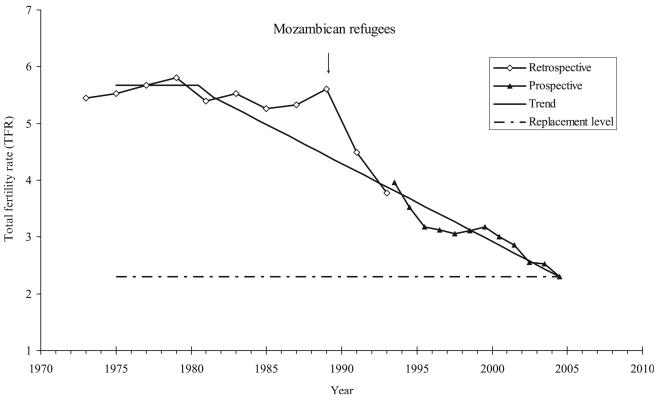
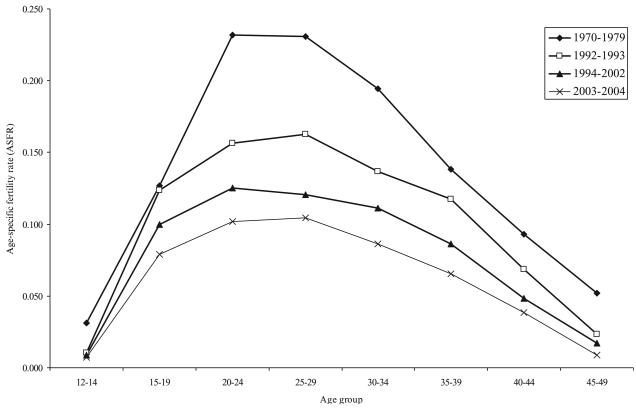
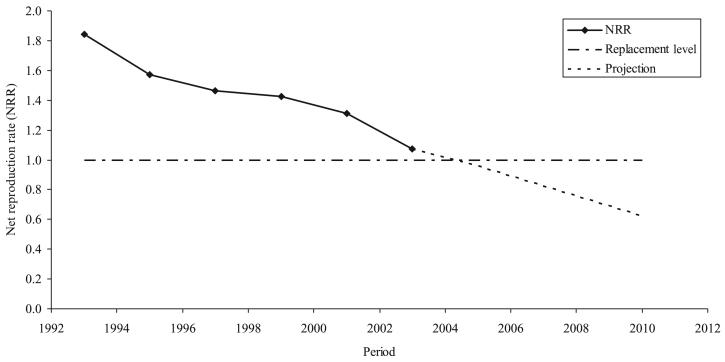
Results: The fertility transition has almost ended over a course of 25 years in Agincourt. The total fertility rate (TFR) averaged 6.0 in 1979 and 2.3 in 2004. Fertility declined in proportionate fashion in all age groups including adolescents in the recent period. The net reproduction rate (NRR) declined from 1.8 to 1.0 during the prospective period (1992-2004). At current rates of change in fertility and mortality, the NRR can be expected to reach 0.63 by the year 2010.
Conclusions: The situation of a below-replacement fertility level is new for rural Africa, and is likely to have many demographic, economic and social implications. The population could decline in the country as a whole, and is nearly static in Agincourt because of negative migration flows balancing the small excess from natural increase.
Figures
Comment in
-
Comment: fertility, mobility, and changing household dynamics in South Africa.Scand J Public Health Suppl. 2007 Aug;69:94-5. doi: 10.1080/14034950701359538. Scand J Public Health Suppl. 2007. PMID: 17676509 No abstract available.
References
-
- Van de Walle E, Foster AD. Fertility decline in Africa: assessment and prospects. World Bank Technical Papers; Washington, DC: 1990. Paper No. 125 (Africa Technical Department Series)
-
- Garenne M, Joseph V. The timing of the fertility transition in sub-Saharan Africa. World Development. 2002;30:1835–43.
-
- Palloni A, van de Walle E, Lamas L, Kephart G, Marcotte J. A model for incorporating the effects of AIDS in population projections. University of Wisconsin-Madison, Center for Demography and Ecology; Madison: 1987. p. 11. (CDE Working Paper 87–37).
-
- Bongaarts J. A model of the spread of HIV infection and the demographic impact of AIDS. Stat Med. 1989;8:103–20. - PubMed
-
- Mostert WP. Demography: Textbook for the South African Student. Human Sciences Research Council; Pretoria: 1998.
Publication types
MeSH terms
Grants and funding
LinkOut - more resources
Full Text Sources