


doi: 10.1080/14034950701355551.
Coping with the cost burdens of illness: combining qualitative and quantitative methods in longitudinal, household research
Affiliations
- PMID: 17676521
- PMCID: PMC2830100
- DOI: 10.1080/14034950701355551
Item in Clipboard
Coping with the cost burdens of illness: combining qualitative and quantitative methods in longitudinal, household research
Scand J Public Health Suppl.
2007 Aug.
Abstract
Over the last 10-15 years, poor African households have had to cope with the burden of increased levels of chronic illness such as HIV/AIDS. How do these households cope with the cost burdens of ill health and healthcare, and has this burden further impoverished them? What policy responses might better support these households? This is a report from the field of the South African Costs and Coping study (SACOCO) - a longitudinal investigation of household experiences in the Agincourt health and demographic surveillance site.
Figures
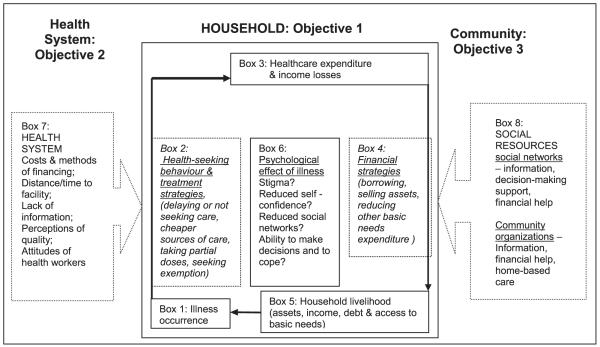
Conceptual framework: Household costs of illness, and coping strategies.
Comment in
-
Comment: healthcare and livelihoods.Scand J Public Health Suppl. 2007 Aug;69:186-7. doi: 10.1080/14034950701359496. Scand J Public Health Suppl. 2007. PMID: 17676522 No abstract available.
References
-
- Abel-Smith B, Rawall P. Can the poor afford ‘free’ health services? A case study of Tanzania. Health Policy and Planning. 1992;7:329–41.
-
- Pryer J. When breadwinners fall ill: Preliminary findings from a case study in Bangladesh. IDS Bull. 1989;20:49–57.
-
- Goudge J, Govender V. A review of experience concerning household ability to cope with the resource demands of ill-health and health care utilisation. Training and Resource Centre; Harare: 2000. (Regional Network for Equity in Health in Southern Africa (EQUINET) Policy Series No. 3).
-
- Davies S. Are coping strategies a cop out? IDS Bull. 1993;24:60–79.
Publication types
MeSH terms
Grants and funding
LinkOut - more resources
Full Text Sources
Medical