


Complexity, connectivity, and duplicability as barriers to lateral gene transfer
- PMID: 17678544
- PMCID: PMC2374987
- DOI: 10.1186/gb-2007-8-8-r156
Complexity, connectivity, and duplicability as barriers to lateral gene transfer
Abstract
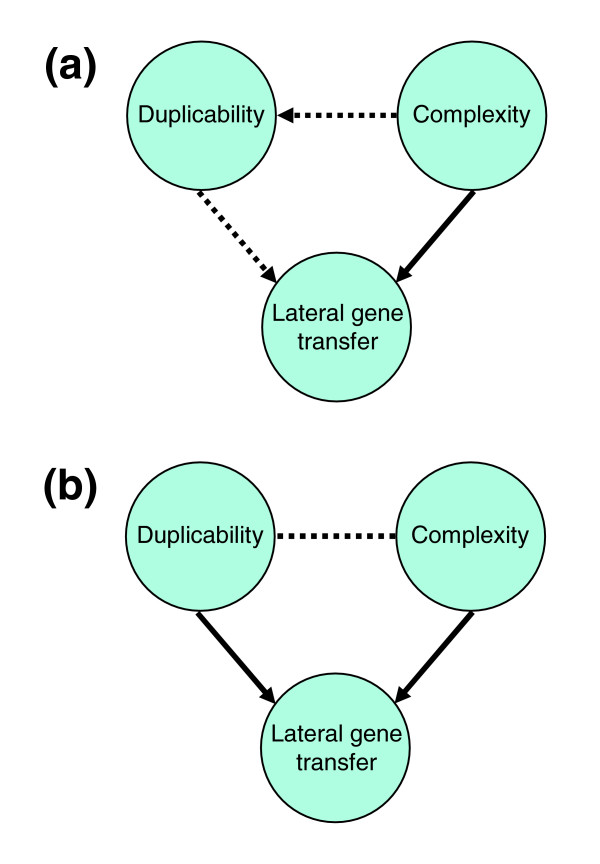
Background: Lateral gene transfer is a major force in microbial evolution and a great source of genetic innovation in prokaryotes. Protein complexity has been claimed to be a barrier for gene transfer, due to either the inability of a new gene's encoded protein to become a subunit of an existing complex (lack of positive selection), or from a harmful effect exerted by the newcomer on native protein assemblages (negative selection).
Results: We tested these scenarios using data from the model prokaryote Escherichia coli. Surprisingly, the data did not support an inverse link between membership in protein complexes and gene transfer. As the complexity hypothesis, in its strictest sense, seemed valid only to essential complexes, we broadened its scope to include connectivity in general. Transferred genes are found to be less involved in protein-protein interactions, outside stable complexes, and this is especially true for genes recently transferred to the E. coli genome. Thus, subsequent to transfer, new genes probably integrate slowly into existing protein-interaction networks. We show that a low duplicability of a gene is linked to a lower chance of being horizontally transferred. Notably, many essential genes in E. coli are conserved as singletons across multiple related genomes, have high connectivity and a highly vertical phylogenetic signal.
Conclusion: High complexity and connectivity generally do not impede gene transfer. However, essential genes that exhibit low duplicability and high connectivity do exhibit mostly vertical descent.
Figures
References
-
- Berg OG, Kurland CG. Evolution of microbial genomes: sequence acquisition and loss. Mol Biol Evol. 2002;19:2265–2276. - PubMed
Publication types
MeSH terms
Substances
LinkOut - more resources
Full Text Sources
