. 2007 Aug 2:8:62.
doi: 10.1186/1471-2202-8-62.

Functional oropharyngeal sensory disruption interferes with the cortical control of swallowing

Affiliations

Functional oropharyngeal sensory disruption interferes with the cortical control of swallowing

Inga K Teismann et al. BMC Neurosci. .

Abstract

Background: Sensory input is crucial to the initiation and modulation of swallowing. From a clinical point of view, oropharyngeal sensory deficits have been shown to be an important cause of dysphagia and aspiration in stroke patients. In the present study we therefore investigated effects of functional oropharyngeal disruption on the cortical control of swallowing. We employed whole-head MEG to study cortical activity during self-paced volitional swallowing with and without topical oropharyngeal anesthesia in ten healthy subjects. A simple swallowing screening-test confirmed that anesthesia caused swallowing difficulties with decreased swallowing speed and reduced volume per swallow in all subjects investigated. Data were analyzed by means of synthetic aperture magnetometry (SAM) and the group analysis of the individual SAM data was performed using a permutation test.

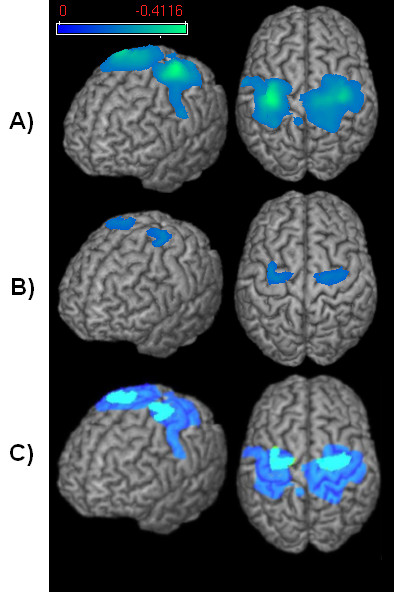
Results: The analysis of normal swallowing revealed bilateral activation of the mid-lateral primary sensorimotor cortex. Oropharyngeal anesthesia led to a pronounced decrease of both sensory and motor activation.

Conclusion: Our results suggest that a short-term decrease in oropharyngeal sensory input impedes the cortical control of swallowing. Apart from diminished sensory activity, a reduced activation of the primary motor cortex was found. These findings facilitate our understanding of the pathophysiology of dysphagia.


Figures
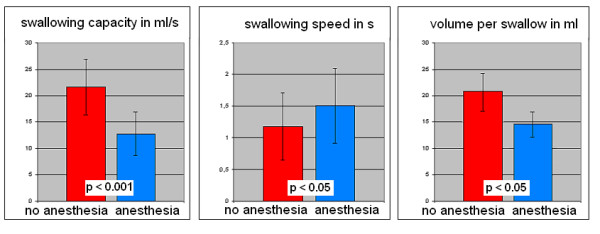
Figure 1
Figure 1
Event-related desynchronisation. Changes in the beta frequency band during the execution phase of a) volitional swallowing and b) pharyngeal anesthesia. The color bar represents the t-value. c) Comparison between ERD in the volitional swallowing [dark blue] and the pharyngeal anesthesia [light blue] condition.
Figure 2
Figure 2
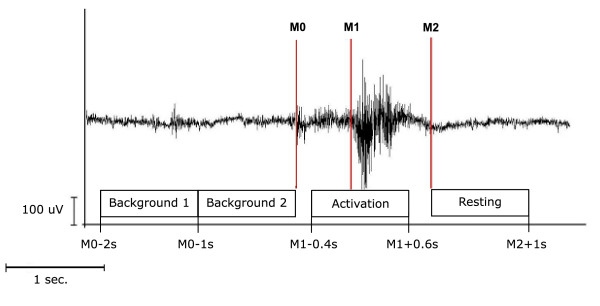
EMG recording and resulting time phases. Definition of active and resting stage of swallowing-related muscle activity. The EMG recording of one swallowing act is shown (surface electrodes, recording from the submental muscles). For the analysis with SAM, the beginning (M1) and the end (M2) of larynx elevation were marked. The activation phase and the corresponding resting phase were defined. To estimate the maximal null distribution a third marker (M0) at the beginning of preparation activity was set and two background phases were defined (Methods).
Figure 3
Figure 3
Swallowing screening test. Comparison between the two conditions (swallowing with and without topical anesthesia) in the swallowing screening-test. The screening-test reveals a significant decrease in swallowing capacity and volume per swallow and increase in swallowing speed after anesthesia was performed.

References

    1. Jean A, Car A, Roman C. Comparison of activity in pontine versus medullary neurones during swallowing. Exp Brain Res. 1975;22:211–220. doi: 10.1007/BF00237690. - DOI - PubMed
    1. Mansson I, Sandberg N. Effects of surface anesthesia on deglutition in man. Laryngoscope. 1974;84:427–437. doi: 10.1288/00005537-197403000-00006. - DOI - PubMed
    1. Mansson I, Sandberg N. Oro-pharyngeal sensitivity and elicitation of swallowing in man. Acta Otolaryngol. 1975;79:140–145. - PubMed
    1. Mansson I, Sandberg N. Salivary stimulus and swallowing reflex in man. Acta Otolaryngol. 1975;79:445–450. - PubMed
    1. Miller AJ. Significance of sensory inflow to the swallowing reflex. Brain Res. 1972;43:147–159. doi: 10.1016/0006-8993(72)90280-6. - DOI - PubMed

Publication types

MeSH terms

Substances