


Temporal summation of second pain and its maintenance are useful for characterizing widespread central sensitization of fibromyalgia patients
- PMID: 17681887
- PMCID: PMC2174917
- DOI: 10.1016/j.jpain.2007.06.006
Temporal summation of second pain and its maintenance are useful for characterizing widespread central sensitization of fibromyalgia patients
Abstract
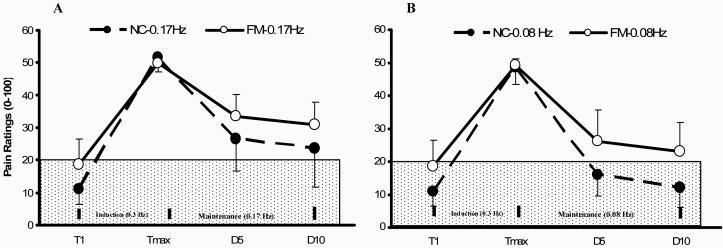
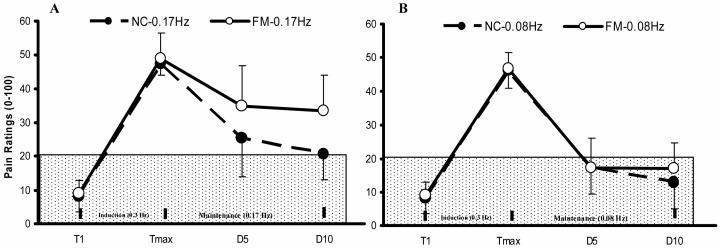
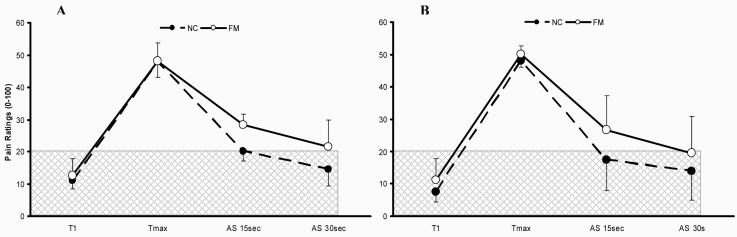
Temporal summation of second pain (TSSP) results from repetitive stimulation of peripheral C-fibers (>0.33 Hz) and is thought to reflect summation mechanisms of dorsal horn neurons (ie, windup). Both TSSP and windup result in short term enhancement of C fiber-evoked responses that decay rapidly after the end of stimulation. However, very low stimulus frequencies (0.17 to 0.08 Hz) can maintain this enhancement after TSSP and windup have occurred. This maintained enhancement is termed TSSP-maintenance (TSSP-M) and is indicative of central sensitization. TSSP-M may be especially relevant for chronic pain conditions such as fibromyalgia (FM) and may play an important role in its pathogenesis. Whereas TSSP-M of heat induced pain is well-characterized in human subjects at spinal cord levels related to the upper body, TSSP-M at spinal levels related to the lower body has not been previously studied. The present study was designed to evoke TSSP-M at the upper and lower extremities of normal controls (NC) and FM patients and thus characterize their spatial distribution of central sensitization. Twenty-three NC and 26 FM patients were enrolled in this study. TSSP-M testing consisted of repetitive heat pain stimulation at the thenar eminences of the hands or feet. The subjects rated the pain intensity of repetitive heat stimuli as well as 15- and 30-second pain aftersensations. The experiments demonstrated significant TSSP-M for both NC and FM patients. In contrast to NC, TSSP-M ratings of heat stimuli were increased in FM patients and their TSSP-aftersensations (TSSP-AS) were prolonged. There was, however, no statistical difference between TSSP-M ratings or TSSP-AS at the hands or feet in either NC or FM patients. These findings demonstrate that central sensitization of FM patients is widespread and similar along the spinal neuroaxis.
Perspective: The pain of FM seems to be accompanied by generalized central sensitization, involving the length of the spinal neuroaxis. Thus, widespread central sensitization appears to be a hallmark of FM and may be useful for the clinical case definition of this prevalent pain syndrome. In addition, measures of widespread central sensitization, like TSSP-M could also be used to assess treatment responses of FM patients.
Figures
References
-
- Arendt-Nielsen L. In: Jensen TS, Turner JA, Wiesenfeld-Hallin Z, editors. Induction and assessment of experimental pain from human skin, muscle, and viscera; Proceedings of the 8th World Congress on Pain; Seattle, IASP Press. 1997.pp. 393–425.
-
- Bajaj P, Bajaj P, Graven-Nielsen T, Arendt-Nielsen L. Osteoarthritis and its association with muscle hyperalgesia: an experimental controlled study. Pain. 2001;93:107–114. - PubMed
-
- Banic B, Petersen-Felix S, Andersen OK, Radanov BP, Villiger PM, Arendt-Nielsen L, Curatolo M. Evidence for spinal cord hypersensitivity in chronic pain after whiplash injury and in fibromyalgia. Pain. 2004;107:7–15. - PubMed
-
- Bendtsen L, Jensen R, Olesen J. Decreased pain detection and tolerance thresholds in chronic tension-type headache. Arch Neurol. 1996;53:373–376. - PubMed
-
- Campbell JN, LaMotte RH. Latency to detection of first pain. Brain Res. 1983;266:203–208. - PubMed
Publication types
MeSH terms
Grants and funding
LinkOut - more resources
Full Text Sources
Medical
Research Materials
