


Glycogen synthase kinase 3 alpha and 3 beta have distinct functions during cardiogenesis of zebrafish embryo
- PMID: 17683539
- PMCID: PMC1988812
- DOI: 10.1186/1471-213X-7-93
Glycogen synthase kinase 3 alpha and 3 beta have distinct functions during cardiogenesis of zebrafish embryo
Abstract
Background: Glycogen synthase kinase 3 (GSK3) encodes a serine/threonine protein kinase, is known to play roles in many biological processes. Two closely related GSK3 isoforms encoded by distinct genes: GSK3alpha (51 kDa) and GSK3beta (47 kDa). In previously studies, most GSK3 inhibitors are not only inhibiting GSK3, but are also affecting many other kinases. In addition, because of highly similarity in amino acid sequence between GSK3alpha and GSK3beta, making it difficult to identify an inhibitor that can be selective against GSK3alpha or GSK3beta. Thus, it is relatively difficult to address the functions of GSK3 isoforms during embryogenesis. At this study, we attempt to specifically inhibit either GSK3alpha or GSK3beta and uncover the isoform-specific roles that GSK3 plays during cardiogenesis.
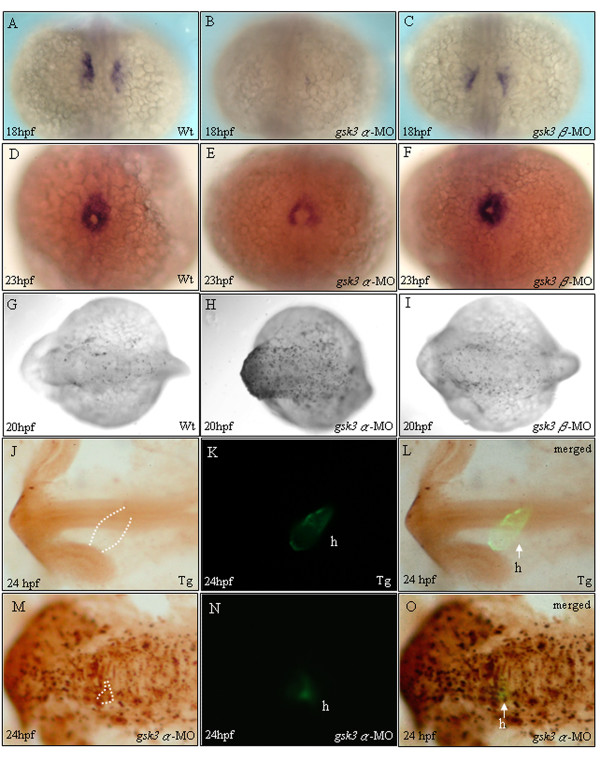
Results: We blocked gsk3alpha and gsk3beta translations by injection of morpholino antisense oligonucleotides (MO). Both gsk3alpha- and gsk3beta-MO-injected embryos displayed similar morphological defects, with a thin, string-like shaped heart and pericardial edema at 72 hours post-fertilization. However, when detailed analysis of the gsk3alpha- and gsk3beta-MO-induced heart defects, we found that the reduced number of cardiomyocytes in gsk3alpha morphants during the heart-ring stage was due to apoptosis. On the contrary, gsk3beta morphants did not exhibit significant apoptosis in the cardiomyocytes, and the heart developed normally during the heart-ring stage. Later, however, the heart positioning was severely disrupted in gsk3beta morphants. bmp4 expression in gsk3beta morphants was up-regulated and disrupted the asymmetry pattern in the heart. The cardiac valve defects in gsk3beta morphants were similar to those observed in axin1 and apcmcr mutants, suggesting that GSK3beta might play a role in cardiac valve development through the Wnt/beta-catenin pathway. Finally, the phenotypes of gsk3alpha mutant embryos cannot be rescued by gsk3beta mRNA, and vice versa, demonstrating that GSK3alpha and GSK3beta are not functionally redundant.
Conclusion: We conclude that (1) GSK3alpha, but not GSK3beta, is necessary in cardiomyocyte survival; (2) the GSK3beta plays important roles in modulating the left-right asymmetry and affecting heart positioning; and (3) GSK3alpha and GSK3beta play distinct roles during zebrafish cardiogenesis.
Figures




References
-
- Plyte SE, Hughes K, Nikolakaki E, Pulverer BJ, Woodgett JR. Glycogen synthase kinase-3: functions in oncogenesis and development. Biochim Biophys Acta. 1992;1114:147–162. - PubMed
-
- van Amerongen R, Berns A. Re-evaluating the role of Frat in Wnt-signal transduction. Cell Cycle. 2005;4:1065–1072. - PubMed
-
- Woodgett JR. cDNA cloning and properties of glycogen synthase kinase-3. Methods Enzymol. 1991;200:564–577. - PubMed
Publication types
MeSH terms
Substances
LinkOut - more resources
Full Text Sources
Molecular Biology Databases
