


Adaptive specialization, conditional plasticity and phylogenetic history in the reproductive cue response systems of birds
- PMID: 17686737
- PMCID: PMC2606750
- DOI: 10.1098/rstb.2007.2139
Adaptive specialization, conditional plasticity and phylogenetic history in the reproductive cue response systems of birds
Abstract
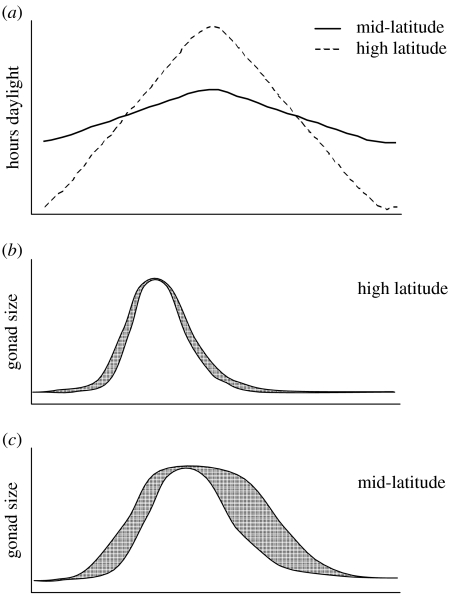
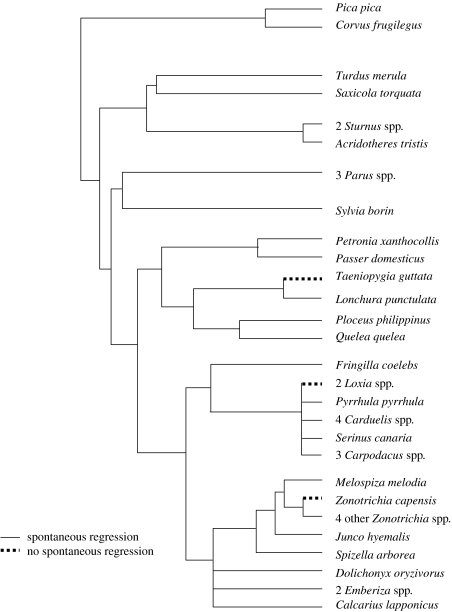
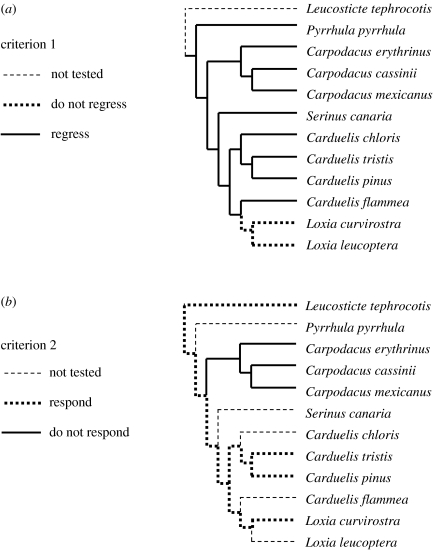
Appropriately timed integration of breeding into avian annual cycles is critical to both reproductive success and survival. The mechanisms by which birds regulate timing of breeding depend on environmental cue response systems that regulate both when birds do and do not breed. Despite there being multiple possible explanations for birds' abilities to time breeding appropriately in different environments, and for the distribution of different cue response system characteristics among taxa, many studies infer that adaptive specialization of cue response systems has occurred without explicitly considering the alternatives. In this paper, we make explicit three hypotheses concerning the timing of reproduction and distribution of cue response characteristics among taxa: adaptive specialization; conditional plasticity; and phylogenetic history. We emphasize in particular that although conditional plasticity built into avian cue response systems (e.g. differing rates of gonadal development and differing latencies until onset of photorefractoriness) may lead to maladaptive annual cycles in some novel circumstances, this plasticity also can lead to what appear to be adaptively specialized cue response systems if not viewed in a comparative context. We use a comparative approach to account for the distribution of one important feature of avian reproductive cue response systems, photorefractoriness. Analysis of the distribution within songbirds of one criterion for absolute photorefractoriness, the spontaneous regression of the gonads without any decline in photoperiod, reveals that a failure to display this trait probably represents an adaptive specialization to facilitate a flexible reproductive schedule. More finely resolved analysis of both criteria for absolute photorefractoriness (the second being total lack of a reproductive response even to constant light after gonadal regression has occurred) within the cardueline finches not only provides further confirmation of this interpretation, but also indicates that these two criteria for photorefractoriness can be, and have been, uncoupled in some taxa. We suggest that careful comparative studies at different phylogenetic scales will be extremely valuable for distinguishing between adaptive specialization and non-adaptive explanations, such as phylogenetic history as explanations of cue response traits in particular taxa. We also suggest that particular focus on taxa in which individuals may breed on very different photoperiods (latitudes or times of year) in different years should be particularly valuable in identifying the range of environmental conditions across which conditionally plastic cue responses can be adaptive.
Figures
References
-
- Adkisson C.S. Red crossbill (Loxia curvirostra) In: Poole A, Gill F, editors. The birds of North America. vol. 256. The Academy of Natural Sciences; The American Ornithologists'Union; Philadelphia, PA; Washington, DC: 1996. pp. 1–24.
-
- Arnaiz-Villena A, Guillen J, Ruiz-del-Valle V, Lowy E, Zamora J, Varela P, Stefani D, Allende L.M. Phylogeography of crossbills, bullfinches, grosbeaks, and rosefinches. Cell. Mol. Life Sci. 2001;58:1159–1166. doi:10.1007/PL00000930 - DOI - PMC - PubMed
-
- Badyaev A.V. Avian life history variation along altitudinal gradients: an example with cardueline finches. Oecologia. 1997;111:365–374. doi:10.1007/s004420050247 - DOI - PubMed
-
- Baker J.R. The evolution of breeding seasons. In: DeBeer G.B, editor. Evolution: essays on aspects of evolutionary biology. Clarendon Press; Oxford, UK: 1938. pp. 161–177.
-
- Ball G.F. The neural integration of environmental information by seasonally breeding birds. Am. Zool. 1993;33:185–199.
Publication types
MeSH terms
LinkOut - more resources
Full Text Sources
