


Epigenetic specificity of loss of imprinting of the IGF2 gene in Wilms tumors
- PMID: 17686827
- PMCID: PMC5533193
- DOI: 10.1093/jnci/djm069
Epigenetic specificity of loss of imprinting of the IGF2 gene in Wilms tumors
Abstract
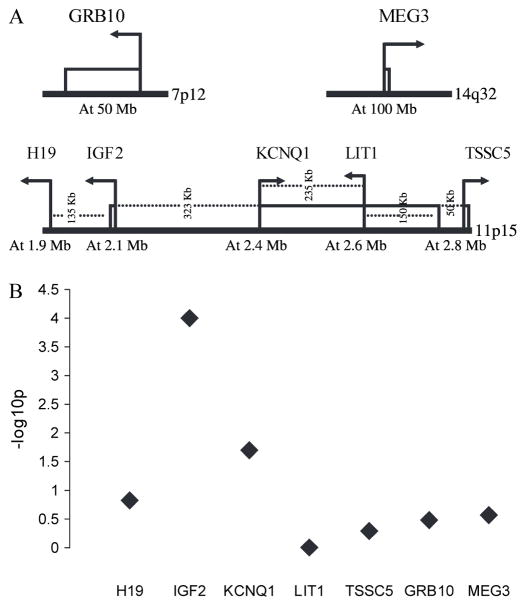
Loss of imprinting (LOI) of the IGF2 gene (which encodes insulin-like growth factor II) is the most common genetic or epigenetic alteration in Wilms tumor; LOI involves aberrant activation of the normally repressed maternally inherited allele. We found previously that LOI of IGF2 occurs in approximately half of all Wilms tumors (i.e., those arising from lineage-committed nephrogenic progenitor cells). We investigated whether LOI of IGF2 is associated with relaxation of imprinting at loci other than IGF2 or with widespread alterations in DNA methylation. We stratified 59 Wilms tumor samples by IGF2 LOI status by use of hot-stop reverse transcription-polymerase chain reaction and/or methylation analysis of the differentially methylated region of the H19 gene and identified 31 samples with and 28 without LOI. We used quantitative allele-specific expression analysis to determine whether six other imprinted genes (i.e., H19, KCNQ1, LIT1, TSSC5, GRB10, and MEG3) had subtle LOI. No statistically significant difference in allele-specific expression between Wilms tumor with or without LOI was found for LIT1, TSSC5, GRB10, and MEG3. For the KCNQ1 gene there was a slight difference between the groups with (37.0%, 95% confidence interval [CI] = 31.8% to 42.2%) and without (27.7%, 95% CI = 21.8% to 33.5%) LOI (P = .02 for F test of group differences in a mixed-effects model). For H19, we also found a slight difference between the groups with (7.5%, 95% CI = 2.4% to 12.7%) and without (2.2%, 95% CI = -3.2% to 7.6%) LOI of IGF2 (P = .15 for F test). In 27 tumor samples, we also used a microarray technique to analyze methylation of 378 genes, 38 of which were suspected or confirmed imprinted genes. We found that statistically significant alterations in only the differentially methylated region of the H19 gene were associated with LOI of IGF2. Thus, epigenetic alterations in Wilms tumors are not widespread, supporting the gene and lineage specificity of LOI of IGF2.
Figures
References
-
- Feinberg AP. Genomic imprinting and gene activation in cancer. Nat Genet. 1993;4:110–3. - PubMed
-
- Rainier S, Johnson LA, Dobry CJ, Ping AJ, Grundy PE, Feinberg AP. Relaxation of imprinted genes in human cancer. Nature. 1993;362:747–9. - PubMed
-
- Ogawa O, Eccles MR, Szeto J, McNoe LA, Yun K, Maw MA, et al. Relaxation of insulin-like growth factor II gene imprinting implicated in Wilms’ tumour. Nature. 1993;362:749–51. - PubMed
-
- Feinberg AP. The epigenetics of cancer etiology. Semin Cancer Biol. 2004;14:427–32. - PubMed
-
- Beckwith JB, Kiviat NB, Bonadio JF. Nephrogenic rests, nephroblastomatosis, and the pathogenesis of Wilms’ tumor. Pediatr Pathol. 1990;10:1–36. - PubMed
Publication types
MeSH terms
Substances
Grants and funding
LinkOut - more resources
Full Text Sources
Other Literature Sources
Medical
Miscellaneous
