Clinical Trial
. 2007 Oct;81(20):11016-31.
doi: 10.1128/JVI.01340-07. Epub 2007 Aug 8.

Adjunctive passive immunotherapy in human immunodeficiency virus type 1-infected individuals treated with antiviral therapy during acute and early infection

Affiliations
Clinical Trial

Adjunctive passive immunotherapy in human immunodeficiency virus type 1-infected individuals treated with antiviral therapy during acute and early infection

Saurabh Mehandru et al. J Virol. 2007 Oct.

Abstract

Three neutralizing monoclonal antibodies (MAbs), 2G12, 2F5, and 4E10, with activity in vitro and in vivo were administered in an open-label, nonrandomized, proof-of-concept study to attempt to prevent viral rebound after interruption of antiretroviral therapy (ART). Ten human immunodeficiency virus type 1-infected individuals identified and treated with ART during acute and early infection were enrolled. The first six patients were administered 1.0 g of each of the three MAbs per infusion. The remaining four patients received 2G12 at 1.0 g/infusion and 2.0 g/infusion of 2F5 and 4E10. The MAbs were well tolerated. Grade I post-partial thromboplastin time prolongations were noted. Viral rebound was observed in 8/10 subjects (28 to 73 days post-ART interruption), and 2/10 subjects remained aviremic over the course of the study. In seven of eight subjects with viral rebound, clear resistance to 2G12 emerged, whereas reductions in the susceptibilities of plasma-derived recombinant viruses to 2F5 and 4E10 were neither sustained nor consistently measured. Viral rebound was associated with a preferential depletion of CD4(+) T cells within the gastrointestinal tract. Though safe, the use of MAbs generally delayed, but did not prevent, virologic rebound. Consideration should be given to further pilot studies with alternative combinations of MAbs and perhaps additional novel treatment modalities.


Figures

FIG. 1.
FIG. 1.
Virologic and immunologic profiles of the 10 study subjects. The viral loads (purple circles) and CD4+ T-cell counts (blue squares), both represented on the y axis, are plotted over time (x axis) for each study subject. The yellow shaded areas represent the periods during which patients received MAb infusions, and the orange lines depict the day of ART discontinuation. Three subjects with early viral rebound requiring MAb discontinuation are shown in the top row, four subjects with intermediate viral rebound are shown in the middle row, and the three subjects with prolonged control of plasma viremia in the absence of ART are shown in the bottom row.
FIG. 2.
FIG. 2.
Initial doubling times of rebounding plasma virus. Shown are the plasma viral loads (y axis) before and after virologic rebound (x axis) in eight study subjects. Linear regression analysis assuming first-order kinetics was used to calculate the initial doubling times of virus rebound in plasma, as previously published (33). T2, initial doubling time.
FIG. 3.
FIG. 3.
Plasma concentration of each of the three MAbs. The concentration of each of the three MAbs—2G12 (green), 2F5 (purple), and 4E10 (orange)—were measured 0.5 hour postinfusion (peak levels) and 7 days later, prior to the next infusion (trough levels). (A) The first six subjects received 1 g/infusion of each of the three MAbs. (B) In the last four subjects, the doses of 2F5 and 4E10 were increased to 2 g/infusion as described in the text. MAb levels (μg/ml) are represented on the y axis and are plotted over time in days (shown on the x axis).
FIG. 4.
FIG. 4.
Neutralization profiles of patient-derived virus at baseline and after rebound. Using a recombinant-virus assay (43), the susceptibilities of baseline and rebounding virus to the three MAbs (measured in μg/ml) (shown on the y axis) were followed over time in days (x axis) in eight study subjects with rebound viremia. The range of susceptibility is shown by the arrows; values above 50 μg/ml were considered resistant and for the sake of illustration were plotted as 60 μg/ml.
FIG. 5.
FIG. 5.
HIV-1 Env amino acid sequences in rebounding plasma HIV-1. Full-length envelope sequencing was performed on plasma-derived HIV-1 prior to and after rebound. Sequences from each patient were aligned with the reference strain HXB2, and changes at N-linked glycosylation sites known to result in reduced susceptibility to 2G12 (49) are highlighted in red.
FIG. 6.
FIG. 6.
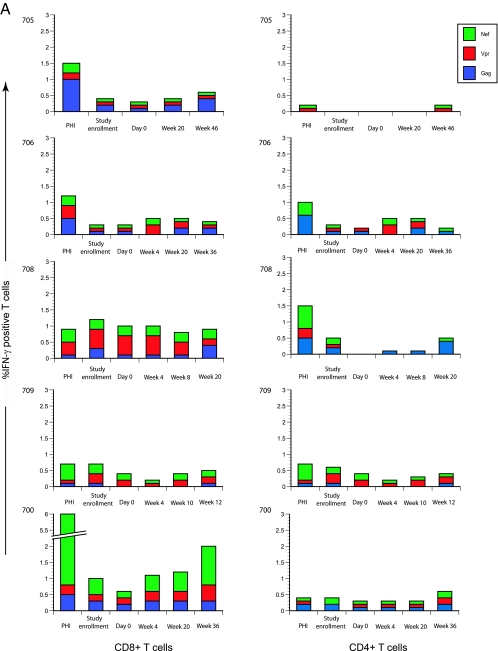
Cellular immune responses at acute and early HIV-1 infection and during the course of study. (A) Five representative subjects were chosen, and CD4+ and CD8+ T-cell responses to pooled peptides representing GAG, VPR, and NEF from HIV-1 clade B were measured. The percentages of IFN-γ-producing cells (y axis) are plotted at sequential time points (x axis). (B) In subject 706, CD4+ and CD8+ T-cell responses were compared between the peripheral blood and GI tract (x axis), and the percentages of cytokine-producing cells (depicted on the y axis) were examined.
FIG. 6.
FIG. 6.
Cellular immune responses at acute and early HIV-1 infection and during the course of study. (A) Five representative subjects were chosen, and CD4+ and CD8+ T-cell responses to pooled peptides representing GAG, VPR, and NEF from HIV-1 clade B were measured. The percentages of IFN-γ-producing cells (y axis) are plotted at sequential time points (x axis). (B) In subject 706, CD4+ and CD8+ T-cell responses were compared between the peripheral blood and GI tract (x axis), and the percentages of cytokine-producing cells (depicted on the y axis) were examined.

References

    1. Armbruster, C., G. M. Stiegler, B. A. Vcelar, W. Jager, U. Koller, R. Jilch, C. G. Ammann, M. Pruenster, H. Stoiber, and H. W. Katinger. 2004. Passive immunization with the anti-HIV-1 human monoclonal antibody (hMAb) 4E10 and the hMAb combination 4E10/2F5/2G12. J. Antimicrob. Chemother. 54:915-920. - PubMed
    1. Armbruster, C., G. M. Stiegler, B. A. Vcelar, W. Jager, N. L. Michael, N. Vetter, and H. W. Katinger. 2002. A phase I trial with two human monoclonal antibodies (hMAb 2F5, 2G12) against HIV-1. AIDS 16:227-233. - PubMed
    1. Binley, J. M., T. Wrin, B. Korber, M. B. Zwick, M. Wang, C. Chappey, G. Stiegler, R. Kunert, S. Zolla-Pazner, H. Katinger, C. J. Petropoulos, and D. R. Burton. 2004. Comprehensive cross-clade neutralization analysis of a panel of anti-human immunodeficiency virus type 1 monoclonal antibodies. J. Virol. 78:13232-13252. - PMC - PubMed
    1. Boden, D., A. Hurley, L. Zhang, Y. Cao, Y. Guo, E. Jones, J. Tsay, J. Ip, C. Farthing, K. Limoli, N. Parkin, and M. Markowitz. 1999. HIV-1 drug resistance in newly infected individuals. JAMA 282:1135-1141. - PubMed
    1. Bozzette, S. A., G. Joyce, D. F. McCaffrey, A. A. Leibowitz, S. C. Morton, S. H. Berry, A. Rastegar, D. Timberlake, M. F. Shapiro, D. P. Goldman, and the H I V Cost and Services Utilization Study Consortium. 2001. Expenditures for the care of HIV-infected patients in the era of highly active antiretroviral therapy. N. Engl. J. Med. 344:817-823. - PubMed

Publication types