. 2007 Nov 14;573(1-3):124-32.
doi: 10.1016/j.ejphar.2007.06.063. Epub 2007 Jul 24.

Nicotinic and dopamine D2 receptors mediate nicotine-induced changes in ventral tegmental area neurotensin system

Affiliations

Nicotinic and dopamine D2 receptors mediate nicotine-induced changes in ventral tegmental area neurotensin system

Mario E Alburges et al. Eur J Pharmacol. .

Abstract

Neuropeptides have been implicated in the psychopathology of stimulants of abuse. Neurotensin is a neuropeptide associated with the regulation of the nigrostriatal and mesolimbic dopamine pathways. In addition, the ventral tegmental area, a midbrain region implicated in the rewarding effects of most, if not all, addictive drugs, appears to be a particularly critical target for nicotine action. Because neurotensin has been linked with both mesolimbic and mesocortical dopamine function, we examined the impact of nicotine treatment on central nervous neurotensin systems by measuring changes in neurotensin tissue content because it has been shown that such changes reflect alterations in release and activity of this peptide system. Male Sprague-Dawley rats received multiple administrations of (+/-) nicotine 4.0 mg/kg/day (0.8 mg/kg, i.p.; 5 x 2-h intervals) in the presence or absence of selective dopamine receptor antagonists (dopamine D(1); SCH 23390 or dopamine D(2); eticlopride) or two doses of the non-selective nicotinic acetylcholine receptor antagonist (mecamylamine; 3.0 and 6.0 mg/kg, s.c.). The nicotine treatment significantly decreased neurotensin-like immunoreactivity content in the ventral tegmental area, as well as related regions such as prefrontal cortex, substantia nigra, and anterior striatal region 12-18 h after drug treatment, but not the nucleus accumbens. The nicotine-mediated decrease in the neurotensin-like immunoreactivity of the ventral tegmental area was selectively blocked by a specific dopamine D(2), but not a dopamine D(1), receptor antagonist, while mecamylamine attenuated at the low (3.0 mg/kg) and completely blocked at high (6.0 mg/kg) dose this nicotine effect. These findings with previous studies, suggest that nicotine-mediated dopamine release activates D(2) receptors which in turn increases neurotensin release, turnover and acutely reduces tissue levels in the ventral tegmental area and other limbic and basal ganglia structures.


Figures
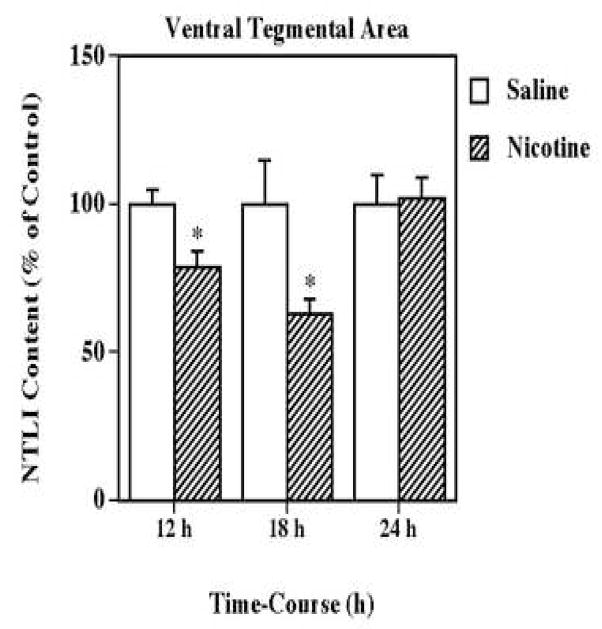
Figure 1
Figure 1
Time-dependent effects of nicotine on neurotensin-like immunoreactivity (NTLI) content in the ventral tegmental area. Animals were administered 5 injections of (±) nicotine (0.8 mg/kg/injection, i.p., 2-h intervals) or saline and killed 12, 18 or 24 h following treatment. Results are expressed as percentages of control and represent mean values ± S.E.M. (n= 8 control and 9 drug-treated animals per group). The average control value of NTLI concentration was 490 ± 36 pg/mg protein. *P < 0.05 vs. control.
Figure 2
Figure 2
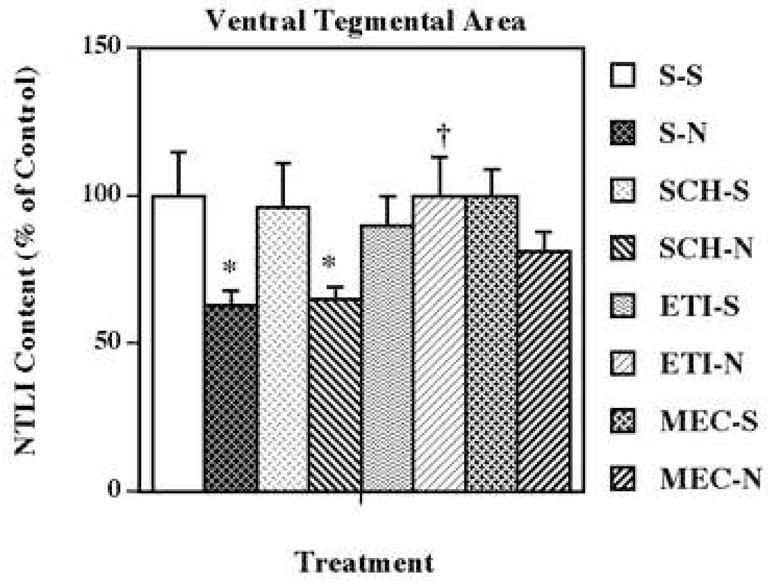
Effects of selective dopamine receptor and nicotinic acetylcholine receptor antagonists on nicotine-induced changes in neurotensin-like immunoreactivity (NTLI) content in the ventral tegmental area. Animals were given 5 administrations of (±) nicotine (N; 0.8 mg/kg/injection, i.p., 2-h intervals) or saline (S; control), alone or 15 min after administration of SCH 23390 (SCH; dopamine D1 receptor antagonist; 0.5 mg/kg/injection, i.p.), eticlopride (ETI; dopamine D2 receptor antagonist; 0.5 mg/kg/injection, i.p.), or mecamylamine (MEC; nicotinic acetylcholine receptor antagonist; 3.0 mg/kg/injection, s.c.). Animals were killed 18 h following the last treatment. Values represent the means ± S.E.M. expressed as percentages of control (n= 8 control and 9 drug-treated animals per group). The control value ± S.E.M. for NTLI concentrations (pg/mg protein) was 403 ± 65. *P < 0.05 vs. saline control; †P < 0.05 vs. corresponding nicotine group.
Figure 3
Figure 3
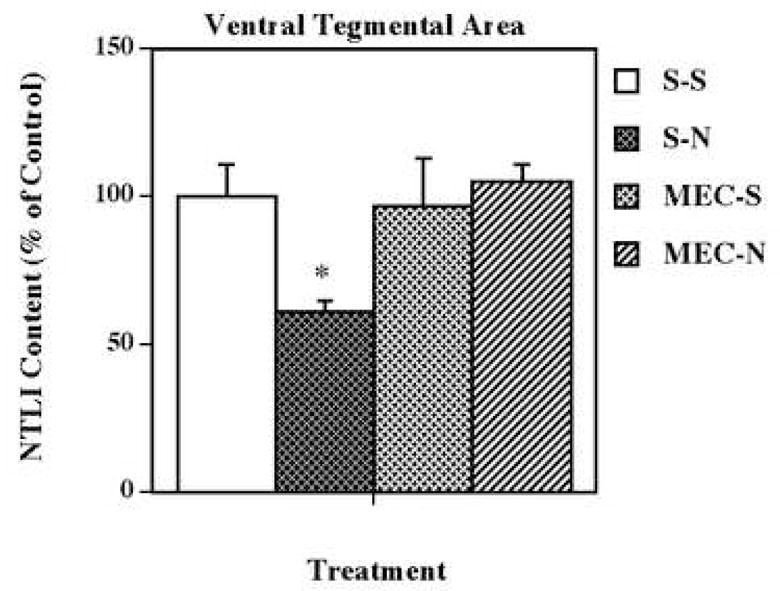
Effects of a high dose of mecamylamine on nicotine-induced changes in neurotensin-like immunoreactivity (NTLI) content in the ventral tegmental area. Animals were given 5 administrations of (±) nicotine (N; 0.8 mg/kg/injection, i.p., 2-h intervals) or saline (S; control), alone or 15 min after administration of the nicotinic antagonist mecamylamine (MEC; 6.0 mg/kg/injection, s.c.). Animals were killed 18 h following the last treatment. Values represent the means ± S.E.M. expressed as percentages of control (n= 8 or 9 in the control or drug-treated animals, respectively). The control value ± S.E.M. for NTLI concentrations (pg/mg protein) was 578 ± 62. *P < 0.05 vs. all other groups.
Figure 4
Figure 4
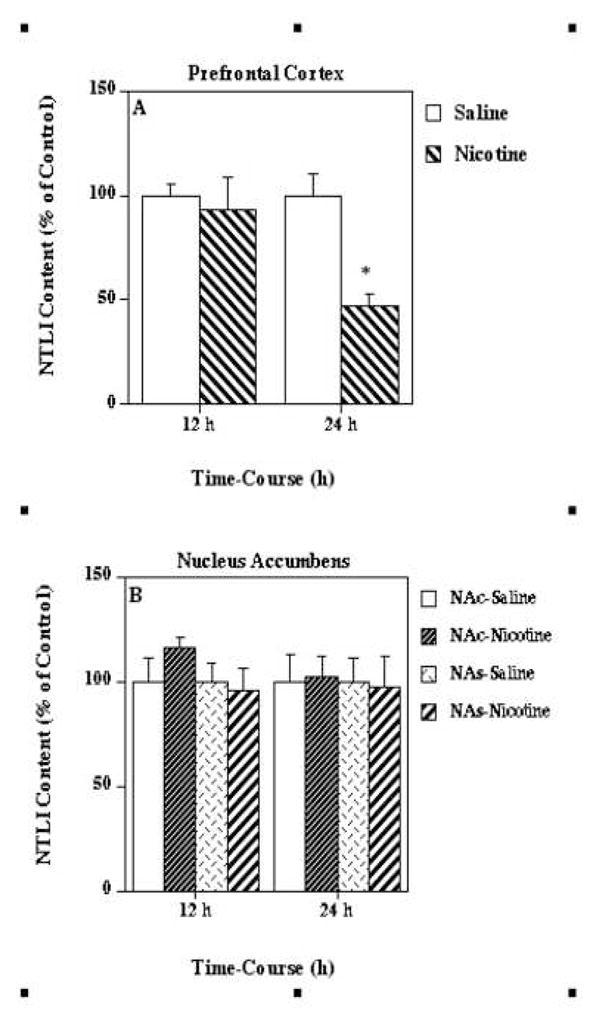
Effects of nicotine on neurotensin-like immunoreactivity (NTLI) levels in ventral tegmental area-related brain regions such as the prefrontal cortex (Fig. 4A) and the nucleus accumbens [core (NAc) and shell (NAs); Fig. 4B]. Animals were given injections of nicotine (as described for Fig. 1) or saline and killed 12 and 24 h following the treatment. Results are expressed as percentages of control and represent mean values ± S.E.M. (n= 8 control and 9 drug-treated animals per group). The average control values of NTLI concentrations for prefrontal cortex, NAs, and NAc were 37 ± 6 pg/mg protein, 270 ± 21 pg/mg protein, and 408 ± 26 pg/mg protein, respectively. *P < 0.05 vs. control.
Figure 5
Figure 5
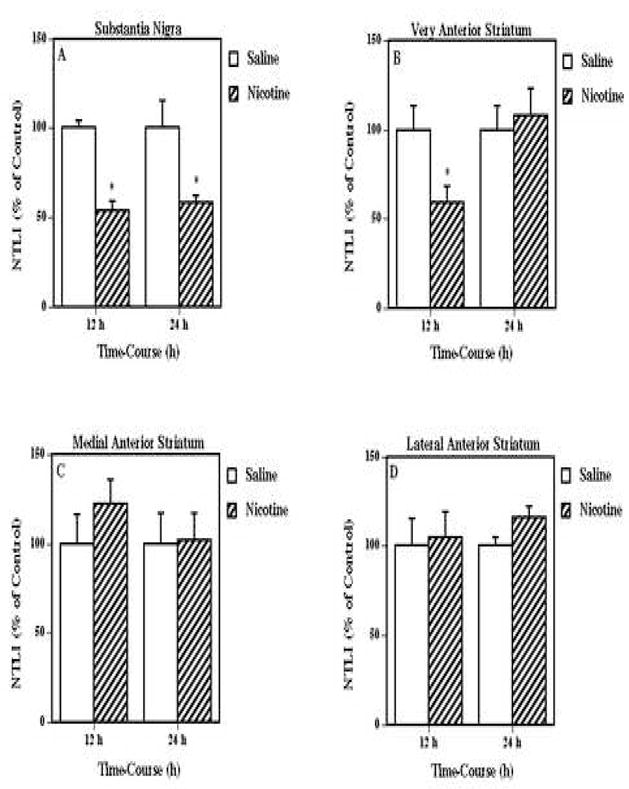
Effects of nicotine on neurotensin-like immunoreactivity (NTLI) content in other dopamine-related systems such as the substantia nigra (Fig. 5A), very anterior striatum (Fig. 5B), medial anterior striatum (Fig. 5C), and lateral anterior striatum (Fig. 5D). Animals were given injections of nicotine (as described for Fig. 1) or saline and killed 12 and 24 h following the treatment. Results are expressed as percentages of control and represent mean values ± S.E.M. (n= 8 control and 9 drug-treated animals per group). The average control values of NTLI concentrations for substantia nigra, very anterior striatum, medial anterior striatum, and lateral anterior striatum were 545 ± 60 pg/mg protein, 114 ± 12 pg/mg protein, 158 ± 17 pg/mg protein, and 80 ± 4 pg/mg protein, respectively. *P < 0.05 vs. control.
Figure 6
Figure 6
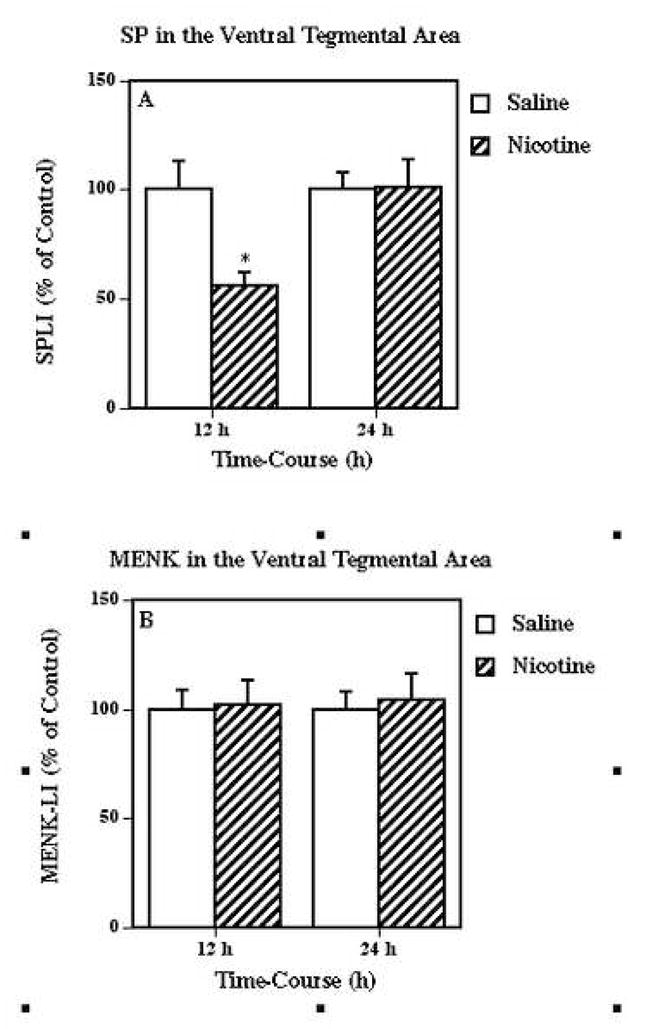
Effects of nicotine on substance P (SP; Fig. 6A) and metenkephalin (MENK; Fig. 5B) systems, in the ventral tegmental area. Animals received injections of nicotine (as described for Fig. 1) or saline and killed 12 and 24 h following the treatment. Results are expressed as percentages of control and represent mean values ± S.E.M. (n= 8 control and 9 drug-treated animals per group). The average control values of SPLI and MENK-LI concentrations for ventral tegmental area were 1036 ± 105 and 2446 ± 172 pg/mg protein, respectively. *P < 0.05 vs. control.

References

    1. Aghajanian GK, Bunney BS. Dopamine ‘autoreceptors’: pharmacological characterization by microiontophoretic single cell recording studies. Naunyn Schmiedeberg’s Arch Pharmacol. 1977;297:1–7. - PubMed
    1. Alburges ME, Keefe KA, Hanson GR. Unique responses of limbic met-enkephalin systems to low and high doses of methamphetamine. Brain Res. 2001a;905:120–126. - PubMed
    1. Alburges ME, Keefe KA, Hanson GR. Contrasting response by basal ganglia metenkephalin systems to low and high doses of methamphetamine in a rat model. J Neurochem. 2001b;76:721–729. - PubMed
    1. Boules M, Iversen I, Oliveros A, Shaw A, Williams K, Robinson J, Fredrickson P, Richelson E. The neurotensin receptor agonist NT69L suppresses sucrose-reinforced operate behavior in the rat. Brain Res. 2007;1127:90–98. - PubMed
    1. Bradford MM. A rapid and sensitive method for quantification of microgram quantities of protein utilizing the principle of protein-dye binding. Anal Biochem. 1976;72:248–254. - PubMed

Publication types

MeSH terms