Probiotics for treatment of acute diarrhoea in children: randomised clinical trial of five different preparations
- PMID: 17690340
- PMCID: PMC1949444
- DOI: 10.1136/bmj.39272.581736.55
Probiotics for treatment of acute diarrhoea in children: randomised clinical trial of five different preparations
Abstract
Objective: To compare the efficacy of five probiotic preparations recommended to parents in the treatment of acute diarrhoea in children. Design Randomised controlled clinical trial in collaboration with family paediatricians over 12 months.
Setting: Primary care.
Participants: Children aged 3-36 months visiting a family paediatrician for acute diarrhoea.
Intervention: Children's parents were randomly assigned to receive written instructions to purchase a specific probiotic product: oral rehydration solution (control group); Lactobacillus rhamnosus strain GG; Saccharomyces boulardii; Bacillus clausii; mix of L delbrueckii var bulgaricus, Streptococcus thermophilus, L acidophilus, and Bifidobacterium bifidum; or Enterococcus faecium SF68.
Main outcome measures: Primary outcomes were duration of diarrhoea and daily number and consistency of stools. Secondary outcomes were duration of vomiting and fever and rate of admission to hospital. Safety and tolerance were also recorded.
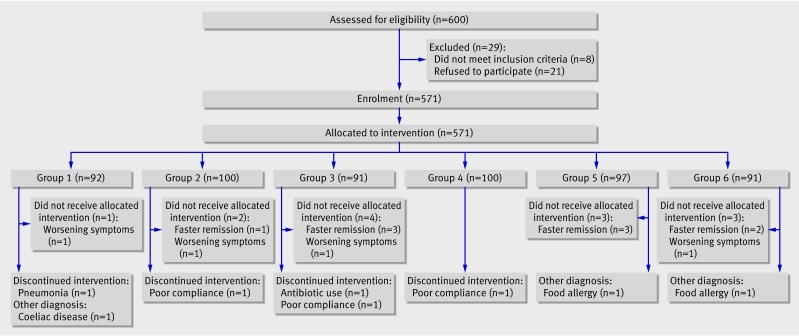
Results: 571 children were allocated to intervention. Median duration of diarrhoea was significantly shorter (P<0.001) in children who received L rhamnosus strain GG (78.5 hours) and the mix of four bacterial strains (70.0 hours) than in children who received oral rehydration solution alone (115.0 hours). One day after the first probiotic administration, the daily number of stools was significantly lower (P<0.001) in children who received L rhamnosus strain GG and in those who received the probiotic mix than in the other groups. The remaining preparations did not affect primary outcomes. Secondary outcomes were similar in all groups.
Conclusions: Not all commercially available probiotic preparations are effective in children with acute diarrhoea. Paediatricians should choose bacterial preparations based on effectiveness data.
Trial registration number: Current Controlled Trials ISRCTN56067537 [controlled-trials.com].
Conflict of interest statement
Competing interests: None declared.
Funding: None.
Figures
Comment in
-
Probiotics in children: All nutritional supplements should be classified as drugs.BMJ. 2007 Sep 1;335(7617):414. doi: 10.1136/bmj.39317.508079.80. BMJ. 2007. PMID: 17762010 Free PMC article. No abstract available.
-
Probiotics in children: Consider microbial cause.BMJ. 2007 Sep 1;335(7617):414. doi: 10.1136/bmj.39317.494549.80. BMJ. 2007. PMID: 17762011 Free PMC article. No abstract available.
-
Not all probiotic preparations are equally effective for diarrhea in children.J Pediatr. 2008 Jan;152(1):142. doi: 10.1016/j.jpeds.2007.10.046. J Pediatr. 2008. PMID: 18154919 No abstract available.
References
-
- Alam NH, Ashraf H. Treatment of infectious diarrhea in children. Paediatr Drugs 2003;5:151-65. - PubMed
-
- Szajewska H, Setty M, Mrukowicz J, Guandalini S. Probiotics in gastrointestinal diseases in children: hard and not-so-hard evidence of efficacy. J Pediatr Gastroenterol Nutr 2006;42:454-75. - PubMed
-
- Davidson GP, Butler RN. Probiotics in intestinal disorders. Curr Opin Pediatr 2000;12:477-81. - PubMed
-
- Saavedra JM, Bauman NA, Oung I, Perman JA, Yolken RH. Feeding of Bifidobacterium bifidum and Streptococcus thermophilus to infants in hospital for prevention of diarrhoea and shedding of rotavirus. Lancet 1994;344:1046-9. - PubMed
Publication types
MeSH terms
Associated data
LinkOut - more resources
Full Text Sources
Other Literature Sources
Medical