


Rheological behavior of living cells is timescale-dependent
- PMID: 17693464
- PMCID: PMC1989695
- DOI: 10.1529/biophysj.107.116582
Rheological behavior of living cells is timescale-dependent
Abstract
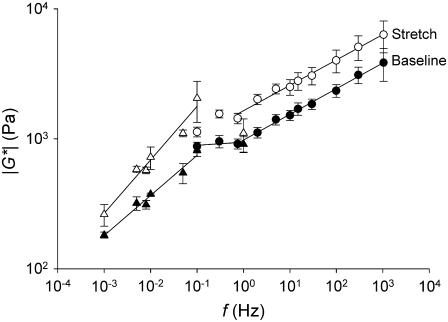
The dynamic mechanical behavior of living cells has been proposed to result from timescale-invariant processes governed by the soft glass rheology theory derived from soft matter physics. But this theory is based on experimental measurements over timescales that are shorter than those most relevant for cell growth and function. Here we report results measured over a wider range of timescales which demonstrate that rheological behaviors of living cells are not timescale-invariant. These findings demonstrate that although soft glass rheology appears to accurately predict certain cell mechanical behaviors, it is not a unified model of cell rheology under biologically relevant conditions and thus, alternative mechanisms need to be considered.
Figures
References
-
- Fabry, B., G. N. Maksym, J. P. Butler, M. Glogauer, D. Navajas, and J. J. Fredberg. 2001. Scaling the microrheology of living cells. Phys. Rev. Lett. 87:148102. - PubMed
-
- Bursac, P., G. Lenormand, B. Fabry, M. Oliver, D. A. Weitz, V. Viasnoff, J. P. Butler, and J. J. Fredberg. 2005. Cytoskeletal remodeling and slow dynamics in living cells. Nat. Mater. 4:557–561. - PubMed
-
- Deng, L., X. Trepat, J. P. Butler, E. Millet, K. G. Morgan, D. A. Weitz, and J. J. Fredberg. 2006. Fast and slow dynamics of the cytoskeleton. Nat. Mater. 5:636–640. - PubMed
Publication types
MeSH terms
Grants and funding
LinkOut - more resources
Full Text Sources
