


Spontaneous elimination of hepatitis C virus infection: a retrospective study on demographic, clinical, and serological correlates
- PMID: 17696252
- PMCID: PMC4250622
- DOI: 10.3748/wjg.v13.i31.4224
Spontaneous elimination of hepatitis C virus infection: a retrospective study on demographic, clinical, and serological correlates
Abstract
Aim: To find correlates to spontaneous clearance of hepatitis C virus (HCV) infection, this study compared individuals with self-limited and chronic infection with regard to clinical, demographic, and serological parameters.
Methods: Sixty-seven anti-HCV positive and repeatedly HCV RNA negative individuals were considered to have resolved HCV infection spontaneously. To determine the viral genotype these patients had been infected with HCV serotyping was performed. For comparison reasons, 62 consecutive patients with chronic hepatitis C were enrolled. Cases and controls were compared stratified for age and sex.
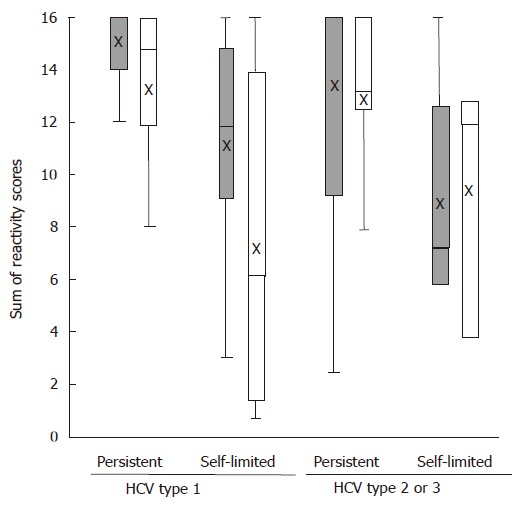
Results: Retrospective analysis showed (1) a lower humoral reactivity to HCV in patients with self-limited compared to chronic HCV-infection and (2) that younger age, history of iv drug use, and acute/post-acute hepatitis A or B co-infections, but not viral genotypes, are independent correlates for spontaneous HCV clearance.
Conclusion: The stronger humoral reactivity to HCV in patients with persistent infections and in those with a history of iv drug use is supposed to be due to continuous or repeated contact(s) to the antigen. Metachronous hepatitis A or hepatitis B infections might favor HCV clearance.
Figures
References
-
- Piasecki BA, Lewis JD, Reddy KR, Bellamy SL, Porter SB, Weinrieb RM, Stieritz DD, Chang KM. Influence of alcohol use, race, and viral coinfections on spontaneous HCV clearance in a US veteran population. Hepatology. 2004;40:892–899. - PubMed
-
- Seeff LB, Hoofnagle JH. National Institutes of Health Consensus Development Conference: management of hepatitis C: 2002. Hepatology. 2002;36:S1–S2. - PubMed
-
- Hoofnagle JH. Course and outcome of hepatitis C. Hepatology. 2002;36:S21–S29. - PubMed
-
- Kaplan M, Gawrieh S, Cotler SJ, Jensen DM. Neutralizing antibodies in hepatitis C virus infection: a review of immunological and clinical characteristics. Gastroenterology. 2003;125:597–604. - PubMed
MeSH terms
Substances
LinkOut - more resources
Full Text Sources
Other Literature Sources
Medical
