


Common genetic variations in CLOCK transcription factor are associated with nonalcoholic fatty liver disease
- PMID: 17696255
- PMCID: PMC4250625
- DOI: 10.3748/wjg.v13.i31.4242
Common genetic variations in CLOCK transcription factor are associated with nonalcoholic fatty liver disease
Abstract
Aim: To investigate the role of gene variants and derived haplotypes of the CLOCK transcription factor in nonalcoholic fatty liver disease (NAFLD) and their relation with the disease severity.
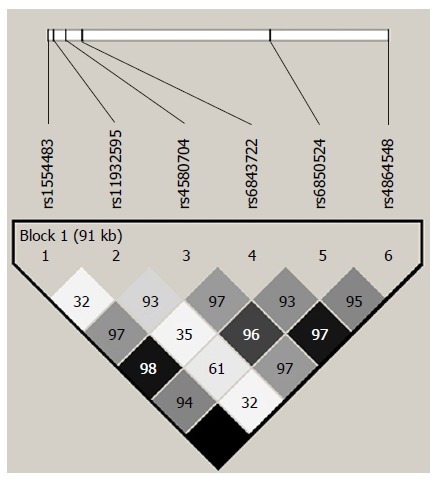
Methods: A total of 136 patients with NAFLD and 64 healthy individuals were studied. Liver biopsy was performed in 91 patients. Six tag SNPs showing a minor allele frequency > 10% (rs1554483 C/G; rs11932595 A/G; rs4580704 C/G; rs6843722 A/C; rs6850524 C/G and rs4864548 A/G) encompassing 117 kb of chromosome 4 and representing 115 polymorphic sites (r(2) > 0.8) were genotyped.
Results: rs11932595 and rs6843722 showed significant associations with NAFLD (empiric P = 0.0449 and 0.023, respectively). A significant association was also observed between clinical or histologic spectrum of NAFLD and rs1554483 (empiric P = 0.0399), rs6843722 (empiric P = 0.0229) and rs6850524 (empiric P = 0.00899) and between fibrosis score and rs1554483 (empiric P = 0.02697), rs6843722 (empiric P = 0.01898) and rs4864548 (empiric P = 0.02697). Test of haplotypic association showed that CLOCK gene variant haplotypes frequencies in NAFLD individuals significantly differed from those in controls (empiric P = 0.0097).
Conclusion: Our study suggests a potential role of the CLOCK polymorphisms and their haplotypes in susceptibility to NAFLD and disease severity.
Figures
References
-
- Desapriya E. Obesity epidemic. Lancet. 2004;364:1488. - PubMed
-
- Kopelman PG. Obesity as a medical problem. Nature. 2000;404:635–643. - PubMed
-
- Marchesini G, Bugianesi E, Forlani G, Cerrelli F, Lenzi M, Manini R, Natale S, Vanni E, Villanova N, Melchionda N, et al. Nonalcoholic fatty liver, steatohepatitis, and the metabolic syndrome. Hepatology. 2003;37:917–923. - PubMed
-
- Bellentani S, Saccoccio G, Masutti F, Crocè LS, Brandi G, Sasso F, Cristanini G, Tiribelli C. Prevalence of and risk factors for hepatic steatosis in Northern Italy. Ann Intern Med. 2000;132:112–117. - PubMed
-
- Matteoni CA, Younossi ZM, Gramlich T, Boparai N, Liu YC, McCullough AJ. Nonalcoholic fatty liver disease: a spectrum of clinical and pathological severity. Gastroenterology. 1999;116:1413–1419. - PubMed
MeSH terms
Substances
LinkOut - more resources
Full Text Sources
Medical
