


Early antibodies specific for the neutralizing epitope on the receptor binding subunit of the lymphocytic choriomeningitis virus glycoprotein fail to neutralize the virus
- PMID: 17699567
- PMCID: PMC2168768
- DOI: 10.1128/JVI.00955-07
Early antibodies specific for the neutralizing epitope on the receptor binding subunit of the lymphocytic choriomeningitis virus glycoprotein fail to neutralize the virus
Abstract
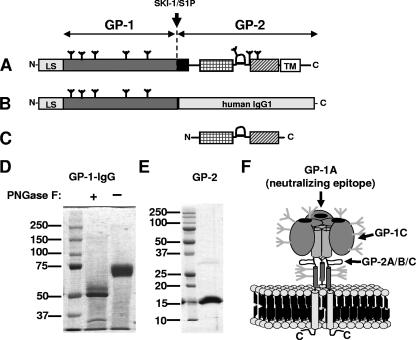
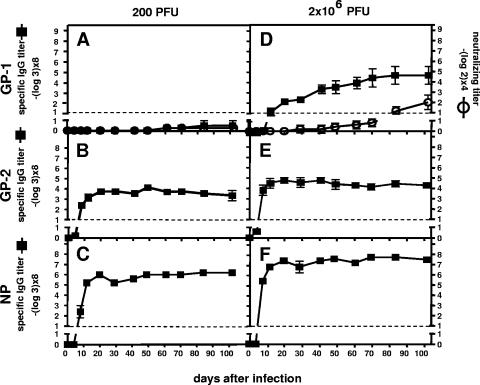
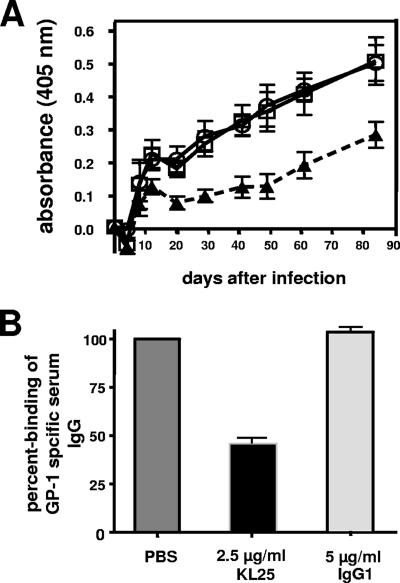
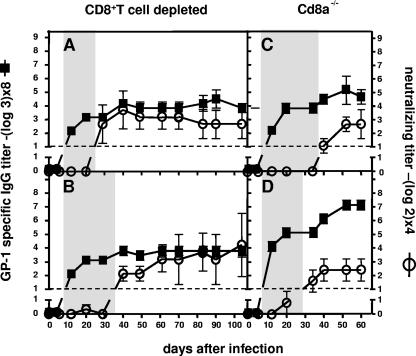
Lymphocytic choriomeningitis virus (LCMV) is a murine arenavirus whose glycoprotein consists of a transmembrane subunit (GP-2) and a receptor-binding subunit (GP-1). LCMV-neutralizing antibodies (nAbs) are directed against a single site on GP-1 and occur 1 month after the infection of cytotoxic-T-lymphocyte (CTL) deficient mice. In wild-type mice, however, CTLs control early infection, and weak nAb titers emerge very late (after 70 to 150 days) if at all. Production of recombinant GP-1 in native conformation enabled us to study the emergence of GP-1-binding antibodies directed against the neutralizing epitope. By combining binding and neutralization assays, we correlated the development of binding antibodies versus nAbs in wild-type and CTL-deficient mice after infection with different LCMV doses. We found that wild-type mice developed GP-1-specific antibodies already by day 8 after exposure to high but not low doses, demonstrating that naive GP-1-specific B cells were infrequent. Furthermore, the induced antibodies bound to the neutralizing GP-1 epitope but failed to neutralize the virus and therefore were of low affinity. In CTL-deficient mice, where massive viremia quickly levels initial differences in viral load, low and high doses induced low-affinity non-neutralizing GP-1-binding antibodies with kinetics similar to high-dose-infected wild-type mice. Only in CTL-deficient mice, however, the GP-1-specific antibodies developed into nAbs within 1 month. We conclude that LCMV uses a dual strategy to evade nAb responses in wild-type mice. First, LCMV exploits a "hole" in the murine B-cell repertoire, which provides only a small and narrow initial pool of low-affinity GP-1-specific B cells. Second, affinity maturation of the available low-affinity non-neutralizing antibodies is impaired.
Figures
References
-
- Althage, A., B. Odermatt, D. Moskophidis, T. Kundig, U. Hoffman-Rohrer, H. Hengartner, and R. M. Zinkernagel. 1992. Immunosuppression by lymphocytic choriomeningitis virus infection: competent effector T and B cells but impaired antigen presentation. Eur. J. Immunol. 22:1803-1812. - PubMed
-
- Battegay, M., S. Cooper, A. Althage, J. Banziger, H. Hengartner, and R. M. Zinkernagel. 1991. Quantification of lymphocytic choriomeningitis virus with an immunological focus assay in 24- or 96-well plates. J. Virol. Methods 33:191-198. - PubMed
-
- Battegay, M., D. Moskophidis, H. Waldner, M. A. Brundler, W. P. Fung-Leung, T. W. Mak, H. Hengartner, and R. M. Zinkernagel. 1993. Impairment and delay of neutralizing antiviral antibody responses by virus-specific cytotoxic T cells. J. Immunol. 151:5408-5415. - PubMed
Publication types
MeSH terms
Substances
LinkOut - more resources
Full Text Sources
