. 2007 Aug;19(8):2430-9.
doi: 10.1105/tpc.107.053009. Epub 2007 Aug 17.

Auxin synthesized by the YUCCA flavin monooxygenases is essential for embryogenesis and leaf formation in Arabidopsis

Affiliations

Auxin synthesized by the YUCCA flavin monooxygenases is essential for embryogenesis and leaf formation in Arabidopsis

Youfa Cheng et al. Plant Cell. 2007 Aug.

Abstract

Auxin plays a key role in embryogenesis and seedling development, but the auxin sources for the two processes are not defined. Here, we demonstrate that auxin synthesized by the YUCCA (YUC) flavin monooxygenases is essential for the establishment of the basal body region during embryogenesis and the formation of embryonic and postembryonic organs. Both YUC1 and YUC4 are expressed in discrete groups of cells throughout embryogenesis, and their expression patterns overlap with those of YUC10 and YUC11 during embryogenesis. The quadruple mutants of yuc1 yuc4 yuc10 yuc11 fail to develop a hypocotyl and a root meristem, a phenotype similar to those of mp and tir1 afb1 afb2 afb3 auxin signaling mutants. We further show that YUC genes play an essential role in the formation of rosette leaves by analyzing combinations of yuc mutants and the polar auxin transport mutants pin1 and aux1. Disruption of YUC1, YUC4, or PIN1 alone does not abolish leaf formation, but the triple mutant yuc1 yuc4 pin1 fails to form leaves and flowers. Furthermore, disruption of auxin influx carrier AUX1 in the quadruple mutant yuc1 yuc2 yuc4 yuc6, but not in wild-type background, phenocopies yuc1 yuc4 pin1, demonstrating that auxin influx is required for plant leaf and flower development. Our data demonstrate that auxin synthesized by the YUC flavin monooxygenases is an essential auxin source for Arabidopsis thaliana embryogenesis and postembryonic organ formation.


Figures
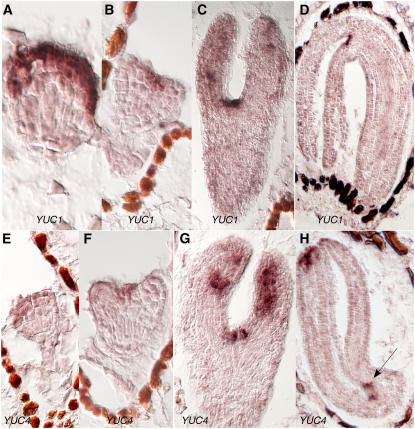
Figure 1.
Figure 1.
Analysis of the Expression Patterns of YUC1 and YUC4 during Embryogenesis by RNA in Situ Hybridization. (A) to (D) YUC1 expression patterns. Note that YUC1 is mainly expressed in the first three cell layers in the apical region in the globular-stage embryos (A). At heart stage, the highest expression is at the meristem region (B). (E) to (H) YUC4 expression patterns. The arrow points to the likely sites for incipient true leaves.
Figure 2.
Figure 2.
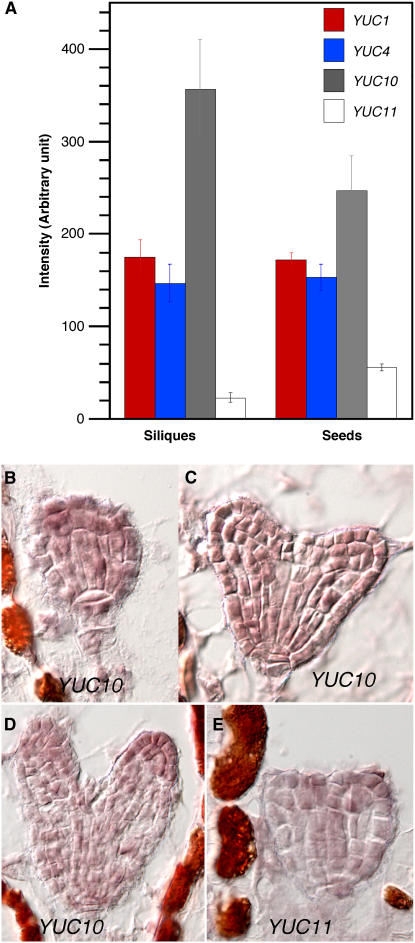
Analysis of the Expression Profile of YUC10 and YUC11. (A) Expression profiles in siliques and seeds. Data were from the public microarray data sets (https://www.genevestigator.ethz.ch). (B) to (D) RNA in situ hybridization of YUC10. (E) RNA in situ hybridization of YUC11.
Figure 3.
Figure 3.
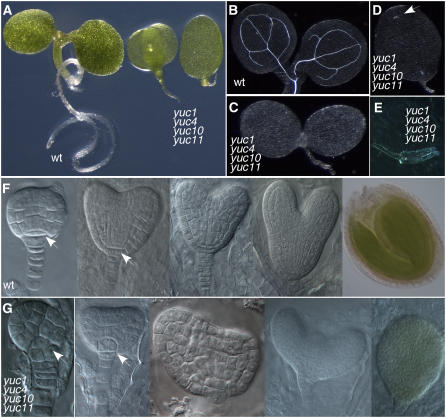
Regulation of Arabidopsis Embryogenesis by YUC Genes. (A) Developmental defects of yuc1 yuc4 yuc10 yuc11 at seedling stages. The seedling at the left is the wild type, and the two seedlings at the right are yuc1 yuc4 yuc10 yuc11. Note that the mutant lacks a hypocotyl and a root. (B) to (E) Vascular defects in yuc1 yuc4 yuc10 yuc11. (B) The wild type. (C) to (E) yuc1 yuc4 yuc10 yuc11. The arrow points to a short and discontinuous vein. The vascular tissue in (E) was from the seedling of (D). (F) Various stages of wild-type embryos. (G) The corresponding stages of embryos of yuc1 yuc4 yuc10 yuc11. The arrows point to where the hypophysis should be.
Figure 4.
Figure 4.
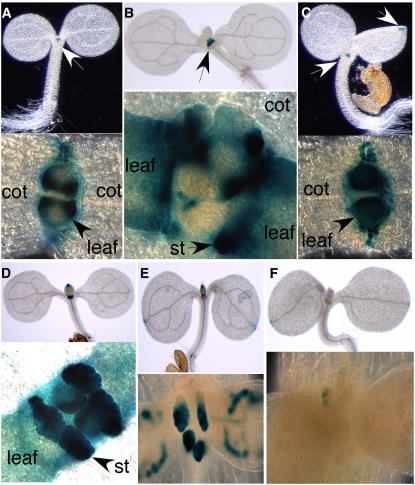
Expression Patterns of YUC1 and YUC4 during Seedling Development and Effects of yuc1 yuc4 on Auxin Reporter DR5-GUS Expression. (A) GUS staining of a 3-d-old light-grown YUC1-GUS seedling. Staining was restricted to the shoot apex without any staining in cotyledons (cot) (top panel). In the apex, strong GUS staining was located at the basal parts of the true leaves (bottom panel). (B) GUS staining of a 5-d-old YUC1-GUS seedling. Staining was observed in stipules (st). (C) GUS staining of a 3-d-old YUC4-GUS seedling. Staining was located at cotyledon tips and the shoot apex (top panel). (D) GUS staining of a 5-d-old YUC4-GUS seedling. Note the strong staining in the stipules (bottom panel). (E) Expression of the auxin reporter DR5-GUS. GUS activities were observed at the cotyledon tip and the shoot apex. At the shoot apex, DR5-GUS is expressed in stipules and vascular tissue (bottom panel). (F) GUS staining of DR5-GUS in the yuc1 yuc4 background. Inactivation of YUC1 and YUC4 leads to a dramatic decrease of DR5-GUS expression in the apex without affecting the staining at the cotyledon tip.
Figure 5.
Figure 5.
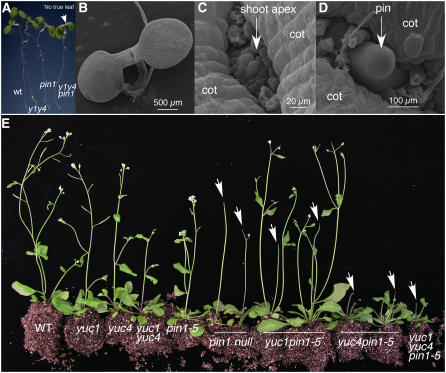
Synergistic Interactions between yuc1 yuc4 and pin1 Mutants during Leaf Development. (A) The triple mutant yuc1 yuc4 pin1 did not make a leaf. Seedlings shown are 7 d old and grown on 0.5× Murashige and Skoog media. Arrow points to the apex of yuc1 yuc4 pin1. The pin1 mutant was a null mutant caused by a T-DNA insertion. From left to right: wild type, yuc1 yuc4, pin1, and yuc1 yuc4 pin1. (B) to (D) Electron micrographs of yuc1 yuc4 pin1. (B) Seven-day-old yuc1 yuc4 pin1. Note that no true leaves were visible at the shoot apex. (C) A close-up of the shoot apex of a yuc1 yuc4 pin1 seedling. (D) Pin-like structure in 2-week-old yuc1 yuc4 pin1. (E) Genetic interactions between yuc1 yuc4 and pin1-5, a weak allele of pin1. From left to right: wild type, yuc1, yuc4, yuc1 yuc4 double mutants, pin1-5, two plants of pin1 null, two plants of yuc1 pin1-5 double mutants, two plants of yuc4 pin1-5 double mutants, and yuc1 yuc4 pin1-5 triple mutants. Note that pin1-5 never forms pin-like inflorescences, but yuc1 pin1-5 or yuc4 pin1-5 generated pin-like inflorescences. The yuc1 yuc4 pin1-5 triple mutants had stronger phenotypes than pin1 null. Arrows point to pin-like inflorescences.
Figure 6.
Figure 6.
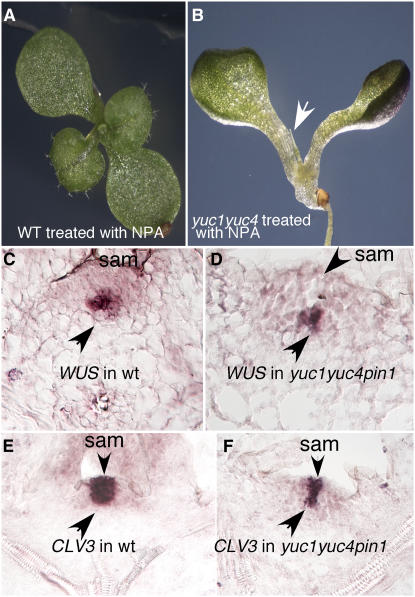
Analysis of Expression Patterns of Apical Meristem Markers in yuc1 yuc4 pin1 and the Effects of NPA on yuc1 yuc4 Development. (A) Wild-type plants grown on 25 μM NPA for 12 d. (B) yuc1 yuc4 seedlings grown on NPA for 12 d. Arrow points to a pin-like structure. (C) Expression patterns of WUS in wild-type shoot apical meristem (sam). WUS was expressed in a small group of cells several layers away from the epidermis. (D) WUS expression in yuc1 yuc4 pin1. Note the similar patterns in the wild type and the mutant. (E) and (F) CLV3 expression in the shoot apical meristem in the wild type (E) and yuc1 yuc4 pin1 (F). The expression patterns were analyzed by RNA in situ hybridization using 8-d-old light-grown seedlings.
Figure 7.
Figure 7.
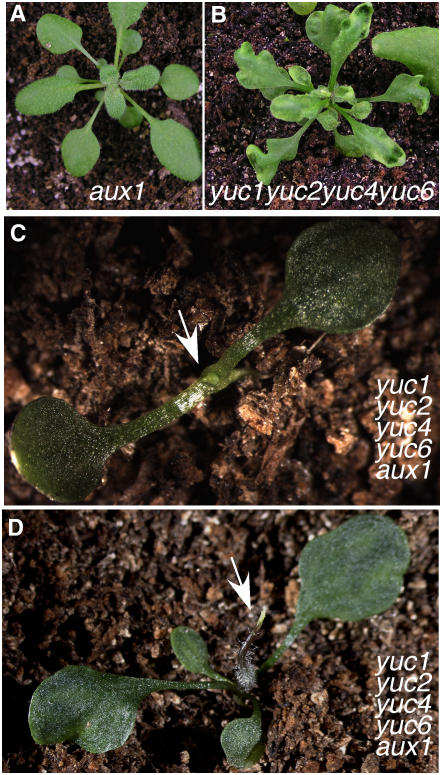
A Role for AUX1 in Leaf and Flower Development. (A) Adult aux1. (B) Adult yuc1 yuc2 yuc4 yuc6. (C) and (D) yuc1 yuc2 yuc4 yuc6 aux1. Note that both aux1 and yuc1 yuc2 yuc4 yuc6 developed leaves, whereas the yuc1 yuc4 yuc6 aux1 quintuple mutants developed fewer leaves and showed phenotypes similar to yuc1 yuc4 pin1.

References

    1. Alonso, J.M., et al. (2003). Genome-wide insertional mutagenesis of Arabidopsis thaliana. Science 301 653–657. - PubMed
    1. Benkova, E., Michniewicz, M., Sauer, M., Teichmann, T., Seifertova, D., Jurgens, G., and Friml, J. (2003). Local, efflux-dependent auxin gradients as a common module for plant organ formation. Cell 115 591–602. - PubMed
    1. Bennett, M.J., Marchant, A., Green, H.G., May, S.T., Ward, S.P., Millner, P.A., Walker, A.R., Schulz, B., and Feldmann, K.A. (1996). Arabidopsis AUX1 gene: A permease-like regulator of root gravitropism. Science 273 948–950. - PubMed
    1. Bennett, S.R.M., Alvarez, J., Bossinger, G., and Smyth, D.R. (1995). Morphogenesis in pinoid mutants of Arabidopsis thaliana. Plant J. 8 505–520.
    1. Berleth, T., and Jurgens, G. (1993). The role of the monopteros gene in organizing the basal body region of the Arabidopsis embryo. Development 118 575–587.

Publication types

MeSH terms

Associated data