


Virtual reality training for endoscopic surgery: voluntary or obligatory?
- PMID: 17704889
- PMCID: PMC2262145
- DOI: 10.1007/s00464-007-9456-9
Virtual reality training for endoscopic surgery: voluntary or obligatory?
Abstract
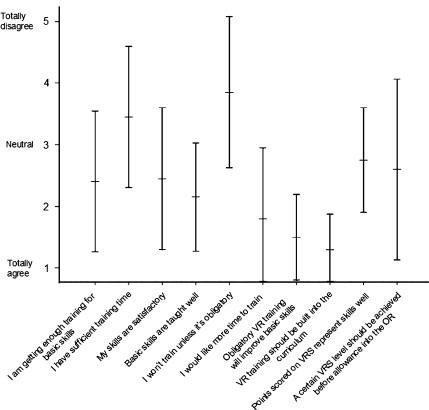
Introduction: Virtual reality (VR) simulators have been developed to train basic endoscopic surgical skills outside of the operating room. An important issue is how to create optimal conditions for integration of these types of simulators into the surgical training curriculum. The willingness of surgical residents to train these skills on a voluntary basis was surveyed.
Methods: Twenty-one surgical residents were given unrestricted access to a VR simulator for a period of four months. After this period, a competitive element was introduced to enhance individual training time spent on the simulator. The overall end-scores for individual residents were announced periodically to the full surgical department, and the winner was awarded a prize.
Results: In the first four months of study, only two of the 21 residents (10%) trained on the simulator, for a total time span of 163 minutes. After introducing the competitive element the number of trainees increased to seven residents (33%). The amount of training time spent on the simulator increased to 738 minutes.
Conclusions: Free unlimited access to a VR simulator for training basic endoscopic skills, without any form of obligation or assessment, did not motivate surgical residents to use the simulator. Introducing a competitive element for enhancing training time had only a marginal effect. The acquisition of expensive devices to train basic psychomotor skills for endoscopic surgery is probably only effective when it is an integrated and mandatory part of the surgical curriculum.
References
-
- European Community. Directive 2000/34/EC of the European Parliament and of the Council of 22 June 2000 amending Council Directive 93/104/EC concerning certain aspects of the organisation of working time to cover sectors and activities excluded from that Directive. Official Journal of the European Communities, No. L 195, 1 August 2000, pp 41–45
-
- Chang L, Petros J, Hess DT, Rotondi C, Babineau TJ (16-12-2006) Integrating simulation into a surgical residency program: Is voluntary participation effective? Surg Endosc (in press) - PubMed
-
- Gallagher AG, McClure N, McGuigan J, Ritchie K, Sheehy NP (1998) An ergonomic analysis of the fulcrum effect in the acquisition of endoscopic skills. Endoscopy 30:617–620 - PubMed
MeSH terms
LinkOut - more resources
Full Text Sources
Medical
