


Global transcription profiling reveals differential responses to chronic nitrogen stress and putative nitrogen regulatory components in Arabidopsis
- PMID: 17705847
- PMCID: PMC1994689
- DOI: 10.1186/1471-2164-8-281
Global transcription profiling reveals differential responses to chronic nitrogen stress and putative nitrogen regulatory components in Arabidopsis
Abstract
Background: A large quantity of nitrogen (N) fertilizer is used for crop production to achieve high yields at a significant economic and environmental cost. Efforts have been directed to understanding the molecular basis of plant responses to N and identifying N-responsive genes in order to manipulate their expression, thus enabling plants to use N more efficiently. No studies have yet delineated these responses at the transcriptional level when plants are grown under chronic N stress and the understanding of regulatory elements involved in N response is very limited.
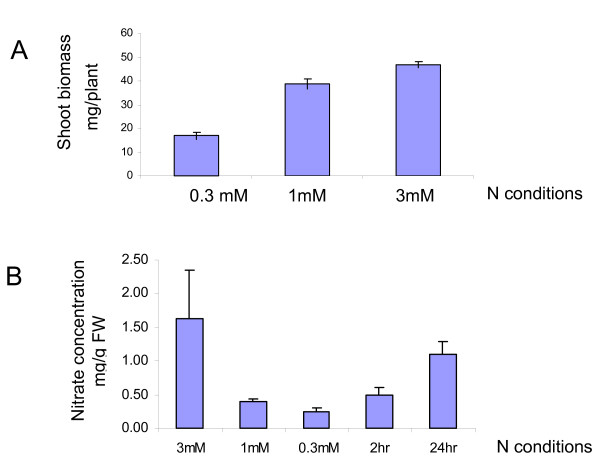
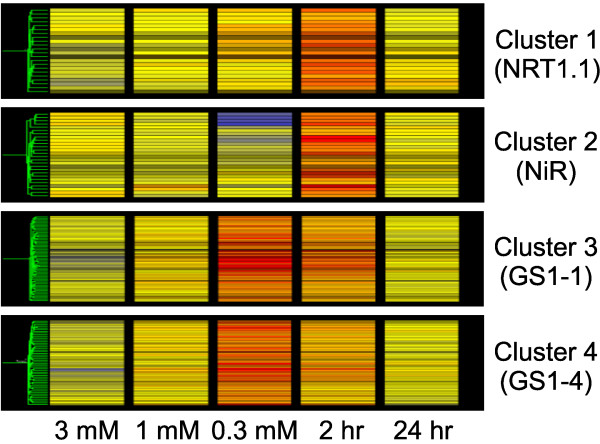
Results: To further our understanding of the response of plants to varying N levels, a growth system was developed where N was the growth-limiting factor. An Arabidopsis whole genome microarray was used to evaluate global gene expression under different N conditions. Differentially expressed genes under mild or severe chronic N stress were identified. Mild N stress triggered only a small set of genes significantly different at the transcriptional level, which are largely involved in various stress responses. Plant responses were much more pronounced under severe N stress, involving a large number of genes in many different biological processes. Differentially expressed genes were also identified in response to short- and long-term N availability increases. Putative N regulatory elements were determined along with several previously known motifs involved in the responses to N and carbon availability as well as plant stress.
Conclusion: Differentially expressed genes identified provide additional insights into the coordination of the complex N responses of plants and the components of the N response mechanism. Putative N regulatory elements were identified to reveal possible new components of the regulatory network for plant N responses. A better understanding of the complex regulatory network for plant N responses will help lead to strategies to improve N use efficiency.
Figures
References
-
- Lea PJ, Morot-Gaudry JF. Plant nitrogen. Berlin ; London , Springer; 2001. p. xi, 407 p..
-
- Scheible WR, Lauerer M, Schulze ED, Caboche M, Stitt M. Accumulation of nitrate in the shoot acts as a signal to regulate shoot-root allocation in tobacco. Plant Journal. 1997;11:671–691. doi: 10.1046/j.1365-313X.1997.11040671.x. - DOI
-
- Stitt M, Krapp A. The interaction between elevated carbon dioxide and nitrogen nutrition: the physiological and molecular background. Plant Cell and Environment. 1999;22:583–621. doi: 10.1046/j.1365-3040.1999.00386.x. - DOI
-
- Marschner H. Mineral nutrition of higher plants. 2nd ed. London , Academic; 1995. p. xv,889p..
Publication types
MeSH terms
Substances
LinkOut - more resources
Full Text Sources
Other Literature Sources
Molecular Biology Databases
