. 2007 Aug 17;2(8):561-71.
doi: 10.1021/cb700110z.

Modulating hypoxia-inducible transcription by disrupting the HIF-1-DNA interface

Affiliations

Modulating hypoxia-inducible transcription by disrupting the HIF-1-DNA interface

Nicholas G Nickols et al. ACS Chem Biol. .

Abstract

Transcription mediated by hypoxia-inducible factor (HIF-1) contributes to tumor angiogenesis and metastasis but is also involved in activation of cell-death pathways and normal physiological processes. Given the complexity of HIF-1 signaling, it could be advantageous to target a subset of HIF-1 effectors rather than the entire pathway. We compare the genome-wide effects of three molecules that each interfere with the HIF-1-DNA interaction: a polyamide targeted to the hypoxia response element, small interfering RNA targeted to HIF-1alpha, and echinomycin, a DNA-binding natural product with a similar but less specific sequence preference than the polyamide. The polyamide affects a subset of hypoxia-induced genes consistent with its binding site preferences. For comparison, HIF-1alpha siRNA and echinomycin each affect the expression of nearly every gene induced by hypoxia. Remarkably, the total number of genes affected by either polyamide or HIF-1alpha siRNA over a range of thresholds is comparable. The data show that polyamides can be used to affect a subset of a pathway regulated by a transcription factor. In addition, this study offers a unique comparison of three complementary approaches towards exogenous control of endogenous gene expression.


Figures
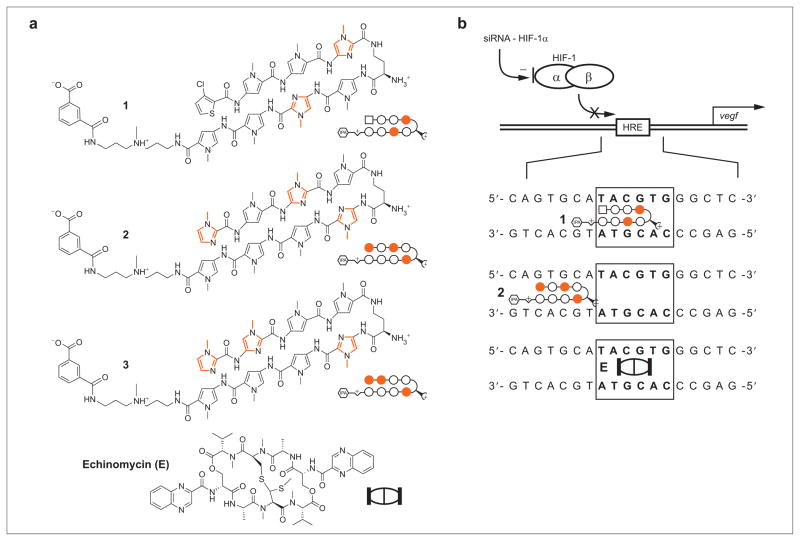
Figure 1
Figure 1
Structures of molecules used in this study. a) Structures of polyamides 1–3 and echinomycin. Imidazole, pyrrole, and chlorothiophene monomer units are represented by, respectively, closed circles, open circles, and squares. b) Three approaches to inhibiting gene expression induced by HIF-1: sequence-specific small-molecule binding to the HRE by a polyamide or echinomycin and reduction in HIF-1α mRNA using siRNA.
Figure 2
Figure 2
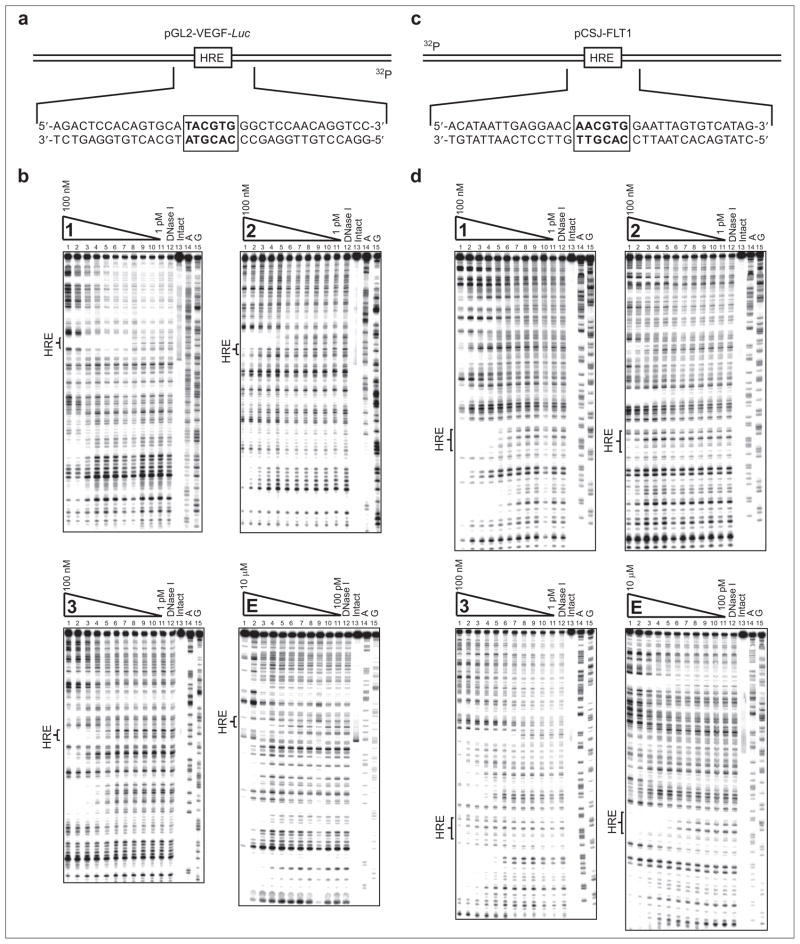
Quantitative DNase I footprint titration experiments for polyamides 1–3 and echinomycin. a) Illustration of pGL2-VEGF-Luc and partial sequence containing the VEGF HRE and putative binding sites for polyamides 1, 2, and echinomycin. b) Quantitative DNase I footprint titration experiments for polyamides 1, 2, 3, and echinomycin, E, on the 5′-end-labeled PCR product of plasmid pGL2-VEGF-Luc. For polyamides 1, 2, and 3: lanes 1–11, 100 nM, 30 nM, 10 nM, 3 nM, 1 nM, 300 pM, 100 pM, 30 pM, 10 pM, 3 pM, and 1 pM polyamide, respectively; lane 12, DNase I standard; lane 13, intact DNA; lane 14, A reaction; lane 15, G reaction. For echinomycin, E: lanes 1–11, 10 μM, 3 μM, 1 μM, 300 nM, 100 nM, 30 nM, 10 nM, 3 nM, 1 nM, 300 pM, and 100 pM echinomycin, respectively; lanes 12–15 as above. Polyamide 1 and echinomycin have Ka = 2.6 (±0.4) × 1010 M−1 and Ka = 8.4 (±2.1) × 106 M−1, respectively, at the VEGF HRE. Polyamide 2 has Ka = 3.2 (±0.6) × 109 M−1 for the site 5′-AGTGCA-3′ immediately 5′ to the VEGF HRE. Polyamide 3 has Ka = 8.0 (±1.0) × 108 M−1 for the VEGF HRE. c) Illustration of pCSJ-FLT1 and partial sequence containing the FLT1 HRE and putative binding sites for polyamides 1 and echinomycin. d) Quantitative DNase I footprint titration experiments for polyamides 1, 2, 3, and echinomycin (E) on the 5′ end-labeled PCR product of plasmid pCSJ-FLT1. Lane assignments for gels shown are as described for panel b. Polyamide 1 and echinomycin have Ka = 2.7 (±0.2) × 109 M−1 and Ka = 2.9 (±0.7) × 107 M−1, respectively, at the FLT1 HRE. Polyamide 2 has Ka = 2.2 (±0.8) × 108 at this site. Polyamide 3 does not bind the FLT1 HRE with a measurable Ka.
Figure 3
Figure 3
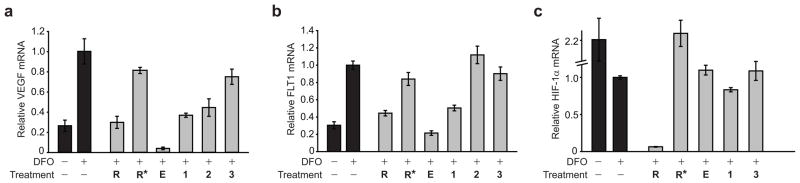
Quantitative real-time PCR measurements. a) Induction of VEGF mRNA by the hypoxia mimetic (DFO) measured by quantitative real-time PCR: HIF-1α siRNA, R; mismatch control siRNA, R*; echinomycin (100 nM), E; and polyamides 1, 2, and 3 (1 μM). Treatment with siRNA, 1, or 2 decreases VEGF mRNA levels to near-noninduced levels. Echinomycin potently inhibits VEGF mRNA to below noninduced levels. Polyamide 3 has a more modest effect. b) Induction of FLT1 mRNA by DFO measured by quantitative real-time PCR: HIF-1α siRNA, R; mismatch control siRNA, R*; echinomycin (100 nM), E; and polyamides 1, 2, and 3 (1 μM). The siRNA, echinomycin, and 1 decrease FLT1 mRNA levels. Polyamides 2 and 3 have minimal or no effect. c) Measurement of HIF-1α mRNA by quantitative real-time PCR: HIF-1α siRNA, R; mismatch control siRNA, R*; echinomycin (100 nM), E; and polyamides 1 and 3 (1 μM). Treatment with siRNA decreases HIF-1α mRNA by >95%.
Figure 4
Figure 4
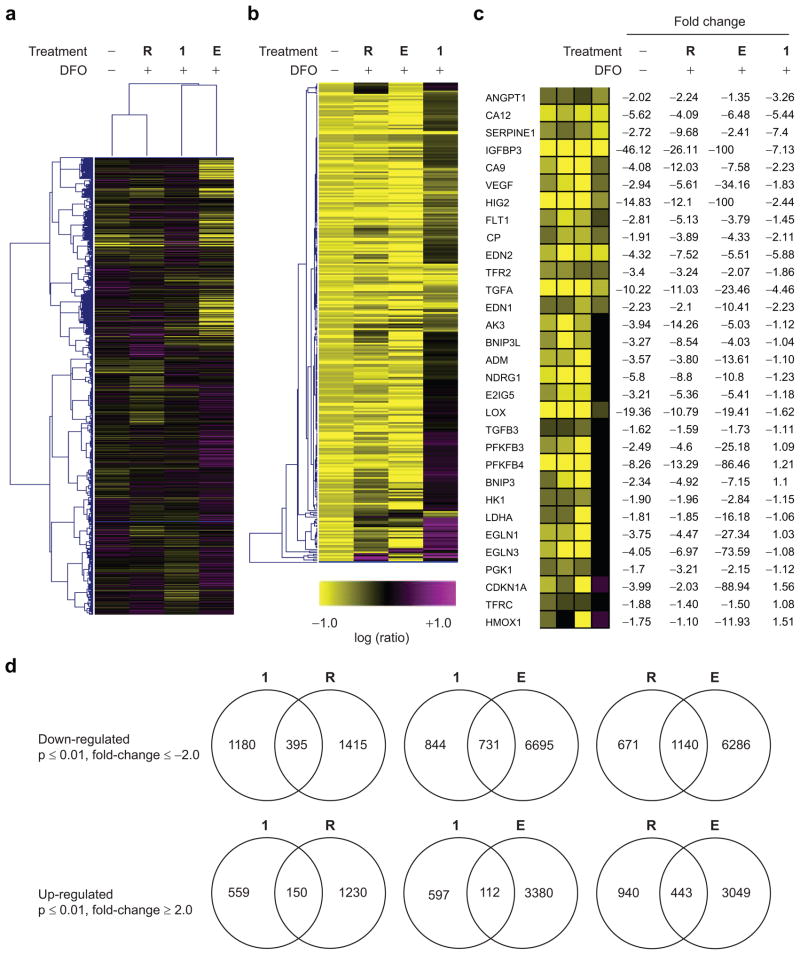
Microarray analysis of gene expression. a) Divisive clustering analysis over all interrogated transcripts for DFO-induced cells: HIF-1α siRNA, R; echinomycin (100 nM), E; and polyamides 1 (1 μM). b) Agglomerative clustering analysis over all 297 transcripts induced by DFO ≥4-fold (p ≤ 0.01). Of this transcript set, HIF-1α siRNA inhibited 244, echinomycin inhibited 263, and polyamide 1 inhibited 69 by ≥2-fold (p ≤ 0.01). c) Effects of the indicated treatments on a panel of genes previously characterized as direct targets of HIF-1 and also induced by DFO at least 1.5-fold (p ≤ 0.01) in this experiment. Treatments reported are an error-weighted average from three experiments. d) Venn diagrams representing transcripts commonly down- and up-regulated (|fold-change| ≥ 2.0, p ≤ 0.01) by 1 and HIF-1α siRNA, by 1 and echinomycin, and by HIF-1α siRNA and echinomycin. Numbers inside the intersections represent transcripts affected by both treatments.
Figure 5
Figure 5
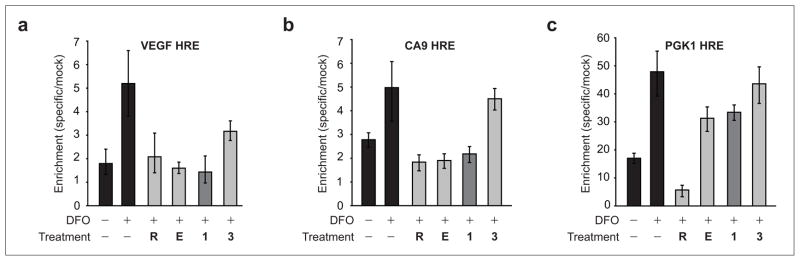
Chromatin immunoprecipitation at three HREs. a) Chromatin immunoprecipitation of HIF-1α at the VEGF HRE following DFO treatment: HIF-1α siRNA, R; echinomycin (100 nM), E; and polyamides 1 and 3 (1 μM). Occupancy is decreased in the presence of R, E, and 1 but only modestly affected by 3. b) Chromatin immunoprecipitation of HIF-1α at the CA9 HRE. c) Chromatin immunoprecipitation of HIF-1α at the PGK1 HRE.

References

    1. Blancafort P, Segal DJ, Barbas CF. Designing transcription factor architectures for drug discovery. Mol Pharmacol. 2004;66:1361–1371. - PubMed
    1. Beerli RR, Barbas CF. Engineering polydactyl zinc-finger transcription factors. Nat Biotechnol. 2002;20:135–141. - PubMed
    1. Beerli RR, Segal DJ, Dreier B, Barbas CF. Toward controlling gene expression at will: specific regulation of the erbB-2/HER-2 promoter by using polydactyl zinc finger proteins constructed from modular building blocks. Proc Natl Acad Sci USA. 1998;95:14628–14633. - PMC - PubMed
    1. Liu PQ, Rebar EJ, Zhang L, Liu Q, Jamieson AC, Liang Y, Qi H, Li PX, Chen B, Mendel MC, Zhong X, Lee YL, Eisenberg SP, Spratt SK, Case CC, Wolffe AP. Regulation of an endogenous locus using a panel of designed zinc finger proteins targeted to accessible chromatin regions–activation of vascular endothelial growth factor A. J Biol Chem. 2001;276:11323–11334. - PubMed
    1. Fire A, Xu SQ, Montgomery MK, Kostas SA, Driver SE, Mello CC. Potent and specific genetic interference by double-stranded RNA in Caenorhabditis elegans. Nature. 1998;391:806–811. - PubMed

Associated data