. 2007 Sep;100(3):497-503.
doi: 10.1093/aob/mcm142.

Nitric oxide is involved in nitrate-induced inhibition of root elongation in Zea mays

Affiliations

Nitric oxide is involved in nitrate-induced inhibition of root elongation in Zea mays

Dong-Yan Zhao et al. Ann Bot. 2007 Sep.

Abstract

Background and aims: Root growth and development are closely dependent upon nitrate supply in the growth medium. To unravel the mechanism underlying dependence of root growth on nitrate, an examination was made of whether endogenous nitric oxide (NO) is involved in nitrate-dependent growth of primary roots in maize.

Methods: Maize seedlings grown in varying concentrations of nitrate for 7 d were used to evaluate the effects on root elongation of a nitric oxide (NO) donor (sodium nitroprusside, SNP), a NO scavenger (methylene blue, MB), a nitric oxide synthase inhibitor (N(omega)-nitro-L-arginine, L-NNA), H(2)O(2), indole-3-acetic acid (IAA) and a nitric reducatse inhibitor (tungstate). The effects of these treatments on endogenous NO levels in maize root apical cells were investigated using a NO-specific fluorescent probe, 4, 5-diaminofluorescein diacetate (DAF-2DA) in association with a confocal microscopy.

Key results: Elongation of primary roots was negatively dependent on external concentrations of nitrate, and inhibition by high external nitrate was diminished when roots were treated with SNP and IAA. MB and L-NNA inhibited root elongation of plants grown in low-nitrate solution, but they had no effect on elongation of roots grown in high-nitrate solution. Tungstate inhibited root elongation grown in both low- and high-nitrate solutions. Endogenous NO levels in root apices grown in high-nitrate solution were lower than those grown in low-nitrate solution. IAA and SNP markedly enhanced endogenous NO levels in root apices grown in high nitrate, but they had no effect on endogenous NO levels in root apical cells grown in low-nitrate solution. Tungstate induced a greater increase in the endogenous NO levels in root apical cells grown in low-nitrate solution than those grown in high-nitrate solution.

Conclusions: Inhibition of root elongation in maize by high external nitrate is likely to result from a reduction of nitric oxide synthase-dependent endogenous NO levels in maize root apical cells.


Figures
F<sc>ig</sc>. 1.
Fig. 1.
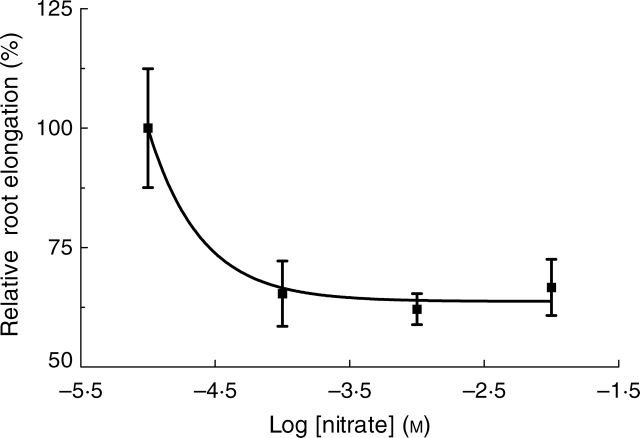
Effect of external nitrate supply on elongation of primary roots of maize seedlings. Root elongation of maize seedlings pre-grown in varying concentrations of nitrate (0·01 mm, 0·1 mm, 1 mm or 10 mm) for 7 d were used to study relative elongation during a 24-h period. The curve was fitted by an exponential decay with the equation y = (1·03 × 10−4)e−2·56x + 63·72. Data were normalized for elongation in 0·01 mm nitrate solution, and represent the mean ± s.e of at least eight roots for each treatment.
F<sc>ig</sc>. 2.
Fig. 2.
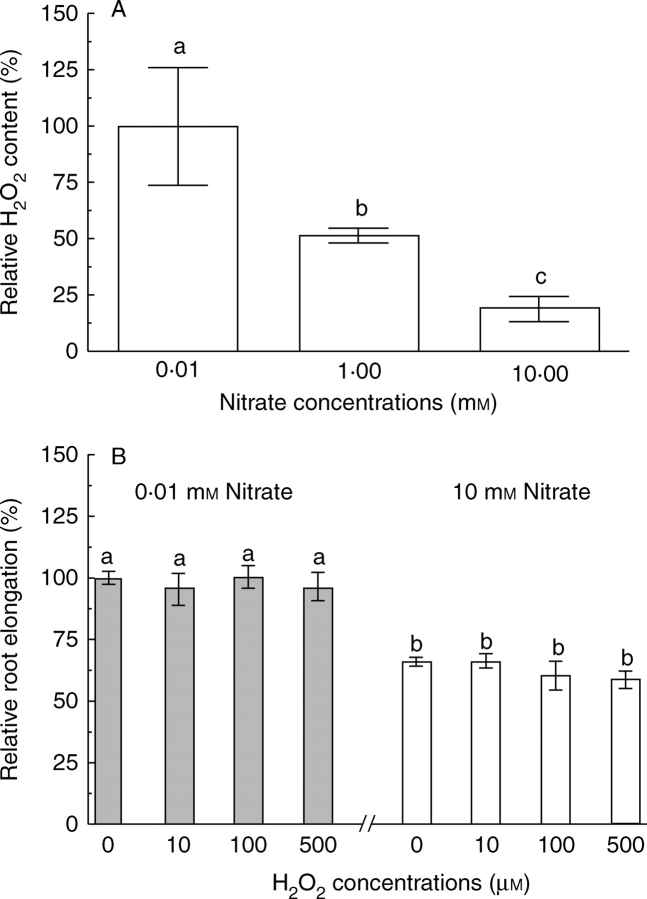
(A) Effect of external nitrate supply on H2O2 in maize seedlings, and (B) responses of root elongation of maize seedlings incubated in 0·01 mm and 10 mm nitrate solutions to exposure to exogenous H2O2 for 48 h. In (A), seedlings were cultivated for 7 d in nutrient solutions varying in nitrate concentration as indicated, and the H2O2 content in the root apices is expressed as relative to that observed in the 0·01 mm nitrate treatment. Data are means ± s.e. of three independent measurements. In (B), relative root elongation was determined in the presence of varying concentrations of H2O2 for seedlings grown in 0·01 or 10 mm nitrate solution, and the data are normalized to the value at 0·01 mm nitrate solution without H2O2. Data are mean ± s.e. of at least eight roots for each treatment. Different letters indicate significantly different values (P = 0·05).
F<sc>ig</sc>. 3.
Fig. 3.
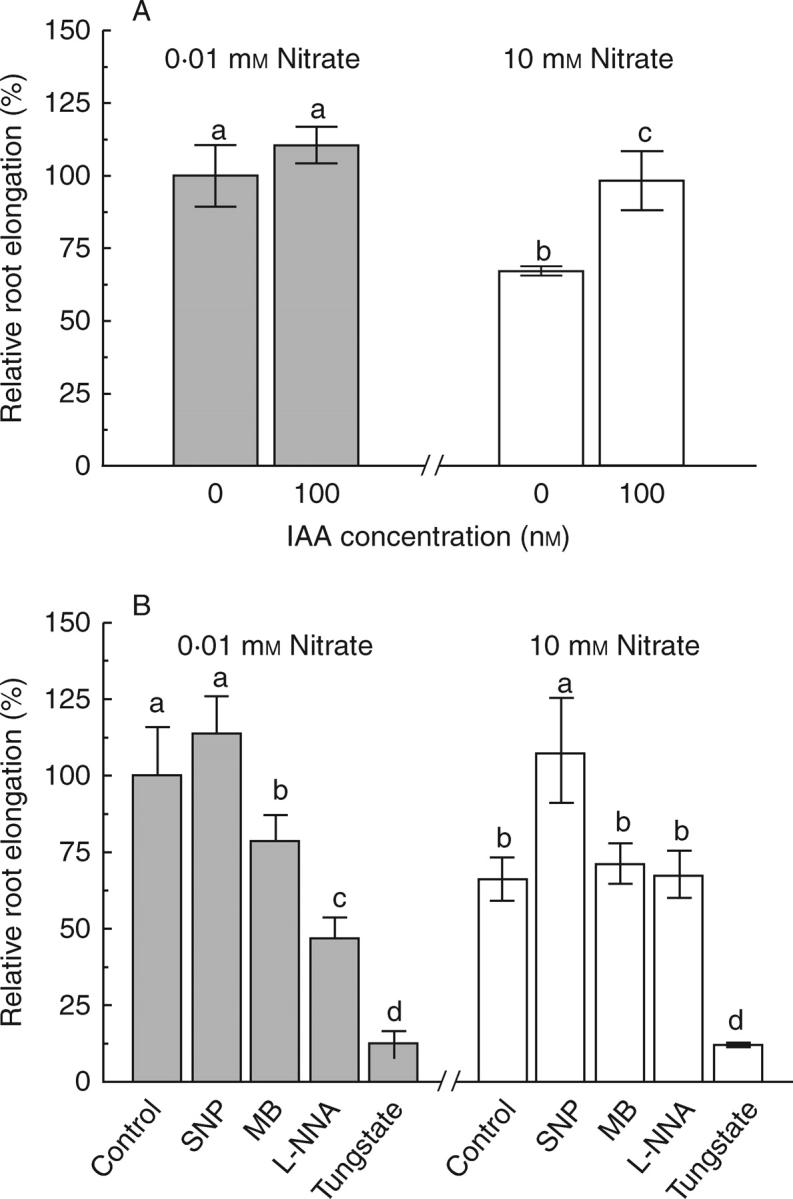
Responses of maize root elongation for seedlings grown in low- or high-nitrate solutions to (A) IAA, and (B) SNP, methylene blue (MB), L-NNA or tungstate. Seedlings were grown for 7 d in either 0·01 mm or 10 mm nitrate and then treated for 48 h with either 0·1 µm IAA, 1 µm SNP, 1 µm methylene blue, 100 µm L-NNA or 100 µm tungstate. Root elongation was expressed relative to the value obtained for seedlings grown in 0·01 mm nitrate without any other chemicals. Data are means ± s.e. of at least eight roots for each treatment. Different letters indicate significantly different values (P = 0·05).
F<sc>ig</sc>. 4.
Fig. 4.
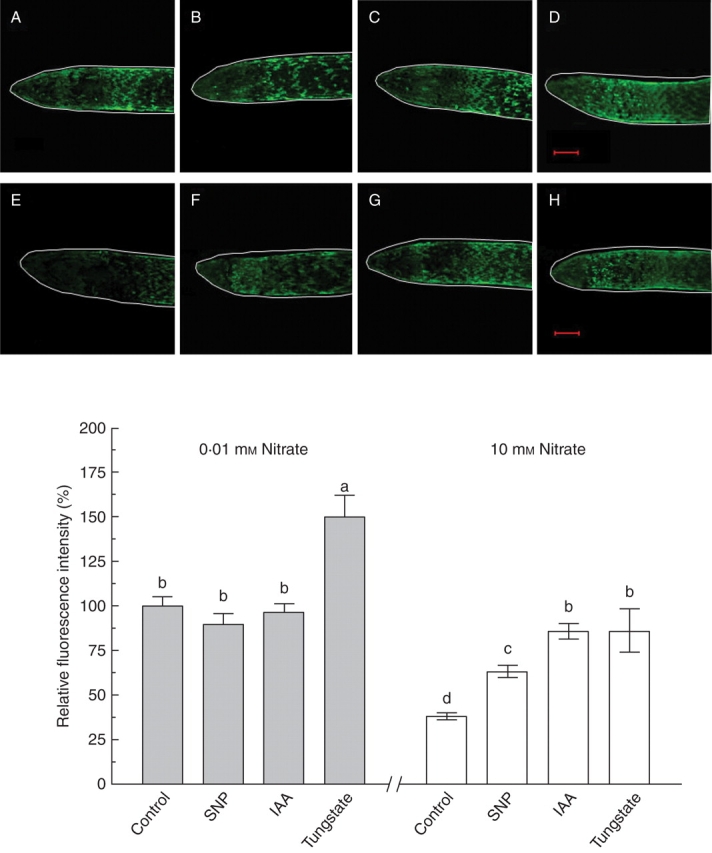
Effects of incubate with SNP, IAA and tungstate for 48 h on endogenous NO levels in primary root apices of maize plants grown in low- (0·01 mm) or high- (10 mm) nitrate solution for 7 d. The NO-specific fluorescent dye DAF-2DA was loaded into roots and fluorescence was detected by a confocal microscopy. Representative images are shown, and scale bars = 500 µm. (A–D) are roots grown in low nitrate (0.01 mM) without any other treatment (A), (B–D) are roots grown in low nitrate and treated with 1 µM SNP (B), 100 nM IAA (C) and 100 µM tungstate (D); (E–F) are roots grown in high nitrate (10 mM) without other treatment (E) and treated with 1 µM SNP (F), 100 nM IAA (G) and 100 µM tungstate (H), respectively. The graph below shows mean fluorescence intensities in the root apices expressed as pixel numbers relative to those measured in 0·01 mm nitrate (G). Data are means ± s.e. from measurements of at least six roots for each treatment. Different letters indicate significantly different values (P = 0·05).

References

    1. Blilou I, Xu J, Wildwater M, Willemsen V, Paponov I, Friml J, et al. The PIN auxin efflux facilitator network controls growth and patterning in Arabidopsis roots. Nature. 2005;433:39–44. - PubMed
    1. Correa-Aragunde N, Graziano M, Lamattina L. Nitric oxide plays a central role in determining lateral root development in tomato. Planta. 2004;218:900–905. - PubMed
    1. Crawford NM, Galli M, Tischner R, Heimer YM, Okamoto M, Mack A. Response to Zemojtel et al. 2006. Plant nitric oxide synthase: back to square one. Trends in Plant Science. 2006;11:526–527.
    1. Desikan R, Griffiths R, Hancock J, Neill S. A new role for an old enzyme: nitrate reductase-mediated nitric oxide generation is required for abscisic acid-induced stomatal closure in Arabidopsis thaliana. Proceedings of the National Academy of Sciences USA. 2002;99:16314–16318. - PMC - PubMed
    1. Forde BG. Local and long-range signaling pathways regulating plant responses to nitrate. Annual Review of Plant Biology. 2002;53:203–224. - PubMed

Publication types

MeSH terms