. 2007 Aug 28;104(35):14169-74.
doi: 10.1073/pnas.0705521104. Epub 2007 Aug 20.

Mendel's green cotyledon gene encodes a positive regulator of the chlorophyll-degrading pathway

Affiliations

Mendel's green cotyledon gene encodes a positive regulator of the chlorophyll-degrading pathway

Yutaka Sato et al. Proc Natl Acad Sci U S A. .

Abstract

Mutants that retain greenness of leaves during senescence are known as "stay-green" mutants. The most famous stay-green mutant is Mendel's green cotyledon pea, one of the mutants used in determining the law of genetics. Pea plants homozygous for this recessive mutation (known as i at present) retain greenness of the cotyledon during seed maturation and of leaves during senescence. We found tight linkage between the I locus and stay-green gene originally found in rice, SGR. Molecular analysis of three i alleles including one with no SGR expression confirmed that the I gene encodes SGR in pea. Functional analysis of sgr mutants in pea and rice further revealed that leaf functionality is lowered despite a high chlorophyll a (Chl a) and chlorophyll b (Chl b) content in the late stage of senescence, suggesting that SGR is primarily involved in Chl degradation. Consistent with this observation, a wide range of Chl-protein complexes, but not the ribulose-1,5-bisphosphate carboxylase/oxygenase (Rubisco) large subunit, were shown to be more stable in sgr than wild-type plants. The expression of OsCHL and NYC1, which encode the first enzymes in the degrading pathways of Chl a and Chl b, respectively, was not affected by sgr in rice. The results suggest that SGR might be involved in activation of the Chl-degrading pathway during leaf senescence through translational or posttranslational regulation of Chl-degrading enzymes.


Conflict of interest statement

The authors declare no conflict of interest.

Figures
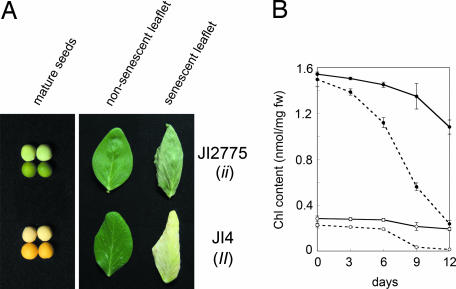
Fig. 1.
Fig. 1.
Stay-green phenotype of the i mutant in pea. (A) Seed color phenotype and naturally senescent leaves of JI4 (II) and JI2775 (ii). (Left) mature seeds with (Upper) and without (Lower) seed coats. (Right) Nonsenescent (Left) and naturally senescent (Right) leaves. Some parts of the senescent leaflet of JI4 and JI2775 are dead, suggesting that both leaflets are in the very late stage of leaf senescence. JI2775 retained greenness even at this stage. (B) Change in Chl content in pea during dark incubation. Detached leaves of the same fresh weight were extracted with the same volume of 80% acetone, and Chl contents were measured spectrophotometrically. Solid line, JI2775; dotted line, JI4; filled circles, Chl a; open circles, Chl b. Bars indicate standard errors; n = 3.
Fig. 2.
Fig. 2.
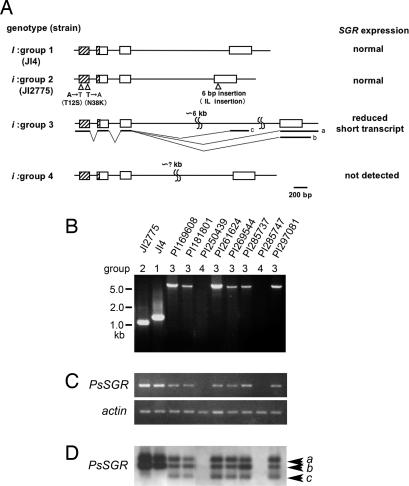
Molecular analysis of the i alleles. (A) Genomic structures of four groups of PsSGR. Group 1 is the wild type (I) and groups 2–4 are mutants (i). Boxes represent exons, and lines are UTRs and introns. Hatched regions correspond to the transit peptide. Bars a, b, and c under the group 3 genome structure indicate the three kinds of transcripts observed in group 3. In group 2, two amino acid substitutions and a two-amino acid insertion were found. The expression level and splicing were normal. In group 3, the third intron was very long, and a short transcript, shown as transcript c, derived from a cryptic splice site, was detected. Transcripts a and b differ in the length of 3′-UTR, and these transcripts were also observed in other groups (see D). The expression level was reduced (see C). In group 4, no amplification of the third intron was observed in genomic PCR, although all exons were retained. mRNA was not detected by RT-PCR analysis (see C). (B) Genomic PCR analysis of the third intron. The strain name and corresponding group are shown above each lane. (C) Semiquantitative RT-PCR analysis of PsSGR. RNA was extracted from leaves incubated in the dark at 18°C for 10 days. The amplified PCR product corresponded to the second to forth exons. Actin was amplified as a reference. (D) RT-PCR Southern blot analysis of the 3′-RACE products using the same RNA as in C. Arrowheads a, b, and c correspond to transcripts a, b, and c in A.
Fig. 3.
Fig. 3.
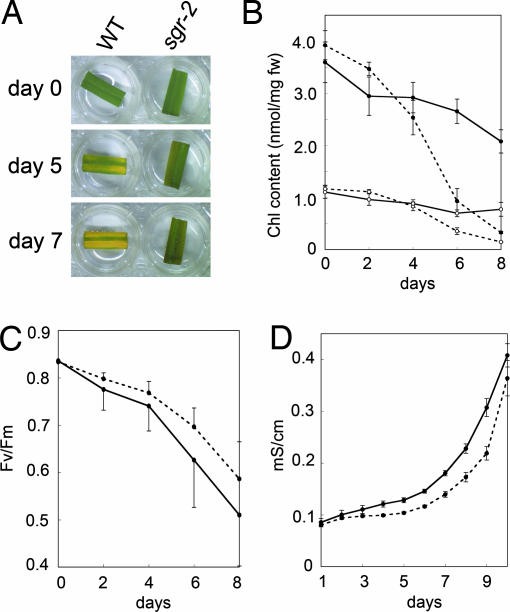
Physiological analysis of senescence in the rice sgr mutant. (A) Dark-induced leaf senescence in sgr-2. (B) Change in Chl content during dark incubation in rice. Chl contents were measured as in Fig. 1B. Solid line, sgr-2; dotted line, WT; filled circles, Chl a; open circles, Chl b. Bars indicate standard errors; n = 3. (C) Fv/Fm values. Solid line, sgr-2; Dotted line, WT. Bars indicate standard errors; n = 3. (D) Membrane ion leakage. Solid line, sgr-2; dotted line, WT. Bars indicate standard errors; n = 11.
Fig. 4.
Fig. 4.
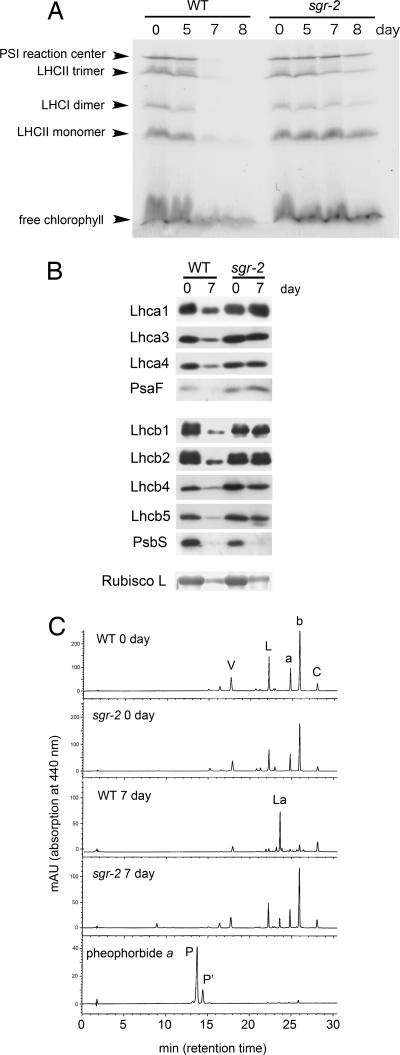
Protein and pigment degradation during senescence in the rice sgr mutant. (A) Change in Chl-binding proteins during dark incubation. The gel was visualized by Chl bound to proteins (green gel). (B) Western blot analysis of photosynthetic proteins from nonsenescent (0 DDI) and senescent (7 DDI) leaves. Rubisco large subunit (Bottom) was detected by SDS/PAGE analysis with Coomassie brilliant blue G 250. (C) HPLC elution profiles of photosynthetic pigments extracted from the rice leaves measured at 440 nm. Extracts from nonsenescent (0 day) and fully senescent (7 day) leaves of WT and sgr-2 were analyzed. Pheophorbide a indicates the HPLC elution profile of commercially available pheophorbide a. V, violaxanthin; L, lutein; La, lutein 3-acetate; b, Chl b; a, Chl a; C, β-carotene; P, Pheide a; P′, an epimer of Pheide a; AU, absorption unit.
Fig. 5.
Fig. 5.
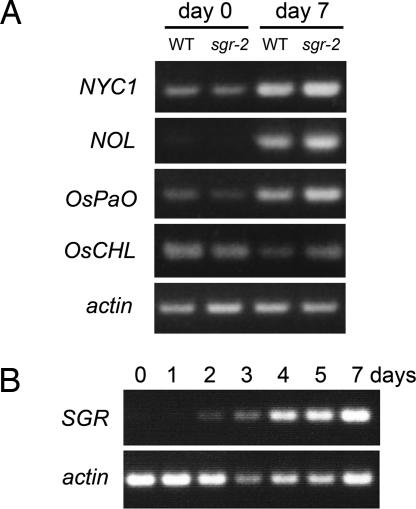
Expression of SGR and the genes encoding enzymes in the Chl-degrading pathway. (A) Semiquantitative RT-PCR analysis of the genes encoding enzymes in the Chl-degrading pathway in dark-induced senescent leaves. (Bottom) Expression of actin as a reference. (B) Semiquantitative RT-PCR analysis of SGR expression during dark-induced senescence. (Bottom) Expression of actin as a reference.
Fig. 6.
Fig. 6.
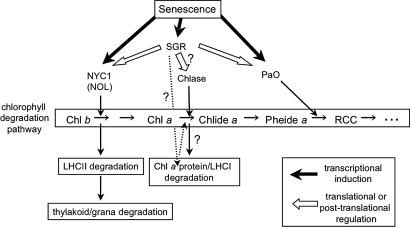
Model of SGR function during leaf senescence. NYC1, NOL, Chlase, and PaO are the enzymes in the Chl-degrading pathway. Chl b is converted into Chl a and metabolized in the Chl a-degrading pathway. The first step of this conversion is catalyzed by the Chl b reductase NYC1. Chl b degradation is necessary for LHCII degradation and thylakoid/grana degradation in senescent leaves. NOL, another Chl b reductase, may also have a minor role in Chl b degradation during leaf senescence (3). Chlase forms Chlide a by dephytylation of Chl a, the major Chl species in higher plants. PaO converts Pheid a into the nongreen compound RCC. Senescence signals induce expression of NYC1, NOL, SGR, and PaO (bold arrows). SGR is involved in Chl b degradation and the resultant LHCII degradation via translational/posttranslational regulation of NYC1 (white arrows). Similarly, SGR might be involved in Chl a degradation via posttranslational regulation of Chlase (white arrows) because posttranslational regulation may be important for in vivo activity of Chlase (20). Alternatively, SGR might be involved in Chl a degradation via the regulation of Chl a-containing protein stability (dashed arrows). In addition, PaO activity is regulated by SGR at the translational/posttranslational level (21).

References

    1. Matile P. Exp Gerontol. 2000;35:145–158. - PubMed
    1. Hörtensteiner S. Annu Rev Plant Biol. 2006;57:55–77. - PubMed
    1. Kusaba M, Ito H, Morita R, Iida S, Sato Y, Fujimoto M, Kawasaki S, Tanaka R, Hirochika H, Nishimura M, et al. Plant Cell. 2007;19:1362–1375. - PMC - PubMed
    1. Thomas H, Howarth J. J Exp Bot. 2000;51:329–337. - PubMed
    1. Lim PO, Woo HR, Nam HG. Trends Plant Sci. 2003;8:272–278. - PubMed

Publication types

LinkOut - more resources