


Repetitive transcranial magnetic stimulation as an adjunct to constraint-induced therapy: an exploratory randomized controlled trial
- PMID: 17709994
- PMCID: PMC2605430
- DOI: 10.1097/PHM.0b013e31813e0de0
Repetitive transcranial magnetic stimulation as an adjunct to constraint-induced therapy: an exploratory randomized controlled trial
Abstract
Objective: To test the potential adjuvant effect of repetitive transcranial magnetic stimulation (rTMS) on motor learning in a group of stroke survivors undergoing constraint-induced therapy (CIT) for upper-limb hemiparesis.
Design: This was a prospective randomized, double-blind, sham-controlled, parallel group study. Nineteen individuals, one or more years poststroke, were randomized to either a rTMS + CIT (n = 9) or a sham rTMS + CIT (n = 10) group and participated in the 2-wk intervention.
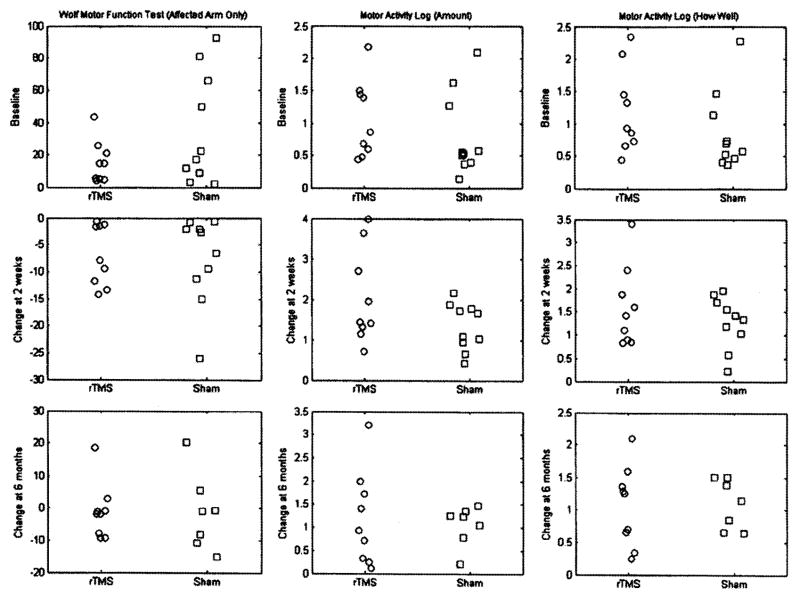
Results: Regardless of group assignment, participants demonstrated significant gains on the primary outcome measures: the Wolf Motor Function Test (WMFT) and the Motor Activity Log (MAL)--Amount of Use, and on secondary outcome measures including the Box and Block Test (BBT) and the MAL--How Well. Participants receiving rTMS failed to show differential improvement on either primary outcome measure.
Conclusions: Although this study provided further evidence that even relatively brief sessions of CIT can have a substantial effect, it provided no support for adjuvant use of rTMS.
Figures
References
-
- Barker AT, Jalinous R, Freeston IL. Non-invasive magnetic stimulation of human motor cortex. Lancet. 1985;1:1106–7. - PubMed
-
- Di Lazzaro V, Oliviero A, Berardelli A, et al. Direct demonstration of the effects of repetitive transcranial magnetic stimulation on the excitability of the human motor cortex. Exp Brain Res. 2002;144:549–53. - PubMed
-
- Peinemann A, Reimer B, Loer C, et al. Long-lasting increase in corticospinal excitability after 1800 pulses of subthreshold 5 Hz repetitive TMS to the primary motor cortex. Clin Neurophysiol. 2004;115:1519–26. - PubMed
-
- Pascual-Leone A, Tormos JM, Keenan J, Tarazona F, Canete C, Catala MD. Study and modulation of human cortical excixility with transcranial magnetic stimulation. J Clin Neuropsychol. 1998;15:333–43. - PubMed
-
- Weber M, Eisen AA. Magnetic stimulation of the central and peripheral nervous systems. Muscle Nerve. 2002;25:160–75. - PubMed
Publication types
MeSH terms
Grants and funding
LinkOut - more resources
Full Text Sources
Medical
Research Materials
