Review
. 2007 Aug 3:5:e006.
doi: 10.1621/nrs.05006.

Steroid receptor RNA activator (SRA1): unusual bifaceted gene products with suspected relevance to breast cancer

Affiliations
Review

Steroid receptor RNA activator (SRA1): unusual bifaceted gene products with suspected relevance to breast cancer

Etienne Leygue. Nucl Recept Signal. .

Abstract

The steroid receptor RNA activator (SRA) is a unique modulator of steroid receptor transcriptional activity, as it is able to mediate its coregulatory effects as a RNA molecule. Recent findings, however, have painted a more complex picture of the SRA gene (SRA1) products. Indeed, even though SRA was initially thought to be noncoding, several RNA isoforms have now been found to encode an endogenous protein (SRAP), which is well conserved among Chordata. Although the function of SRAP remains largely unknown, it has been proposed that, much like its corresponding RNA, the protein itself might regulate estrogen and androgen receptor signaling pathways. As such, data suggest that both SRA and SRAP might participate in the mechanisms underlying breast, as well as prostate tumorigenesis. This review summarizes the published literature dealing with these two faces of the SRA gene products and underscores the relevance of this bifaceted system to breast cancer development.


Figures
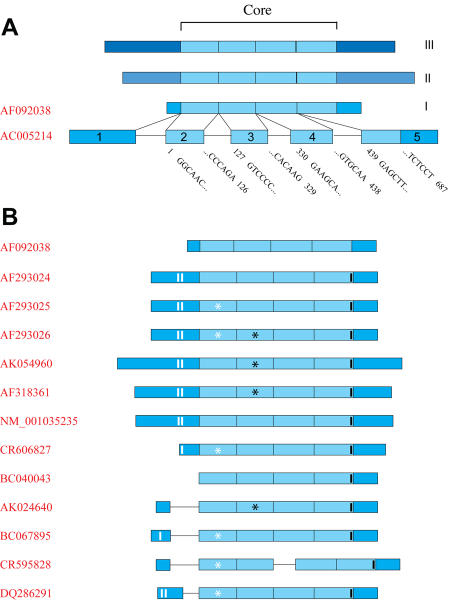
Figure 1
Figure 1. SRA1 genomic structure and transcripts.
A. Original SRA transcripts. Three SRA sequences (I, II and II) were originally described, differing in their 5' and 3' extremities, but sharing a central core sequence depicted in light blue [Lanz et al., 1999]. One sequence has been registered with the NCBI nucleotide database (AF092038). Alignment with chromosome 5q31.3 genomic sequence is provided. Introns and exons are represented by black lines and blue boxes, respectively. B. Currently identified SRA transcripts. Thirteen sequences, corresponding to all SRA transcripts identified to date, have been aligned with the genomic sequence of chromosome 5q31.3 (AC005214). White and black strips indicate the position of SRAP translation start and stop codons, respectively. White and black stars correspond to a point mutation in exon-2 (position 98 of the core: U to C) and a point mutation followed by a full codon (position 271 of the core: G to CGAC), respectively.
Figure 2
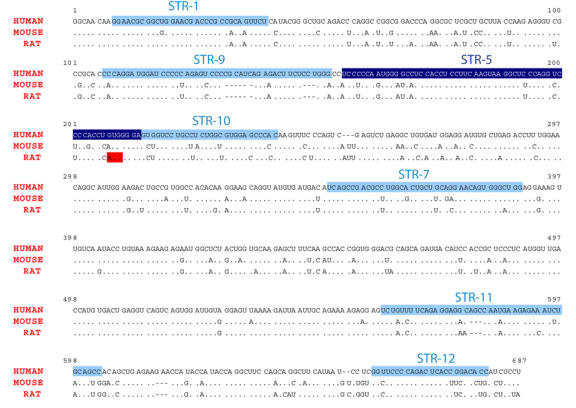
Figure 2. Alignment of human, mouse and rat core SRA RNA sequences.
Nucleotide sequences corresponding to structures shown to be functionally relevant (STR1, 9, 5, 10, 7, 11 and 12) are boxed in blue [Lanz et al., 2002]. STR5 structure, containing an important pseudouridylation site at position 207 ([Zhao et al., 2007], and see the subsection "Effect of SRA on ER-α and ER-β-mediated transcription") is shaded in dark blue. AUG codon at position 208 in the rat sequence (and referred to in the subsection "SRAP function") is boxed in red.
Figure 3
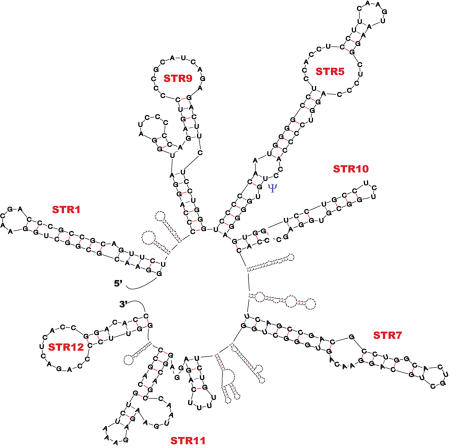
Figure 3. Schematic profile of the predicted secondary structure of human core SRA RNA.
The secondary structure profile of SRA core sequence has been modeled using Mfold software [Zuker, 2003]. Detailed structure of STR1, 9, 5, 10, 7, 11 and 12 [Lanz et al., 2002] is provided. The position of Uridine residue 207 in STR-5, found to be a site of pseudouridylation (see the "Emerging mechanism of action subsection"), is shown by a blue Ψ.
Figure 4
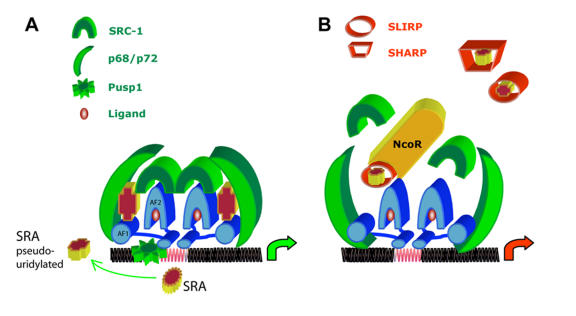
Figure 4. Emerging putative model of SRA RNA action on ER-α signaling.
A. Activation of ER-α gene expression by SRA RNA. Pus1p (green wheel), which is able to bind the DNA binding domain of all nuclear receptors, pseudouridylates specific SRA RNA uridine residues, leading to an optimum configuration of this RNA. The resulting SRA-ψ (cross), could now form a stabilizing complex with p68 (green crescent able to bind SRC-1 and ER-α AF-1 region) and SRC-1 (green horseshoe). Transcription of target genes with suitable ERE (red elements on DNA) will occur. It should be stressed that the physical presence of SRA RNA at the level of promoter has not yet been established experimentally. Similarly, the kinetics of events involving these molecules at the promoter site, as well as the possible effect of specific ligands (red sphere), remain to determined. B. Inhibition of SRA RNA-mediated ER-α. SLIRP (hollow red cylinder) and SHARP (hollow trapeze) act as negative regulators. It has been proposed that they might act by sequestrating SRA, by destabilizing the complex SRA/SRC-1 or by recruiting the nuclear receptor corepressor N-CoR at the promoter region of silenced genes. ER-α ligand binding domain, DNA binding domain and AF-1 domain are shown in blue horseshoe, flat elliptic cylinder and blue cylinder, respectively.
Figure 5
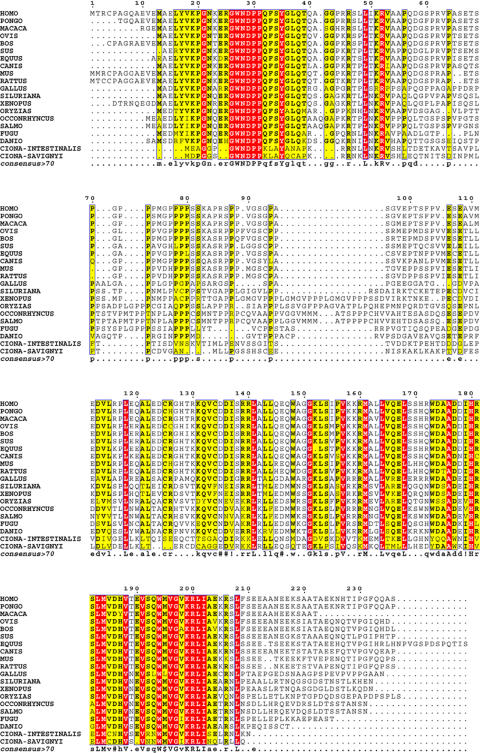
Figure 5. Alignment of SRA protein-related sequences.
Putative SRA protein sequence homologues corresponding to 20 Chordata species are aligned. The numbers indicated on top of the alignment correspond to amino acid numbering of the human SRAP isoform 1. Amino acids conserved in all species are in red letters, whereas those observed in between 70% and 100% of all species are in yellow. Within the consensus sequence, #, ! and $ stand for D or E, I or V, M or L, respectively.

References

    1. Ali S., Metzger D., Bornert J. M., Chambon P. Modulation of transcriptional activation by ligand-dependent phosphorylation of the human oestrogen receptor A/B region. Embo J. 1993;12:1153–60. - PMC - PubMed
    1. Anderson E., Clarke R. B. Steroid receptors and cell cycle in normal mammary epithelium. J Mammary Gland Biol Neoplasia. 2004;9:3–13. - PubMed
    1. Barkhem T., Carlsson B., Nilsson Y., Enmark E., Gustafsson J., Nilsson S. Differential response of estrogen receptor α and estrogen receptor β to partial estrogen agonists/antagonists. Mol Pharmacol. 1998;54:105–12. - PubMed
    1. Caretti G., Lei E. P., Sartorelli V. The DEAD-box p68/p72 proteins and the noncoding RNA steroid receptor activator SRA: eclectic regulators of disparate biological functions. Cell Cycle. 2007;6:1172–6. - PubMed
    1. Caretti G., Schiltz R. L., Dilworth F. J., Di Padova M., Zhao P., Ogryzko V., Fuller-Pace F. V., Hoffman E. P., Tapscott S. J., Sartorelli V. The RNA helicases p68/p72 and the noncoding RNA SRA are coregulators of MyoD and skeletal muscle differentiation. Dev Cell. 2006;11:547–60. - PubMed

Publication types