Proprioception contributes to the sense of agency during visual observation of hand movements: evidence from temporal judgments of action
- PMID: 17714014
- PMCID: PMC2570482
- DOI: 10.1162/jocn.2007.19.9.1535
Proprioception contributes to the sense of agency during visual observation of hand movements: evidence from temporal judgments of action
Abstract
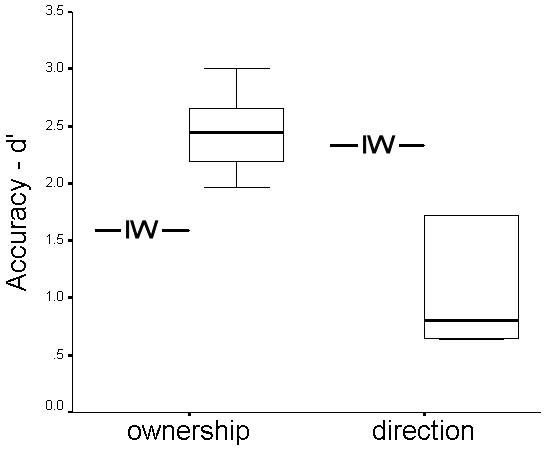
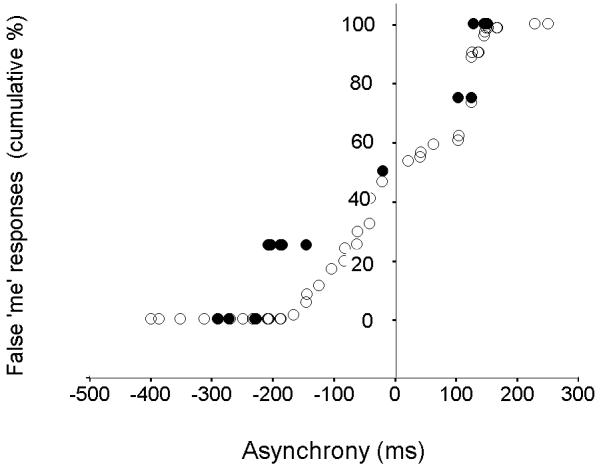
The ability to recognize visually one's own movement is important for motor control and, through attribution of agency, for social interactions. Agency of actions may be decided by comparisons of visual feedback, efferent signals, and proprioceptive inputs. Because the ability to identify one's own visual feedback from passive movements is decreased relative to active movements, or in some cases is even absent, the role of proprioception in self-recognition has been questioned. Proprioception during passive and active movements may, however, differ, and so to address any role for proprioception in the sense of agency, the active movement condition must be examined. Here we tested a chronically deafferented man (I.W.) and an age-matched group of six healthy controls in a task requiring judgement of the timing of action. Subjects performed finger movements and watched a visual cursor that moved either synchronously or asynchronously with a random delay, and reported whether or not they felt they controlled the cursor. Movement accuracy was matched between groups. In the absence of proprioception, I.W. was less able than the control group to discriminate self- from computer-produced cursor movement based on the timing of movement. In a control visual discrimination task with concurrent similar finger movements but no agency detection, I.W. was unimpaired, suggesting that this effect was task specific. We conclude that proprioception does contribute to the visual identification of ownership during active movements and, thus, to the sense of agency.
Figures
References
-
- Blakemore SJ, Wolpert DM, Frith CD. Central cancellation of self-produced tickle sensation. Nat Neurosci. 1998;1:635–40. - PubMed
-
- Facchini S, Aglioti SM. Short term light deprivation increases tactile spatial acuity in humans. Neurology. 2003;60:1998–9. - PubMed
-
- Farrer C, Franck N, Paillard J, Jeannerod M. The role of proprioception in action recognition. Conscious Cogn. 2003;12:609–19. - PubMed
-
- Frith C. The role of the prefrontal cortex in self-consciousness: the case of auditory hallucinations. Philos Trans R Soc Lond B Biol Sci. 1996;351:1505–12. - PubMed
Publication types
MeSH terms
Grants and funding
LinkOut - more resources
Full Text Sources
Medical