


The spectra of large second-step mutations are similar for two different mouse autosomes
- PMID: 17714739
- PMCID: PMC2233933
- DOI: 10.1016/j.mrfmmm.2007.07.001
The spectra of large second-step mutations are similar for two different mouse autosomes
Abstract
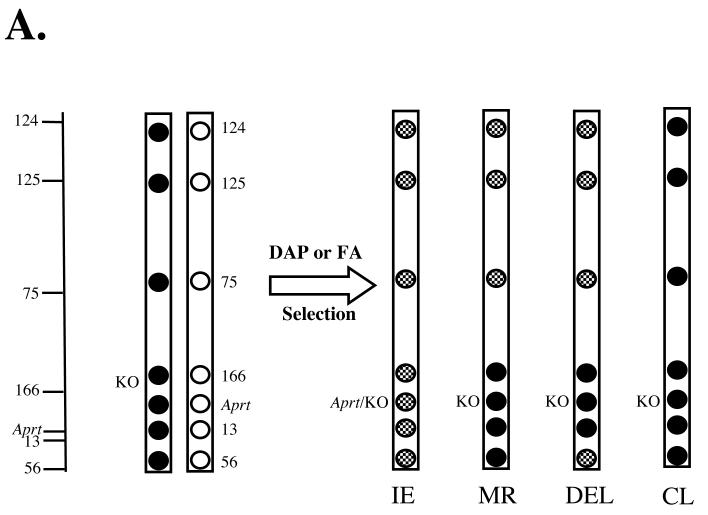
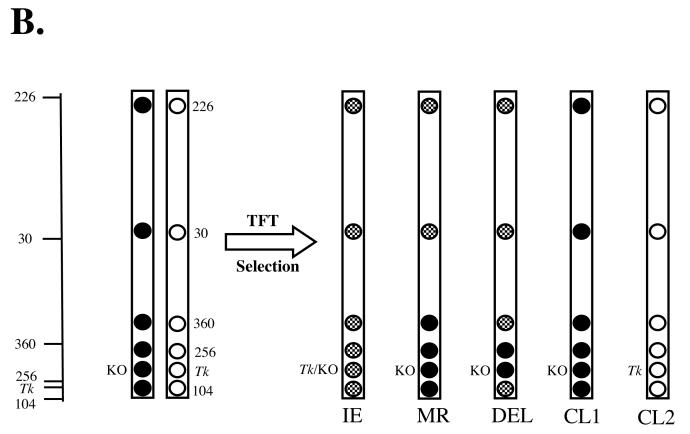
Loss of tumor suppressor gene expression via mutations plays a critical role in cancer development, particularly when occurring in heterozygous cells. These so-called "second-step" mutational events are often large in size and arise most often from chromosome loss, mitotic recombination, or interstitial deletion. An open question in cancer research is whether different chromosomes are equally susceptible to formation of large mutations, or alternatively if the unique sequence of each chromosome will lead to chromosome-specific mutational spectra. To address this question, the spectra of second-step mutations were determined for chromosomes 8 and 11 in Aprt and Tk mutants, respectively, isolated from primary kidney clones heterozygous for both loci. The results showed that the spectra of large mutational events were essentially the same. This observation suggests that internal and external cellular environments provide the driving force for large autosomal mutational events, and that chromosome structure per se is the substrate upon which these forces act.
Figures
References
-
- Knudson AG. Two genetic hits (more or less) to cancer. Nature Rev Cancer. 2001;1:157–162. - PubMed
-
- Turker MS. Autosomal mutation in somatic cells of the mouse. Mutagenesis. 2003;18:1–6. - PubMed
-
- Ponomareva ON, Rose JA, Lasarev M, Rasey J, Turker MS. Tissue-specific Deletion and Discontinuous Loss of Heterozygosity Are Signatures for the Mutagenic Effects of Ionizing Radiation in Solid Tissues. Cancer Res. 2002;62:1518–1523. - PubMed
-
- Von Tungeln LS, Williams LD, Doerge DR, Shaddock JG, McGarrity LJ, Morris SM, Mittelstaedt RA, Heflich RH, Beland FA. Transplacental drug transfer and frequency of Tk and Hprt lymphocyte mutants and peripheral blood micronuclei in mice treated transplacentally with zidovudine and lamivudine. Environ Mol Mutagen. 2006 - PubMed
-
- Wijnhoven SW, Sonneveld E, Kool HJ, Van Teijlingen CM, Vrieling H. Chemical carcinogens induce varying patterns of LOH in mouse T- lymphocytes. Carcinogenesis. 2003;24:139–144. - PubMed
Publication types
MeSH terms
Substances
Grants and funding
LinkOut - more resources
Full Text Sources
