. 2007 Nov;156(1):41-50.
doi: 10.1016/j.molbiopara.2007.07.005. Epub 2007 Jul 17.

Histone modifications in Trypanosoma brucei

Affiliations

Histone modifications in Trypanosoma brucei

Veena Mandava et al. Mol Biochem Parasitol. 2007 Nov.

Abstract

Several biological processes in Trypanosoma brucei are affected by chromatin structure, including gene expression, cell cycle regulation, and life-cycle stage differentiation. In Saccharomyces cerevisiae and other organisms, chromatin structure is dependent upon posttranslational modifications of histones, which have been mapped in detail. The tails of the four core histones of T. brucei are highly diverged from those of mammals and yeasts, so sites of potential modification cannot be reliably inferred, and no cross-species antibodies are available to map the modifications. We therefore undertook an extensive survey to identify posttranslational modifications by Edman degradation and mass spectrometry. Edman analysis showed that the N-terminal alanine of H2A, H2B, and H4 could be monomethylated. We found that the histone H4 N-terminus is heavily modified, while, in contrast to other organisms, the histone H2A and H2B N-termini have relatively few modifications. Histone H3 appears to have a number of modifications at the N-terminus, but we were unable to assign many of these to a specific amino acid. Therefore, we focused our efforts on uncovering modification states of H4. We discuss the potential relevance of these modifications.


Figures

Fig. 1
Fig. 1
Representative sequence alignments of the N-termini of each core histone and the C-terminus of H2A. Identical residues are shaded. Important sites of homology, which are referred to in the text, are indicated by arrows. The sequence ruler, which is included only when the sequences are very concordant, is numbered according to the Homo sapiens sequence position. Residues found to be acetylated in T. brucei histones are indicated with an (*) and methylated residues with a (+). A putative site of ubiquitination at the H2A C-terminus is indicated with a (#). (A) H2A N-terminus. (B) H2A C-terminus. (C) H2B N-terminus. (D) H3 N-terminus. (E) H4 N-terminus.
Fig. 2
Fig. 2
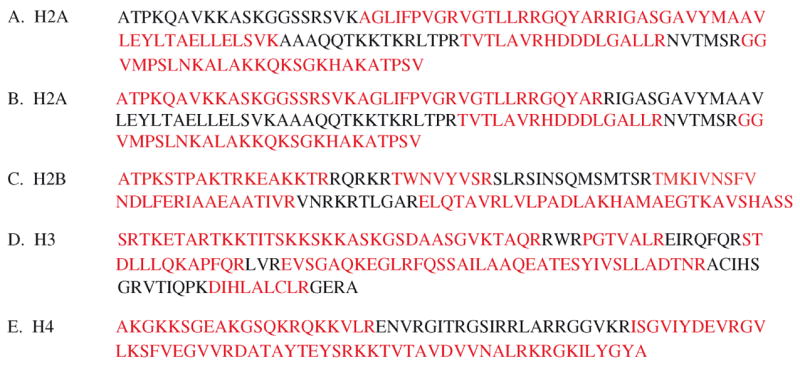
T. brucei histone sequences with regions for which tandem MS data were acquired after endoproteinase digestion highlighted in red. (A) H2A trypsin digest. (B) H2A PA-trypsin digest. (C) H2B PA-trypsin digest. (D) H3 PA-trypsin digest. (E) H4 PA-trypsin digest.
Fig. 3
Fig. 3
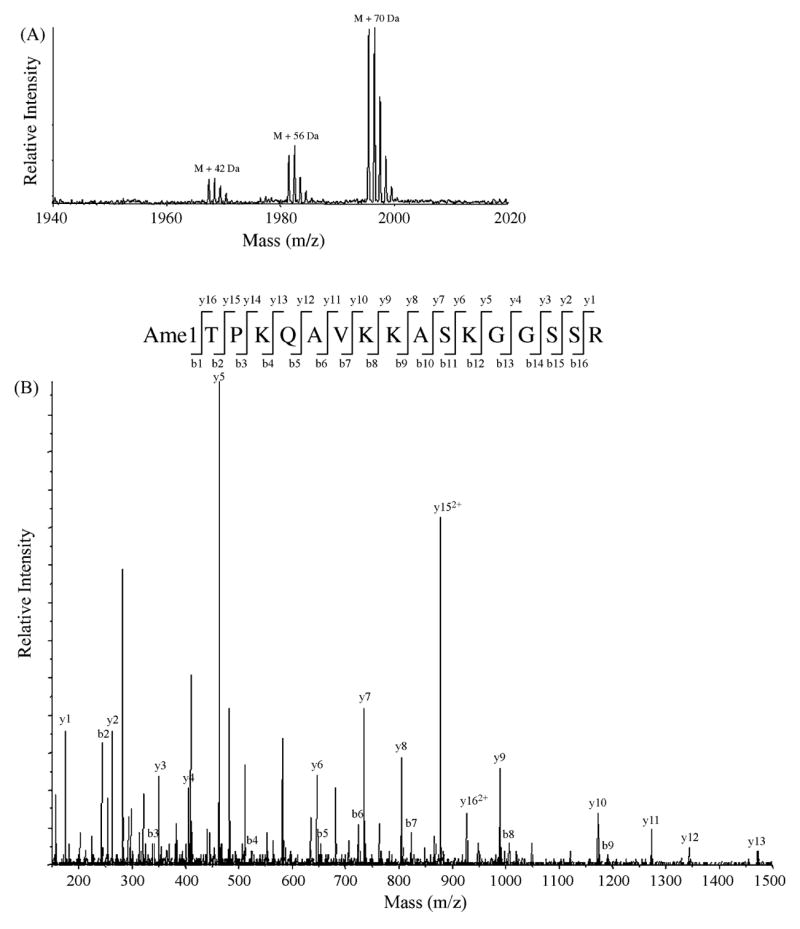
Histone H2A alanine 1 can be unmodified, acetylated, or monomethylated. H2A was propionylated and digested with trypsin. Peptide 1–17 (ATPKQAVKKASKGGSSR) was subjected to MALDI-TOF analysis and sequencing by tandem MS. (A) MALDI-TOF shows that peptide 1–17 is present in three modified states. M is the molecular mass ion of peptide 1–17 with all lysines propionylated (1924 Da). Tandem MS sequencing of peaks labeled M + 42 Da, M + 56 Da, and M + 70 Da species indicate that H2A A1 can be acetylated, propionylated (meaning it is unmodified), or both propionylated and monomethylated, respectively. Multiple peaks representing each modified peptide show the isotope pattern, with the first peak representing the monoisotopic m/z. (B) A representative tandem MS showing that H2A A1 is monomethylated. All of the b-series ions are shifted +70 Da relative to the unmodified species. Also, the difference between the MH+ of the spectrum (m/z 1995) and y16 provides the mass of the modified A1. y152+ and y162+ represent doubly charged ions [M + 2H]/[2+].
Fig. 4
Fig. 4
Histone H2B lysines 12 and 16 are acetylated. H2B was propionylated and digested by trypsin. Peptide 12–18 (KEAKKTR) was sequenced by tandem MS. A single MS spectrum contains two modified species, demonstrating that either K12 (b2″–b3″ and y3″–y6″) or K16 (b1′–b3′ and y3′–y6′) are acetylated. An arrow points to the immonium ion of acetylated lysine (m/z 126). b72+ and y72+ represent to doubly charged ions.
Fig. 5
Fig. 5
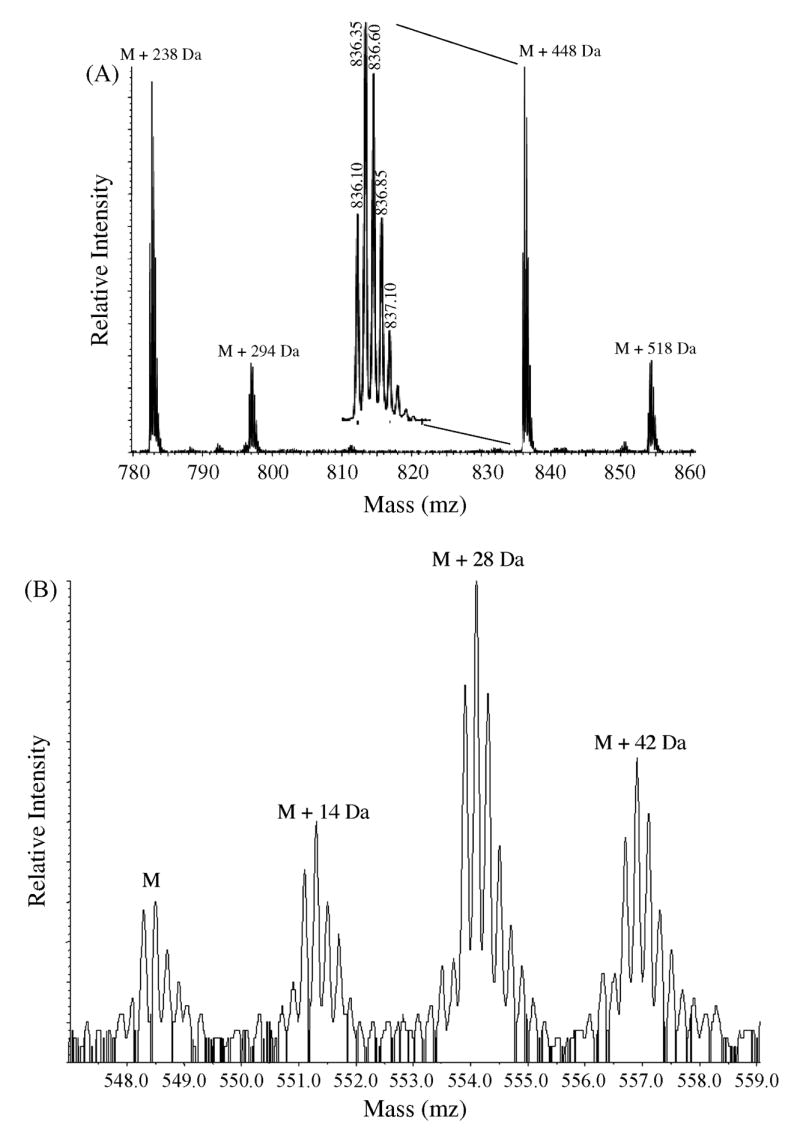
The N-terminus of histone H3 is present in multiple modification states. Quadrupole-quadrupole-TOF data were acquired for H3 digested with endoproteinases trypsin and Asp-N. M is the molecular ion mass of each peptide. (A) Propionylated H3 digested with trypsin produces peptide 9–36 (TKKTITSKKSKKASKGSDAASGVKTAQR), which was observed as [MH4]4+(m/z 723.9). Sequencing by tandem MS of the peptide labeled M + 448 Da shows that this is the species for which all 8 lysines are propionylated. Magnification of peak M + 448 Da (inset) shows the isotope pattern of this peptide, which enabled us to determine that this is a +4 species. Partial sequencing by tandem MS of the remaining three peaks confirms that they correspond to peptide 9–36, but modifications could not be assigned to specific parent residues. Based on the possible combinations allowed by the mass of the modified peptide, we speculate that M + 238 Da is a species that possesses 1 trimethyl (or acetyl) and 7 dimethyl lysines. We also speculate that M + 518 Da is a species that possesses either 5 monomethyl lysines or 1 trimethyl (or acetyl) and 6 monomethyl lysines. (B) Asp-N-digested H3 produces peptide 1–25 (SRTKETARTKKTITSKKSKKASKGS), which was observed at m/z 548.3 for [MH5]5+. Sequencing by tandem MS confirms that the peak labeled M is unmodified peptide 1–25. Partial sequencing by tandem MS of the three modified species M + 14 Da, M + 28 Da, and M + 42 Da confirms that they correspond to peptide 1–25, but modifications could not be assigned to specific parent residues.
Fig. 6
Fig. 6
Histone H4 peptide 9–22 is present in multiple modification states. H4 digested by endoproteinase Glu-C was fractionated by HPLC. MALDI-TOF data were acquired for 5 consecutive HPLC fractions. Sequencing by tandem MS confirmed that these peaks correspond to peptide 9–22 (AKGSQKRQKKVLRE). Peaks are separated by 14 Da, the molecular mass of a methyl group. M is the molecular ion mass of peptide 9–22 (1655 Da).

References

    1. Fischle W, Wang Y, Allis CD. Histone and chromatin cross-talk. Curr Opin Cell Biol. 2003;15:172–83. - PubMed
    1. Grunstein M. Histone acetylation in chromatin structure and transcription. Nature. 1997;389:349–52. - PubMed
    1. Brower-Toland B, Wacker DA, Fulbright RM, Lis JT, Kraus WL, Wang MD. Specific contributions of histone tails and their acetylation to the mechanical stability of nucleosomes. J Mol Biol. 2005;346:135–46. - PubMed
    1. Kuo MH, vom Baur E, Struhl K, Allis CD. Gcn4 activator targets Gcn5 histone acetyltransferase to specific promoters independently of transcription. Mol Cell. 2000;6:1309–20. - PubMed
    1. Kurdistani SK, Grunstein M. Histone acetylation and deacetylation in yeast. Nat Rev Mol Cell Biol. 2003;4:276–84. - PubMed

Publication types

LinkOut - more resources