. 2007 Nov;81(21):11560-8.
doi: 10.1128/JVI.00713-07. Epub 2007 Aug 22.

Immunization of primates with a Newcastle disease virus-vectored vaccine via the respiratory tract induces a high titer of serum neutralizing antibodies against highly pathogenic avian influenza virus

Affiliations

Immunization of primates with a Newcastle disease virus-vectored vaccine via the respiratory tract induces a high titer of serum neutralizing antibodies against highly pathogenic avian influenza virus

Joshua M DiNapoli et al. J Virol. 2007 Nov.

Abstract

The ongoing outbreak of highly pathogenic avian influenza virus (HPAIV) in birds, the incidence of transmission to humans with a resulting high mortality rate, and the possibility of a human pandemic warrant the development of effective human vaccines against HPAIV. We developed an experimental live-attenuated vaccine for direct inoculation of the respiratory tract based on recombinant avian Newcastle disease virus (NDV) expressing the hemagglutinin (HA) glycoprotein of H5N1 HPAIV (NDV-HA). Expression of the HPAIV HA gene slightly reduced NDV virulence, as evidenced by the increased mean embryo death time and reduced replication in chickens. NDV-HA was administered to African green monkeys in two doses of 2 x 10(7) infectious units each with a 28-day interval to evaluate the systemic and local antibody responses specific to H5N1 HPAIV. The virus was shed only at low titers from the monkeys, indicative of safety. Two doses of NDV-HA induced a high titer of H5N1 HPAIV-neutralizing serum antibodies in all of the immunized monkeys. Moreover, a substantial mucosal immunoglobulin A response was induced in the respiratory tract after one and two doses. The titers of neutralizing antibodies achieved in this study suggest that the vaccine would be likely to prevent mortality and reduce morbidity caused by the H5N1 HPAIV. In addition, induction of a local immune response in the respiratory tract is an important advantage that is likely to reduce or prevent transmission of the virus during an outbreak or a pandemic. This vaccine is a candidate for clinical evaluation in humans.


Figures
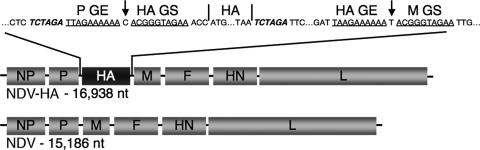
FIG. 1.
FIG. 1.
Genome of recombinant NDV bearing the HPAIV H5 HA coding sequence as an additional gene located between the P and M genes (NDV-HA). A cDNA of the codon-optimized HPAIV HA ORF was cloned into the P-M junction of the NDV antigenomic cDNA using XbaI sites (italicized) such that it was placed under the control of a set of NDV gene start (GS) and gene end (GE) transcription signals (underlined) directing its expression as a separate mRNA. NDV genes are shown as gray boxes, and the HPAIV HA insert is indicated as a black box. The nucleotide sequence spanning the inserted transcription cassette is shown at the top of the figure as positive-sense DNA. The single intergenic nucleotide located on either side of the inserted transcriptional unit is indicated by an arrow.
FIG. 2.
FIG. 2.
Northern blotting analysis of the HA transcripts. A portion (1.5 μg) of total intracellular RNA from cells infected with NDV or NDV-HA (as indicated) was separated on a 1.2% agarose gel, transferred to a membrane, and analyzed by hybridization with a radiolabeled HA-specific DNA probe. The positions and nucleotide lengths of single-stranded RNA markers (RiboRuler; Fermentas, Hanover, MD) are shown to the left. The most abundant product had the expected mobility of the full-length HA mRNA, with less abundant bands representing genomic RNA and unidentified readthrough transcripts, as indicated on the right.
FIG. 3.
FIG. 3.
Analysis of the expression of the HA protein, its incorporation into the vector particle, and trimerization. (A) Western blot analysis of NDV- and NDV-HA-infected cells and purified virions. Virions were purified from the clarified medium supernatants from infected cells by centrifugation over a sucrose gradient. Whole-cell lysates and purified virions were subjected to SDS-PAGE under denaturing and reducing conditions, followed by Western blot analysis of duplicate gels using antiserum raised against NDV virions (lanes 1 to 5) or a synthetic peptide representing the HPAIV HA1 subunit (lanes 6 to 10). Lanes 1 and 6, uninfected cell lysate; lanes 2 and 7, NDV-infected cell lysate; lanes 3 and 8, NDV-HA-infected cell lysate; lanes 4 and 9, purified NDV virions; lanes 5 and 10, purified NDV-HA virions. Cell lysate samples represent approximately equal numbers of cells, and virion samples represent approximately equal proportions of the purified virus preparations. (B) Analysis of NDV-HA following one (1x sucrose) and two (2x sucrose) rounds of purification by sucrose gradient centrifugation. Samples were subjected to SDS-PAGE under reducing and denaturing conditions. The gel in the panel on the left was analyzed by silver staining; the other two panels are replicate gels that were analyzed by Western blotting with polyclonal antibodies raised against NDV virions (middle panel) or a monoclonal antibody specific to the HA protein (right panel). Lanes 1, 3, 5, 7, 9, and 11, purified NDV virions; lanes 2, 4, 6, 8, 10, and 12, purified NDV-HA virions. The major NDV proteins HN, NP, F1, P, and M were identified according to published studies (, , , 29). (C) Cross-linking analysis of the HA protein present in sucrose gradient-purified NDV-HA virions. Aliquots of NDV virions (lanes 1 and 3) or NDV-HA virions (lanes 2 and 4) were mock-treated (lanes 1 and 2) or subjected to cross-linking with formaldehyde (lanes 3 and 4). The samples were subjected to denaturing/reducing SDS, followed by Western blotting with an HA-specific monoclonal antibody. All of the lanes are from a single gel. (D) Nondenaturing PAGE analysis of the HA protein present in sucrose gradient-purified NDV-HA virions. Aliquots of NDV virions (lanes 1 and 3) or NDV-HA virions (lanes 2 and 4) were left undenatured (lanes 1 and 2) or were heated at 95°C for 1 h (lanes 3 and 4), which was done to reduce and denature the samples without introducing diffusible reducing or denaturing agents that might affect adjacent lanes during PAGE. The samples were subjected to nondenaturing PAGE and analyzed by Western blotting with the HA-specific monoclonal antibody. All of the lanes were from a single gel. Molecular masses (in kilodaltons), shown to the left of the blots, were determined by loading a MagicMark XP marker (Invitrogen) on the reducing gels and a NativeMark marker (Invitrogen) on the nonreducing gel.
FIG. 4.
FIG. 4.
Immunoelectron microscopy of purified NDV and NDV-HA virus particles. Purified virus preparations were adsorbed to grids, and antigens were detected with the same NDV- and HPAIV HA1-specific antibodies used in the Western blot analysis in Fig. 3, as indicated at the left, followed by gold-bead-labeled secondary antibodies. The grids were subjected to negative staining and analyzed by transmission electron microscopy. The virus particle size and morphology correspond to that previously described for NDV: generally rounded particles 100 to 500 nm in diameter (1).

Comment in

References

    1. Alexander, D. J. 1991. Newcastle disease and other paramyxovirus infections, p. 496-519. In B. W. Calnek, H. J. Barnes, C. W. Beard, W. M. Reid, and H. W. Yoder, Jr (ed.), Diseases of poultry, 9th ed. Iowa State University Press, Ames, IA.
    1. Bukreyev, A., Z. Huang, L. Yang, S. Elankumaran, M. St. Claire, B. R. Murphy, S. K. Samal, and P. L. Collins. 2005. Recombinant Newcastle disease virus expressing a foreign viral antigen is attenuated and highly immunogenic in primates. J. Virol. 79:13275-13284. - PMC - PubMed
    1. Bukreyev, A., E. W. Lamirande, U. J. Buchholz, L. N. Vogel, W. R. Elkins, M. St Claire, B. R. Murphy, K. Subbarao, and P. L. Collins. 2004. Mucosal immunization of African green monkeys (Cercopithecus aethiops) with an attenuated parainfluenza virus expressing the SARS coronavirus spike protein for the prevention of SARS. Lancet 363:2122-2127. - PMC - PubMed
    1. Bukreyev, A., P. E. Rollin, M. K. Tate, L. Yang, S. R. Zaki, W. J. Shieh, B. R. Murphy, P. L. Collins, and A. Sanchez. 2007. Successful topical respiratory tract immunization of primates against Ebola virus. J. Virol. 81:6379-6388. - PMC - PubMed
    1. Clements, M. L., M. H. Snyder, A. J. Buckler-White, E. L. Tierney, W. T. London, and B. R. Murphy. 1986. Evaluation of avian-human reassortant influenza A/Washington/897/80 x A/Pintail/119/79 virus in monkeys and adult volunteers. J. Clin. Microbiol. 24:47-51. - PMC - PubMed

Publication types

LinkOut - more resources