


Medicaid's expenditures for newer pharmacotherapies for adults with disabilities
- PMID: 17722749
- PMCID: PMC4194999
Medicaid's expenditures for newer pharmacotherapies for adults with disabilities
Abstract
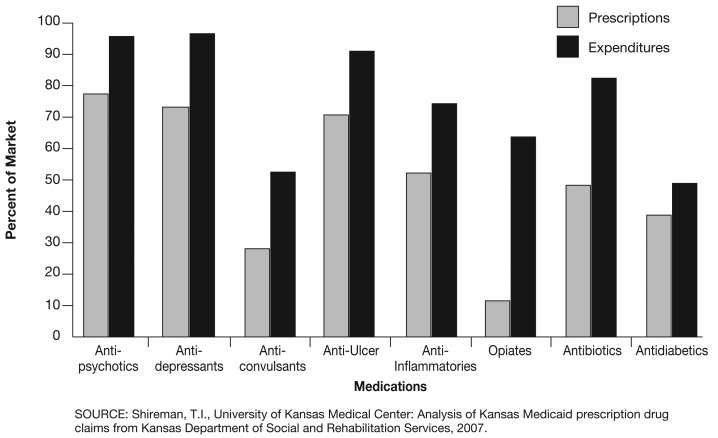
Medicaid's drug expenditures have grown at double-digit inflation rates since 2000. These prescription drug costs are important contributors to increasing health care costs for disabled persons. In spite of this knowledge, little has been reported about specific patterns of medication use among disabled enrollees. We analyzed Kansas Medicaid data to describe trends in medication use patterns across 3 years among disabled beneficiaries. The marked shifts toward newer medications and disproportionate contributions of newer, more expensive medications to overall prescription costs for antipsychotics, antidepressants, anticonvulsants, antiulcer medications, anti-inflammatory agents, and opioids have implications for both policy and practice.
Figures
References
-
- Centers for Disease Control and Prevention. International Classification of Diseases, Ninth Revision, Clinical Modification (ICD-9-CM) Internet address: http://www.cdc.gov/nchs/about/otheract/icd9/abticd9.htm (Accessed 2007.)
-
- Crowley JS, Ashner D, Elam L. State Medicaid Outpatient Prescription Drug Policies: Findings from a National Survey, 2005 Update. The Henry J. Kaiser Family Foundation; Washington, DC.: Oct, 2005. Internet address: http://www.kff.org/medicaid/7381.cfm (Accessed 2007.)
-
- Dai C, Stafford R, Alexander G. National Trends in Cyclooxygenase-2 Inhibitor Use Since Market Release: Nonselective Diffusion of a Selectively Cost-Effective Innovation. Archives of Internal Medicine. 2005 Jan;165:171–177. - PubMed
-
- Federal Register: Medicare Program; Medicare Prescription Drug Benefit; Final Rule. Jan 28, 2005. 42 CFR Parts 400, 403, 411, 417, and 423. - PubMed
Publication types
MeSH terms
Grants and funding
LinkOut - more resources
Full Text Sources
Medical