


In vitro activity of human beta-defensin 2 against Pseudomonas aeruginosa in the presence of tear fluid
- PMID: 17724155
- PMCID: PMC2151451
- DOI: 10.1128/AAC.01317-06
In vitro activity of human beta-defensin 2 against Pseudomonas aeruginosa in the presence of tear fluid
Abstract
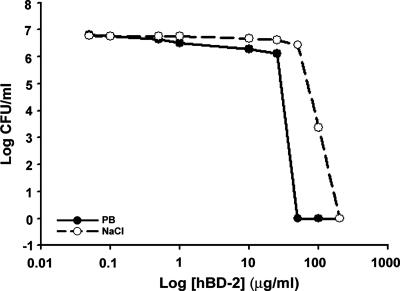
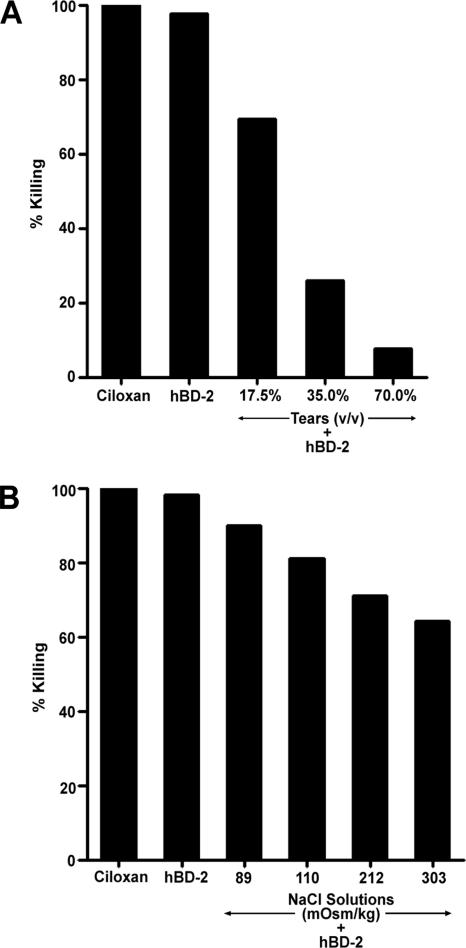
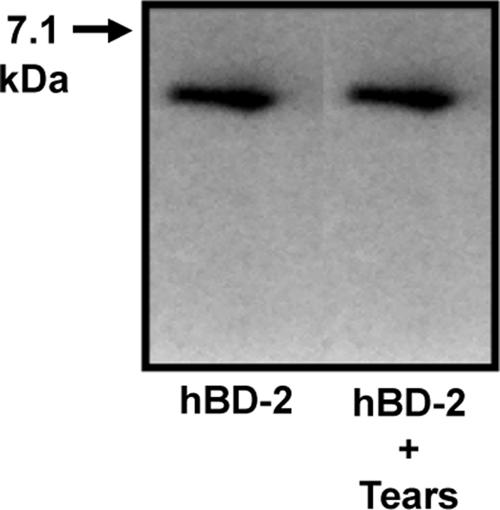
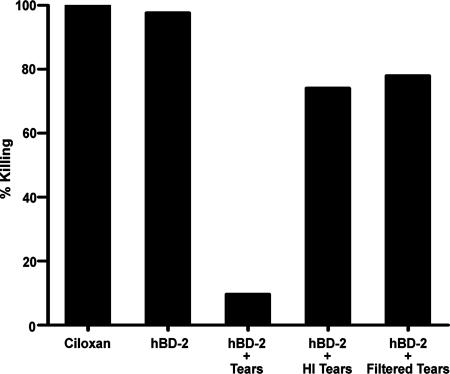
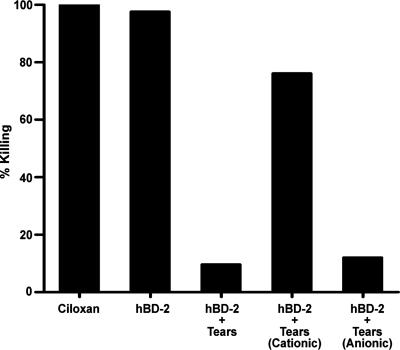
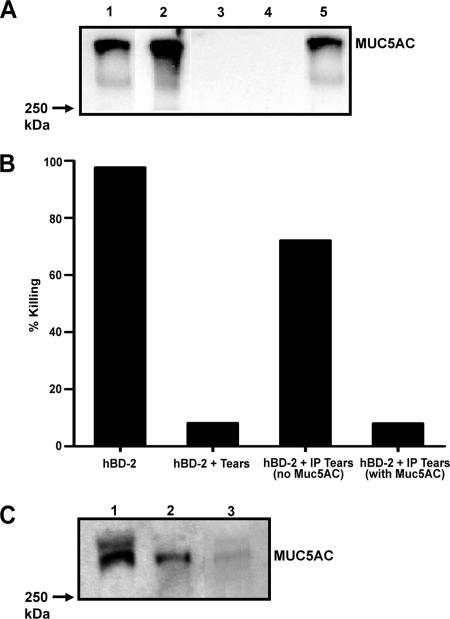
Pseudomonas aeruginosa causes vision-threatening keratitis and is difficult to treat due to emerging resistance. Human beta-defensin 2 (hBD-2) is an antimicrobial peptide expressed by ocular surface epithelia with broad-spectrum activity against various pathogens, including P. aeruginosa. The activity of hBD-2 against P. aeruginosa in the presence of human tears or NaCl was studied. In some experiments, tears were heat-inactivated, filtered, and separated into cationic/anionic fractions or mucin MUC5AC was removed by immunoprecipitation before use. Immunoprecipitation was performed to study the interaction between hBD-2 and MUC5AC. hBD-2 activity was reduced by 40 to 90% in the presence of 17.5 to 70% (vol/vol) tears. NaCl reduced hBD-2 activity, but at most it could account for only 36% of the inhibitory effect of tears. Heat inactivation and filtration attenuated the ability of tears to inhibit hBD-2 activity by 65 and 68%, respectively. Anionic tear fractions significantly reduced (86%) the activity of hBD-2, whereas only a 22% reduction was observed with the cationic fractions. In the absence of MUC5AC, the activity of hBD-2 was restored by 64%. Immunoprecipitation studies suggested that the loss of hBD-2 activity in tears is due to a direct binding interaction with MUC5AC. Our data showed that the antimicrobial activity of hBD-2 is sensitive to the presence of human tears and that this is partly due to the salt content and also the presence of MUC5AC. These data cast doubt on the effectiveness of hBD-2 as an antimicrobial peptide, and additional studies are required to conclusively elucidate its role in innate immunity at the ocular surface in vivo.
Figures
References
-
- Aarbiou, J., R. M. Verhoosel, S. Van Wetering, W. I. De Boer, J. H. Van Krieken, S. V. Litvinov, K. F. Rabe, and P. S. Hiemstra. 2004. Neutrophil defensins enhance lung epithelial wound closure and mucin gene expression in vitro. Am. J. Respir. Cell Mol. Biol. 30:193-201. - PubMed
-
- Ahn, C. S., T. McMahon, J. Sugar, L. Zhou, and B. Y. Yue. 1999. Levels of alpha1-proteinase inhibitor and alpha2-macroglobulin in the tear film of patients with keratoconus. Cornea 18:194-198. - PubMed
-
- Akinbi, H. T., V. Narendran, A. K. Pass, P. Markart, and S. B. Hoath. 2004. Host defense proteins in vernix caseosa and amniotic fluid. Am. J. Obstet. Gynecol. 191:2090-2096. - PubMed
-
- Befus, A. D., C. Mowat, M. Gilchrist, J. Hu, S. Solomon, and A. Bateman. 1999. Neutrophil defensins induce histamine secretion from mast cells: mechanisms of action. J. Immunol. 163:947-953. - PubMed
Publication types
MeSH terms
Substances
Grants and funding
LinkOut - more resources
Full Text Sources
Other Literature Sources
Medical
Miscellaneous
