


Dichotomy and perceptual distortions in absolute pitch ability
- PMID: 17724340
- PMCID: PMC1959403
- DOI: 10.1073/pnas.0703868104
Dichotomy and perceptual distortions in absolute pitch ability
Abstract
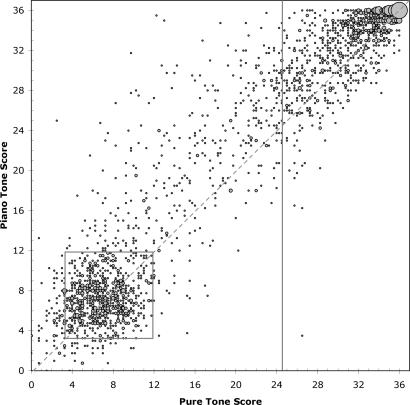
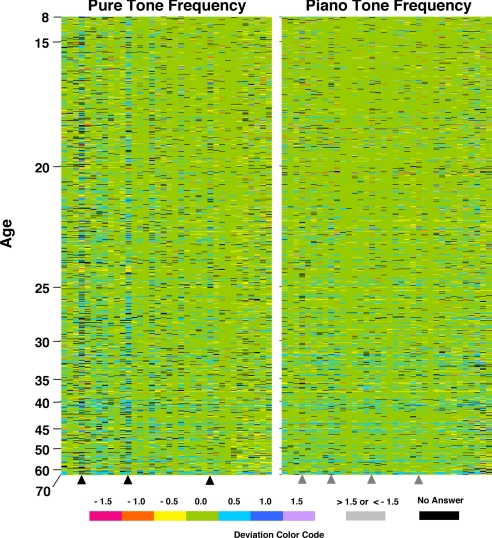
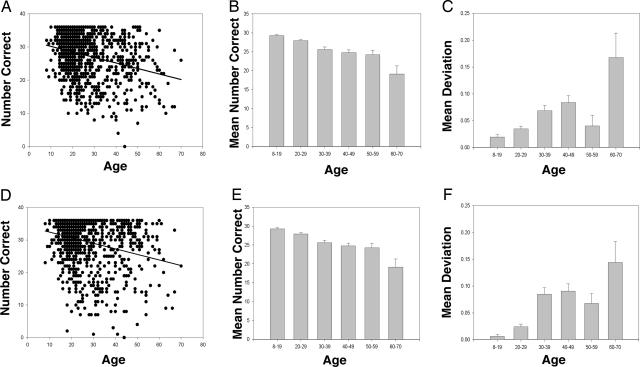
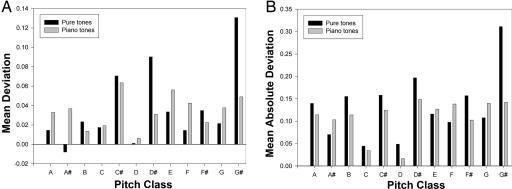
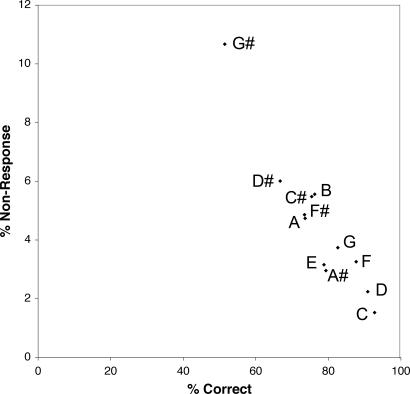
Absolute pitch (AP) is the rare ability to identify the pitch of a tone without the aid of a reference tone. Understanding both the nature and genesis of AP can provide insights into neuroplasticity in the auditory system. We explored factors that may influence the accuracy of pitch perception in AP subjects both during the development of the trait and in later age. We used a Web-based survey and a pitch-labeling test to collect perceptual data from 2,213 individuals, 981 (44%) of whom proved to have extraordinary pitch-naming ability. The bimodal distribution in pitch-naming ability signifies AP as a distinct perceptual trait, with possible implications for its genetic basis. The wealth of these data has allowed us to uncover unsuspected note-naming irregularities suggestive of a "perceptual magnet" centered at the note "A." In addition, we document a gradual decline in pitch-naming accuracy with age, characterized by a perceptual shift in the "sharp" direction. These findings speak both to the process of acquisition of AP and to its stability.
Conflict of interest statement
The authors declare no conflict of interest.
Figures
Comment in
-
Absolute pitch: a special group of ears.Proc Natl Acad Sci U S A. 2007 Sep 11;104(37):14549-50. doi: 10.1073/pnas.0707287104. Epub 2007 Sep 10. Proc Natl Acad Sci U S A. 2007. PMID: 17846431 Free PMC article. No abstract available.
References
-
- Ward WD. Deutsch D. The Psychology of Music. 2nd Ed. San Diego: Academic; 1999. pp. 265–298.
-
- Zatorre RJ. Nat Neurosci. 2003;6:692–695. - PubMed
-
- Sergeant D. J Res Music Education. 1969;17:135–143.
-
- Takeuchi AH, Hulse SH. Psychol Bull. 1993;113:345–361. - PubMed
-
- Bachem A. J Acous Soc Am. 1955;27:1180–1185.
Publication types
MeSH terms
LinkOut - more resources
Full Text Sources
