


Organizational interventions employing principles of complexity science have improved outcomes for patients with Type II diabetes
- PMID: 17725834
- PMCID: PMC2018702
- DOI: 10.1186/1748-5908-2-28
Organizational interventions employing principles of complexity science have improved outcomes for patients with Type II diabetes
Abstract
Background: Despite the development of several models of care delivery for patients with chronic illness, consistent improvements in outcomes have not been achieved. These inconsistent results may be less related to the content of the models themselves, but to their underlying conceptualization of clinical settings as linear, predictable systems. The science of complex adaptive systems (CAS), suggests that clinical settings are non-linear, and increasingly has been used as a framework for describing and understanding clinical systems. The purpose of this study is to broaden the conceptualization by examining the relationship between interventions that leverage CAS characteristics in intervention design and implementation, and effectiveness of reported outcomes for patients with Type II diabetes.
Methods: We conducted a systematic review of the literature on organizational interventions to improve care of Type II diabetes. For each study we recorded measured process and clinical outcomes of diabetic patients. Two independent reviewers gave each study a score that reflected whether organizational interventions reflected one or more characteristics of a complex adaptive system. The effectiveness of the intervention was assessed by standardizing the scoring of the results of each study as 0 (no effect), 0.5 (mixed effect), or 1.0 (effective).
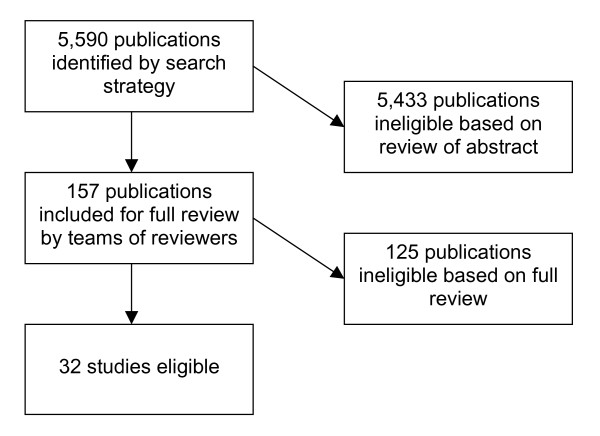
Results: Out of 157 potentially eligible studies, 32 met our eligibility criteria. Most studies were felt to utilize at least one CAS characteristic in their intervention designs, and ninety-one percent were scored as either "mixed effect" or "effective." The number of CAS characteristics present in each intervention was associated with effectiveness (p = 0.002). Two individual CAS characteristics were associated with effectiveness: interconnections between participants and co-evolution.
Conclusion: The significant association between CAS characteristics and effectiveness of reported outcomes for patients with Type II diabetes suggests that complexity science may provide an effective framework for designing and implementing interventions that lead to improved patient outcomes.
Figures
References
-
- Wu S, A G. Projection of Chronic Illness Prevalence and Cost Inflation. Santa Monica, CA: RAND Health. 2000.
-
- Grimshaw JM, Thomas RE, MacLennan G, Fraser C, Ramsay CR, Vale L, Whitty P, Eccles MP, Matowe L, Shirran L, Wensing M, Dijkstra R, Donaldson C. Effectiveness and efficiency of guideline dissemination and implementation strategies. Health Technol Assess. 2004;8:iii–iv. 1–72. - PubMed
-
- Solberg LI, Kottke TE, Brekke ML, Magnan S, Davidson G, Calomeni CA, Conn SA. Failure of a continuous quality improvement intervention to increase the delivery of preventive services. A randomized trial. EffClin Pract. 2000;3:105–15. - PubMed
LinkOut - more resources
Full Text Sources
Miscellaneous
