. 2007 Aug 29:2:25.
doi: 10.1186/1747-1028-2-25.

Mitotic regulation by NIMA-related kinases

Affiliations

Mitotic regulation by NIMA-related kinases

Laura O'regan et al. Cell Div. .

Abstract

The NIMA-related kinases represent a family of serine/threonine kinases implicated in cell cycle control. The founding member of this family, the NIMA kinase of Aspergillus nidulans, as well as the fission yeast homologue Fin1, contribute to multiple aspects of mitotic progression including the timing of mitotic entry, chromatin condensation, spindle organization and cytokinesis. Mammals contain a large family of eleven NIMA-related kinases, named Nek1 to Nek11. Of these, there is now substantial evidence that Nek2, Nek6, Nek7 and Nek9 also regulate mitotic events. At least three of these kinases, as well as NIMA and Fin1, have been localized to the microtubule organizing centre of their respective species, namely the centrosome or spindle pole body. Here, they have important functions in microtubule organization and mitotic spindle assembly. Other Nek kinases have been proposed to play microtubule-dependent roles in non-dividing cells, most notably in regulating the axonemal microtubules of cilia and flagella. In this review, we discuss the evidence that NIMA-related kinases make a significant contribution to the orchestration of mitotic progression and thereby protect cells from chromosome instability. Furthermore, we highlight their potential as novel chemotherapeutic targets.


Figures
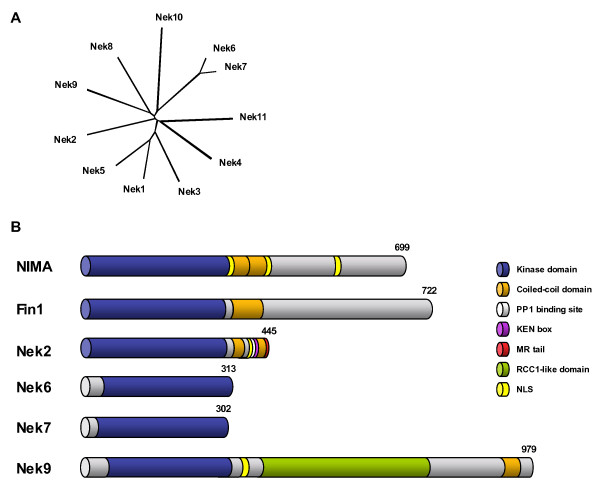
Figure 1
Figure 1
The NIMA-related kinase family. A. A phylogenetic tree generated by a manually edited multiple sequence alignment of the catalytic domains of the eleven human NIMA-related kinases using the Neighbor Joining method in ClustalX. B. A schematic representation of the two fungal (Aspergillus NIMA and S. pombe Fin1) and four mammalian (Nek2, Nek6, Nek7 and Nek9) NIMA-related kinases implicated in mitotic regulation indicating the relative positions of different domains and motifs. Three splice variants of Nek2 have been described; the longest of these, Nek2A, is shown here. Numbers represent protein length in amino acids.
Figure 2
Figure 2
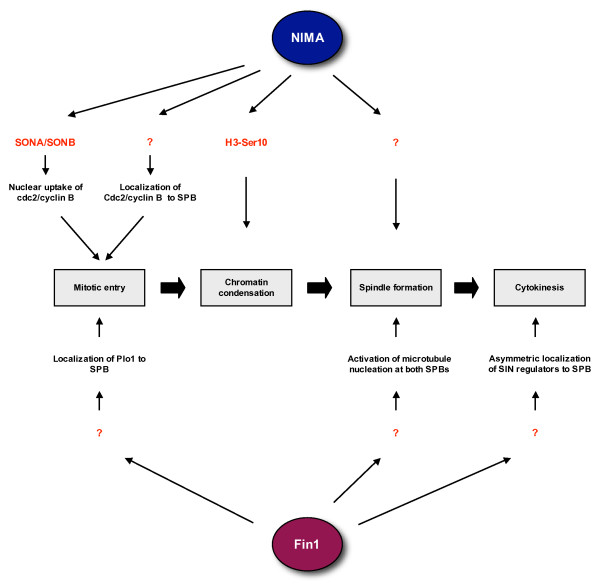
Regulation of mitotic events by fungal NIMA-related kinases. The Aspergillus NIMA kinase and fission yeast Fin1 kinase regulate multiple events during mitotic progression. Both proteins contribute to the timing of mitotic entry through controlling the localization and/or activation of the Cdc2/cyclin B kinase (Plo1 is an upstream activator of Cdc2/cyclin B). However, the relative importance of NIMA and Fin1 in this event appears to vary as nimA mutants block mitotic entry, whereas fin1 mutants only delay mitotic entry. Both proteins are also strongly implicated in regulation of mitotic spindle formation. In addition, NIMA promotes chromatin condensation, while Fin1 is involved in the pathway regulating cytokinesis. Unfortunately, the mechanisms by which these kinases operate remain poorly understand primarily because few direct substrates (indicated in red) have been identified.
Figure 3
Figure 3
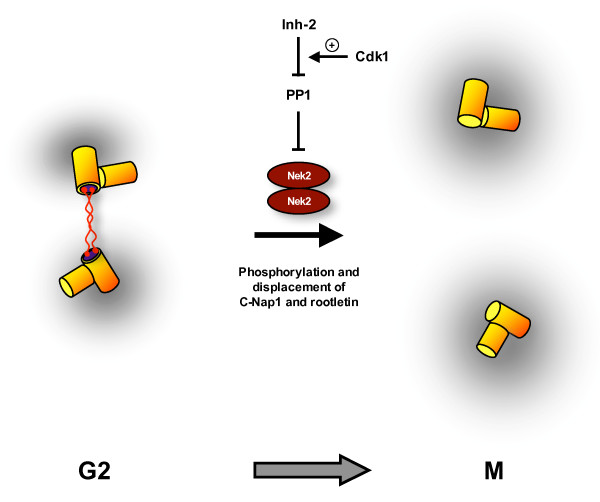
Nek2 promotes centrosome separation at mitotic onset. G2 cells contain a duplicated centrosome that consists of two pairs of centrioles (yellow cylinders) surrounded by pericentriolar material (grey cloud). It is proposed that the two centrosomes lie in close proximity as a result of a proteinaceous linker that connects the proximal ends of the parental centrioles. This structure contains at least two proteins, C-Nap1 (blue disc) and rootletin (red fibres). At this time, the Nek2 kinase, which exists as a stable homodimer, is inhibited by the protein phosphatase, PP1. Upon entry into mitosis, PP1 itself is inhibited as a result of binding of the Inhibitor-2 protein (Inh-2), an interaction that may be stimulated by Cdk1. The consequence is that Nek2 kinase is activated leading to phosphorylation and displacement of C-Nap1 and rootletin from the centrosome. The two disconnected pairs of centrioles can then be driven apart to form the two poles of the emerging mitotic spindle.
Figure 4
Figure 4
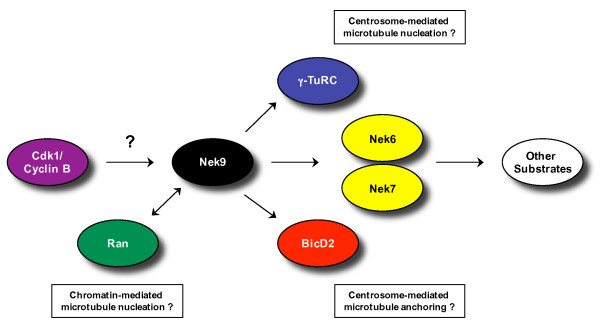
Mitotic interactions of the Nek9 kinase. This figure illustrates what is currently known about the potential upstream regulation and downstream targets of the Nek9 kinase during mitosis. It also suggests possible mechanisms by which Nek9 might regulate spindle organization, although these currently remain only hypotheses. Cdk1 can phosphorylate Nek9 in vitro and both proteins localize to the centrosome; hence, it is possible that Nek9 is activated upon mitotic entry by Cdk1/cyclin B. Once active, it is attractive to speculate that Nek9 may regulate chromatin-mediated microtubule nucleation as Nek9 can interact with Ran through its RCC1-like and catalytic domains. However, it is yet to be shown whether Nek9 influences Ran activity or vice versa. Equally, Nek9 may regulate centrosome-mediated microtubule nucleation and/or anchoring via its interactions with the γ-tubulin ring complex (γ-TuRC) and BicD2, respectively. Finally, Nek9 is proposed to activate two other NIMA-related kinases, Nek6 and Nek7, and, although substrates of Nek6 and Nek7 remain to be identified, it is likely that these also play important roles in mitotic spindle organisation and chromosome segregation.

References

    1. Morris NR. Mitotic mutants of Aspergillus nidulans. Genet Res. 1975;26:237–254. - PubMed
    1. Oakley BR, Morris NR. A mutation in Aspergillus nidulans that blocks the transition from interphase to prophase. J Cell Biol. 1983;96:1155–1158. doi: 10.1083/jcb.96.4.1155. - DOI - PMC - PubMed
    1. Osmani AH, McGuire SL, Osmani SA. Parallel activation of the NIMA and p34cdc2 cell cycle-regulated protein kinases is required to initiate mitosis in A. nidulans. Cell. 1991;67:283–291. doi: 10.1016/0092-8674(91)90180-7. - DOI - PubMed
    1. Osmani SA, May GS, Morris NR. Regulation of the mRNA levels of nimA, a gene required for the G2-M transition in Aspergillus nidulans. J Cell Biol. 1987;104:1495–1504. doi: 10.1083/jcb.104.6.1495. - DOI - PMC - PubMed
    1. Osmani SA, Pu RT, Morris NR. Mitotic induction and maintenance by overexpression of a G2-specific gene that encodes a potential protein kinase. Cell. 1988;53:237–244. doi: 10.1016/0092-8674(88)90385-6. - DOI - PubMed