Familial pathways to early-onset suicidal behavior: familial and individual antecedents of suicidal behavior
- PMID: 17728421
- PMCID: PMC3804909
- DOI: 10.1176/appi.ajp.2007.06091522
Familial pathways to early-onset suicidal behavior: familial and individual antecedents of suicidal behavior
Abstract
Objective: The authors sought to identify clinical predictors of new-onset suicidal behavior in children of parents with a history of mood disorder and suicidal behavior.
Method: In a prospective study of offspring of parents with mood disorders, 365 offspring (average age, 20 years) of 203 parents were followed for up to 6 years. Offspring with incident suicide attempts or emergency referrals for suicidal ideation or behavior ("incident events") were compared with offspring without such events on demographic and clinical characteristics. Multivariate analyses were conducted to examine predictors of incident events and predictors of time to incident event.
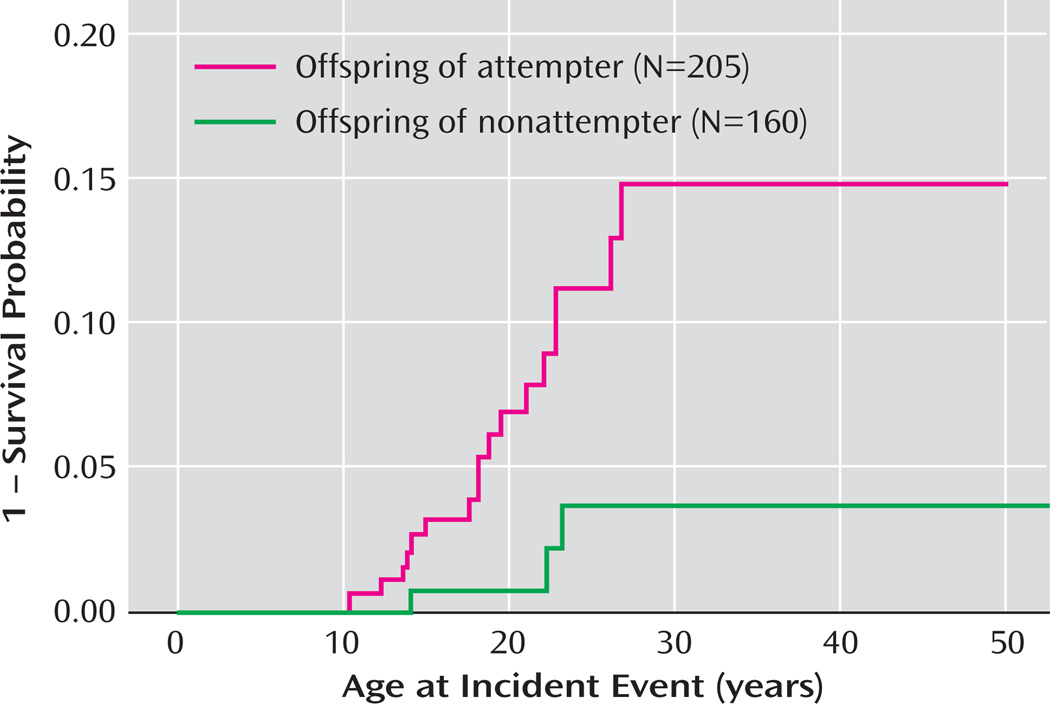
Results: Offspring of probands who had made suicide attempts, compared with offspring of parents with mood disorders who had not made attempts, had a higher rate of incident suicide attempts (4.1% versus 0.6%, relative risk=6.5) as well as overall suicidal events (8.3% versus 1.9%, relative risk=4.4). Mood disorder and self-reported impulsive aggression in offspring and a history of sexual abuse and self-reported depression in parents predicted earlier time to, and greater hazard of, an incident suicidal event.
Conclusions: In offspring of parents with mood disorders, precursors of early-onset suicidal behavior include mood disorder and impulsive aggression as well as parental history of suicide attempt, sexual abuse, and self-reported depression. These results suggest that efforts to prevent the familial transmission of early-onset suicidal behavior by targeting these domains could reduce the morbidity of suicidal behavior in high-risk youths.
Figures
Comment in
-
A developmental perspective on the controversy surrounding the use of SSRIs to treat pediatric depression.Am J Psychiatry. 2007 Sep;164(9):1304-6. doi: 10.1176/appi.ajp.2007.07050880. Am J Psychiatry. 2007. PMID: 17728409 No abstract available.
-
Offspring of suicide attempters at greater risk of suicide events.Evid Based Ment Health. 2008 May;11(2):55. doi: 10.1136/ebmh.11.2.55. Evid Based Ment Health. 2008. PMID: 18441144 No abstract available.
References
-
- Brent DA, Mann JJ. Family genetic studies, suicide, and suicidal behavior. Am J Med Genet C Semin Med Genet. 2005;133:13–24. - PubMed
-
- Fergusson DM, Beautrais AL, Horwood LJ. Vulnerability and resiliency to suicidal behaviours in young people. Psychol Med. 2003;33:61–73. - PubMed
-
- Molnar BE, Berkman LF, Buka SL. Psychopathology, childhood sexual abuse, and other childhood adversities: relative links to subsequent suicidal behaviour in the US. Psychol Med. 2001;31:965–977. - PubMed
-
- Lewinsohn PM, Rohde P, Seeley JR. Psychosocial risk factors for future adolescent suicide attempts. J Consult Clin Psychol. 1994;62:297–305. - PubMed
-
- Brent DA, Bridge J, Johnson BA, Connolly J. Suicidal behavior runs in families: a controlled family study of adolescent suicide victims. Arch Gen Psychiatry. 1996;53:1145–1152. - PubMed
Publication types
MeSH terms
Grants and funding
LinkOut - more resources
Full Text Sources
Medical