Decreased left ventricular torsion and untwisting in children with dilated cardiomyopathy
- PMID: 17728501
- PMCID: PMC2693811
- DOI: 10.3346/jkms.2007.22.4.633
Decreased left ventricular torsion and untwisting in children with dilated cardiomyopathy
Abstract
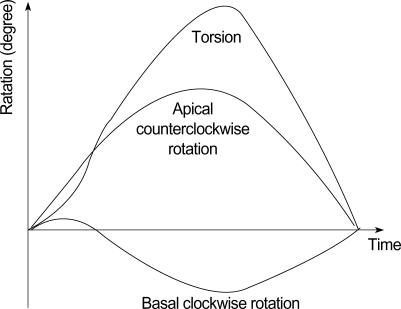
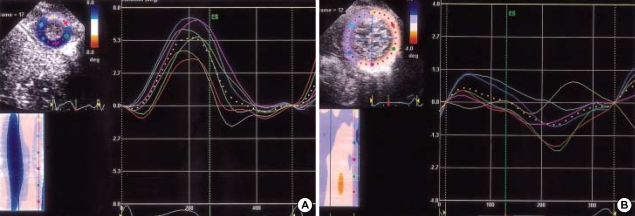
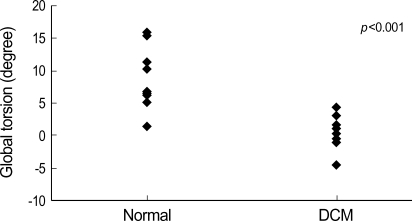
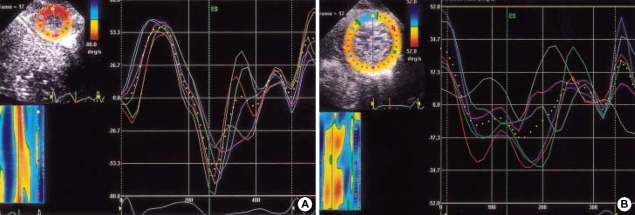
The purpose of this study was to analyze left ventricular (LV) torsion and untwisting, and to evaluate the correlation between torsion and other components of LV contraction in children with dilated cardiomyopathy (DCM). Segmental and global rotation, rotational rate (Vrot) were measured at three levels of LV using the two dimensional (2D) speckle tracking imaging (STI) method in 10 DCM patients (range 0.6-15 yr, median 6.5 yr, 3 females) and 17 age- and sex-matched normal controls. Global torsion was decreased in DCM (peak global torsion; 10.9 +/- 4.6 degrees vs. 0.3 +/- 2.1 degrees , p<0.001). Loss of LV torsion occurred mainly by the diminution of counterclockwise apical rotation and was augmented by somewhat less reduction in clockwise basal rotation. In DCM, the normal counterclockwise apical rotation was not observed, and the apical rotation about the central axis was clockwise or slightly counterclockwise (peak apical rotation; 5.9 +/- 4.1 degrees vs. -0.9 +/- 3.1 degrees , p<0.001). Systolic counterclockwise Vrot and early diastolic clockwise Vrot at the apical level were decreased or abolished. In DCM, decreased systolic torsion and loss of early diastolic recoil contribute to LV systolic and diastolic dysfunction. The STI method may facilitate the serial evaluation of the LV torsional behavior in clinical settings and give new biomechanical concepts for better management of patients with DCM.
Figures
References
-
- Buckberg GD, Clemente C, Cox JL, Coghlan HC, Castella M, Torrent-Guasp F, Gharib M. The structure and function of the helical heart and its buttress wrapping. IV. Concepts of dynamic function from the normal macroscopic helical structure. Semin Thorac Cardiovasc Surg. 2001;13:342–357. - PubMed
-
- Burleson KO, Schwartz GE. Cardiac torsion and electromagnetic fields: the cardiac bioinformation hypothesis. Medical Hypotheses. 2005;64:1109–1116. - PubMed
-
- Yun KL, Niczyporuk MA, Daughters GT, Ingels NB, Jr, Stinson EB, Alderman EL, Hansen DE, Miller DC. Alterations in left ventricular diastolic twist mechanics during acute human cardiac allograft rejection. Circulation. 1991;83:962–973. - PubMed
-
- Notomi Y, Srinath G, Shiota T, Martin-Miklovic MG, Beachler L, Howell K, Oryszak SJ, Deserranno DG, Freed AD, Greenberg NL, Younoszai A, Thomas JD. Maturational and adaptive modulation of left ventricular torsional biomechanics: Doppler tissue imaging observation from infancy to adulthood. Circulation. 2006;113:2534–2541. - PubMed
-
- Tibayan FA, Lai DT, Timek TA, Dagum P, Liang D, Daughters GT, Ingels NB, Miller DC. Alterations in left ventricular torsion in tachycardia-induced dilated cardiomyopathy. J Thorac Cardiovasc Surg. 2002;124:43–49. - PubMed
MeSH terms
LinkOut - more resources
Full Text Sources
Other Literature Sources