


Strategies and models for agricultural sustainability in developing Asian countries
- PMID: 17761471
- PMCID: PMC2610115
- DOI: 10.1098/rstb.2007.2189
Strategies and models for agricultural sustainability in developing Asian countries
Abstract
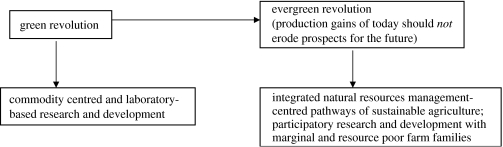
The green revolution of the 1960s and 1970s which resulted in dramatic yield increases in the developing Asian countries is now showing signs of fatigue in productivity gains. Intensive agriculture practiced without adherence to the scientific principles and ecological aspects has led to loss of soil health, and depletion of freshwater resources and agrobiodiversity. With progressive diversion of arable land for non-agricultural purposes, the challenge of feeding the growing population without, at the same time, annexing more forestland and depleting the rest of life is indeed daunting. Further, even with food availability through production/procurement, millions of marginal farming, fishing and landless rural families have very low or no access to food due to lack of income-generating livelihoods. Approximately 200 million rural women, children and men in India alone fall in this category. Under these circumstances, the evergreen revolution (pro-nature, pro-poor, pro-women and pro-employment/livelihood oriented ecoagriculture) under varied terms are proposed for achieving productivity in perpetuity. In the proposed 'biovillage paradigm', eco-friendly agriculture is promoted along with on- and non-farm eco-enterprises based on sustainable management of natural resources. Concurrently, the modern ICT-based village knowledge centres provide time- and locale-specific, demand-driven information needed for evergreen revolution and ecotechnologies. With a system of 'farm and marine production by masses', the twin goals of ecoagriculture and eco-livelihoods are addressed. The principles, strategies and models of these are briefly discussed in this paper.
Figures
References
-
- Brown L.R. Earthscan Publications Ltd; London, UK: 1996. Tough choices—facing the challenge of food security.
-
- Brown L.R, Kane H. The Worldwatch Institute; Washington, DC: 1994. Full house—reassessing the earth's population carrying capacity.
-
- Bose A. Hunger-free India 2007: need for evergreen revolution. Econ. Polit. Week. 2004;39:1202–1204. http://www.epw.org.in/showArticles.php?root=2004&leaf=03&filename=6969&f...
-
- Carson R. Miffen Co; Boston, MA: 1962. Silent spring.
-
- Clarke, A. A. D. 2006 The human ecological footprint See http://www.energybulletin.net/16237.html
Publication types
MeSH terms
LinkOut - more resources
Full Text Sources
